
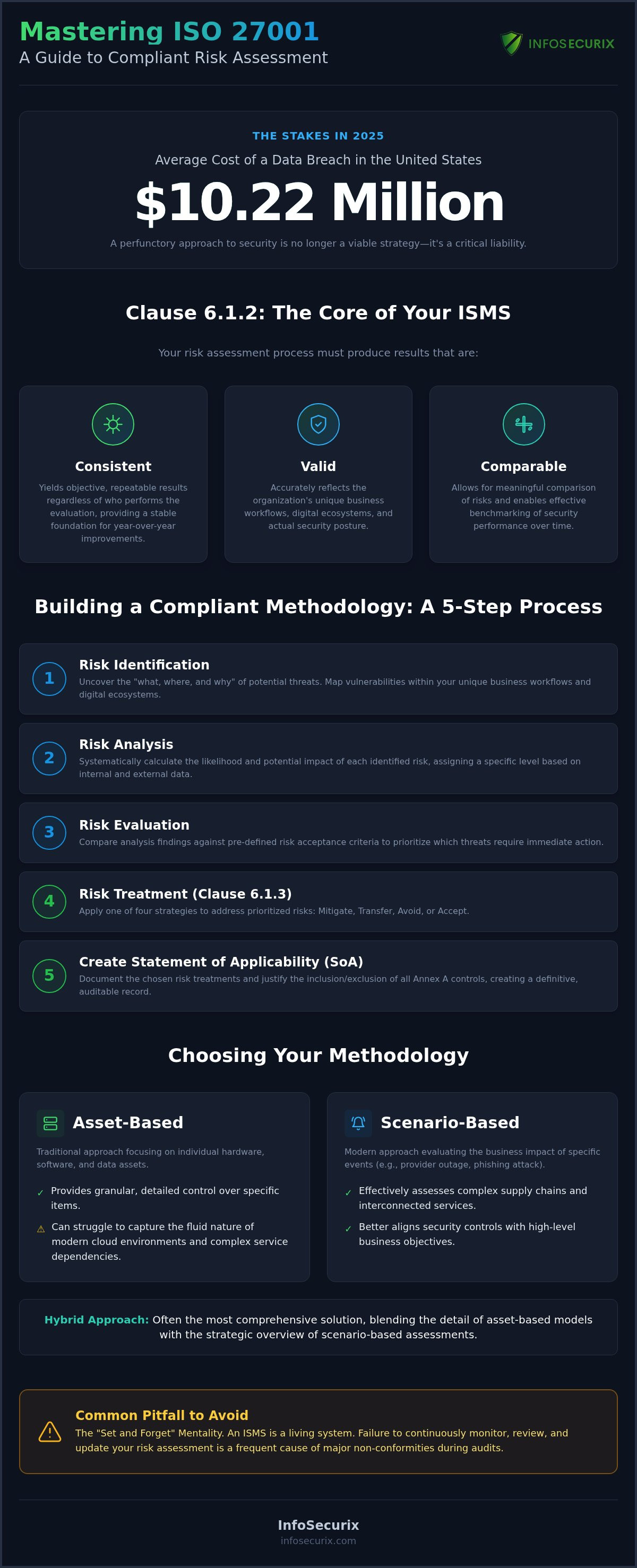
With the average cost of a data breach in the United States reaching $10.22 million in 2025, a perfunctory approach to security is no longer a viable business strategy: it’s a liability. You likely understand that achieving compliance is about more than checking boxes, yet the inherent ambiguity in the standard’s language often creates a sense of unease. Many organizations struggle to bridge the gap between technical controls and executive expectations, fearing that a misstep in their methodology will lead to a major non-conformity during a Stage 2 audit. We recognize these challenges and serve as a seasoned guide to help you navigate this complexity with absolute confidence.
This guide empowers you to master the mandatory ISO 27001 risk assessment requirements, transforming Clause 6.1.2 from a regulatory hurdle into a strategic engine for growth. You’ll gain a clear roadmap for establishing a robust methodology that satisfies auditors and strengthens your security posture. By the end of this article, you’ll have the insights needed to align your security investments with business objectives, ensuring your organization remains resilient against an evolving threat landscape. We’ll explore the specific steps required to identify, analyze, and treat risks while maintaining the rigorous ISO/IEC 27001:2022 standards required for success in 2026.
Key Takeaways
- Gain absolute clarity on mandatory ISO 27001 risk assessment requirements to ensure your methodology is consistent, valid, and fully prepared for audit scrutiny.
- Evaluate the strategic merits of asset, threat, and scenario-based methodologies to determine the most effective approach for your organization’s unique scope.
- Master the nuances of Clause 6.1.3: learn to confidently apply the four risk treatment options and create a definitive Statement of Applicability.
- Protect your certification journey by identifying the “set and forget” mentality and other common pitfalls that frequently lead to major non-conformities.
- Discover how a bespoke risk methodology bridges the gap between technical security controls and high-level business objectives.
Decoding the Mandatory ISO 27001 Risk Assessment Requirements
Clause 6.1.2 serves as the strategic heart of your Information Security Management System (ISMS). It is the mechanism that transforms abstract security goals into a tangible, defensible roadmap for your entire organization. To satisfy the rigorous ISO 27001 risk assessment requirements, your leadership must implement a process that is “consistent, valid, and comparable.” This means your chosen methodology must yield objective results regardless of which team member performs the evaluation; such consistency provides a stable foundation for year-over-year security improvements and benchmarking. While the standard does not mandate a specific methodology, such as asset-based or process-based models, it does demand absolute transparency. Every decision must be documented to provide the evidentiary trail that auditors require during Stage 2 certifications. This documentation proves that your security posture is a result of deliberate strategy rather than circumstantial reaction.
Clause 6.1.2: Information Security Risk Assessment
Risk identification is the first critical phase: it is the process of uncovering the “what, where, and why” of potential threats to your information assets. You aren’t just listing hardware; you are mapping the vulnerabilities within your unique business workflows and digital ecosystems. Following identification, risk analysis involves a meticulous calculation of likelihood and impact. This systematic approach allows you to assign a specific level to each risk based on your internal data and external threat intelligence. The process concludes with risk evaluation: a decisive step where you compare your findings against pre-defined acceptance criteria to determine which threats require immediate resources and which can be monitored over time. This structured evaluation ensures that your limited resources are always directed toward the most significant vulnerabilities.
Establishing Risk Acceptance Criteria
Defining “acceptable risk” is a foundational exercise that must occur before the assessment begins. This threshold reflects your organization’s risk appetite: the level of uncertainty you are willing to tolerate in pursuit of your strategic objectives. These criteria must align seamlessly with your corporate governance and legal obligations to ensure your security posture supports, rather than hinders, business growth. By documenting a clear threshold for mandatory risk treatment, you provide your security team with a definitive mandate for action. This clarity ensures that high-priority vulnerabilities are addressed with precision and urgency. It is this level of foresight and commitment to the ISO 27001 risk assessment requirements that separates a compliant organization from a truly resilient one in the 2026 landscape. Senior management’s endorsement of these criteria is essential, as it provides the authority needed to manage risks across departmental silos effectively.
Building a Compliant Risk Assessment Methodology
Constructing a methodology that satisfies ISO 27001 risk assessment requirements demands a structured, five-step approach. It begins with defining the scope: ensuring your assessment boundaries mirror your ISMS exactly to prevent gaps in your security posture. Next, select a methodology tailored to your operational complexity. Once the framework is established, you must identify information assets and their respective owners, pinpoint specific threats and vulnerabilities, and calculate a risk score using a standardized matrix. This logical progression provides the “consistent and comparable” results that auditors expect during a certification review.
Asset-Based vs. Scenario-Based Approaches
Traditional asset-based models focus on individual pieces of hardware or software. While this provides granular detail, it often struggles to capture the fluid nature of modern cloud environments. Scenario-based assessments have gained prominence in 2026 as a way to evaluate complex supply chains and interconnected service dependencies. These models examine the broader business impact of specific events: such as a service provider outage or a multi-stage social engineering attack. Choosing between them depends on your infrastructure; a hybrid approach often yields the most comprehensive results for mid-to-large enterprises seeking a balanced view of their vulnerabilities.
Assigning Risk Ownership
Identifying risk owners is a mandatory component of the standard that requires careful consideration. These individuals must have the authority and budget to manage the risks assigned to them. A common mistake is delegating all security risks to the IT department. Security is a business function, not just a technical one; therefore, department heads or process owners often make the most effective risk owners. Training stakeholders to understand their role ensures that risk decisions are made by those who best understand the business impact. If you’re unsure how to structure these internal relationships, engaging with an expert for ISO 27001 Certification Readiness can provide the necessary clarity.
Finally, calculating the risk score using a standardized 3×3 or 5×5 matrix ensures repeatability. This score serves as the primary evidence for why certain controls were selected over others in your Statement of Applicability. By documenting this process meticulously, you satisfy the primary ISO 27001 risk assessment requirements while demonstrating to auditors that your security investments are based on data-driven priorities rather than guesswork. This level of rigor not only ensures compliance but also strengthens your organization’s overall resilience against sophisticated threats.
The Risk Treatment Process and Statement of Applicability
Clause 6.1.3 represents the transition from theoretical analysis to operational security. It’s the stage where your organization decides how to address the vulnerabilities identified in the previous steps. To fulfill ISO 27001 risk assessment requirements, you must apply one of four treatment options: treating the risk with controls, tolerating it within acceptance limits, transferring it via insurance or outsourcing, or terminating the activity entirely. This decision-making process must be methodical and documented within a Risk Treatment Plan (RTP). The RTP serves as your internal roadmap, detailing exactly who is responsible for implementing each control and the specific timeline for completion. It transforms your risk assessment from a static document into a living, breathing strategy for resilience.
Developing the Statement of Applicability (SoA)
The Statement of Applicability is arguably the most critical document in your ISMS: it’s the primary point of focus for any external auditor. This document lists all 93 controls from Annex A and provides a definitive “yes” or “no” regarding their implementation. You must provide a clear justification for every exclusion; simply claiming a control is “not applicable” without context will trigger immediate scrutiny. A high-quality SoA links every selected control back to a specific risk identified during your ISO 27001 risk assessment requirements phase or to a specific legal requirement. This creates a transparent, defensible link between your business needs and your security architecture.
The Role of Residual Risk
No security framework can eliminate risk entirely. What remains after your controls are in place is known as residual risk. Successfully managing this is a hallmark of a mature security program. You must present these remaining risks to senior management for formal approval. This process ensures that those with the ultimate authority over the business understand and accept the potential impact of these vulnerabilities. It’s vital that these residual levels stay within the risk acceptance criteria you established at the beginning of your journey. If the residual risk is too high, you must revisit your treatment plan to implement additional safeguards until the threat is sufficiently mitigated.
Common Pitfalls in ISO 27001 Risk Assessments
Even the most meticulous teams can falter when translating ISO 27001 risk assessment requirements into daily operations. One recurring error is the “set and forget” mentality: the belief that an annual review suffices in an environment where threats evolve weekly. Stale data leads to a false sense of security. Auditors also frequently reject assessments that lack granular detail. Vague entries like “cyber attack” or “system failure” fail to provide the specific context needed for effective control selection. Every threat must be articulated with precision to justify your security investments and demonstrate a deep understanding of your operational vulnerabilities.
Inconsistency remains another significant hurdle. If two different assessors evaluate the same risk and reach wildly different conclusions, the methodology is likely flawed. This subjectivity undermines the “comparable” requirement of the standard. Additionally, many organizations over-focus on technological vulnerabilities while neglecting the human element. Considering that human error contributes to up to 90% of security breaches according to the ISMS Directory Blog (January 2026), your assessment must rigorously evaluate social engineering and internal procedural failures. A balanced approach ensures that your security posture is resilient against both digital and physical threats.
Audit Readiness: What the External Auditor Looks For
External auditors seek evidence of a mature, repeatable process. They’ll look for your methodology document first, but they’ll quickly move to verify that risk owners were actually involved in decision-making. A hallmark of a successful audit is the “Golden Thread.” This is the ability to trace a single risk from its initial identification through its analysis and treatment, finally seeing it reflected accurately in your Statement of Applicability. If this thread is broken, the integrity of your entire ISMS may be questioned. Ensuring this continuity requires disciplined documentation and clear communication across all departments.
Leveraging Internal Audits for Pre-Certification
Leveraging information security internal audits serves as your final safety net. These reviews identify methodology gaps and inconsistent scoring before an external body discovers them. Simulating auditor questions during a readiness review prepares your team to defend their risk decisions with poise and clarity. It’s an opportunity to apply corrective actions to your scoring process and ensure every stakeholder understands their responsibilities. If your organization requires a partner to refine these processes, our bespoke Risk Assessments provide the expert oversight needed for a seamless certification experience.
Strategic Risk Management with InfoSecurix
InfoSecurix leverages a 25-year legacy to transform complex regulatory burdens into manageable strategic actions. We understand that a standard-issue approach rarely addresses the unique vulnerabilities of a high-growth organization; instead, it often leaves critical gaps in your security architecture. Our boutique consultancy provides a bespoke information security risk assessment tailored specifically to your industry threat landscape. By moving beyond simple compliance, we help you achieve enterprise-wide resilience that protects your most sensitive data assets while enabling sustainable growth. It’s about creating a culture of security that persists long after the auditor leaves the room.
Partnering with a seasoned guide ensures that your security investments are both efficient and effective. We act as a collaborative ally, bridging the gap between technical controls and high-level business objectives. Our methodology is designed to be steady and measured: reflecting our commitment to detail and accuracy. We don’t just identify risks; we provide a clear narrative of achievement that demonstrates your organization’s maturity to clients, stakeholders, and certification bodies alike. This top-down approach ensures that every security measure serves a definitive business purpose.
Our ISO 27001 Certification Readiness Services
Our engagement begins with a rigorous gap analysis to identify exactly where your current processes fall short of mandatory ISO 27001 risk assessment requirements. We provide comprehensive documentation support: crafting a valid and comparable methodology that stands up to the most demanding external scrutiny. Recognizing that security is a governance priority, we also facilitate executive briefings. These sessions empower your leadership team to understand their critical role in risk acceptance and strategic resource allocation. We ensure that your risk owners are not just names on a document, but active participants in your organization’s defense.
Taking the Next Step Toward Certification
Investing in a professional readiness assessment significantly reduces the risk of costly remediation and embarrassing audit failures. It’s about getting it right the first time to save both time and capital. Transitioning from a preliminary review to full ISO 27001 certification readiness requires a partner who has seen every possible scenario and remains unfazed by complexity. We invite you to engage in a strategic consultation with our seasoned experts to future-proof your business. Let’s ensure your organization doesn’t just meet ISO 27001 risk assessment requirements but sets a new standard for corporate excellence in your sector.
Securing Your Path to Audit Success
Mastering the ISO 27001 risk assessment requirements is more than a compliance exercise; it’s a strategic commitment to your organization’s longevity. By establishing a repeatable methodology and fostering active engagement among risk owners, you transform a complex regulatory mandate into a robust framework for resilience. Success in 2026 hinges on your ability to bridge the gap between technical controls and business objectives; ensuring every security investment is both defensible and impactful.
InfoSecurix brings over 25 years of specialized security consulting experience to your certification journey. Our boutique approach ensures you receive senior-level attention at every stage, providing the precision and care your critical data deserves. We deliver comprehensive corrective action plans designed to eliminate ambiguity and guarantee audit success. Secure your certification with an InfoSecurix ISO 27001 Readiness Assessment and gain the absolute confidence that comes from working with a seasoned guide. Your path to a more secure future starts with a single, deliberate step toward excellence.
Frequently Asked Questions
What is the difference between risk assessment and risk treatment in ISO 27001?
Risk assessment involves identifying, analyzing, and evaluating threats to determine their severity; risk treatment is the subsequent process of selecting and implementing controls to mitigate those threats. While the assessment phase identifies the “what” and “why” of vulnerabilities, the treatment phase focuses on the “how” of security. This distinction ensures that every security measure responds directly to a verified business risk rather than being applied indiscriminately or without a clear strategic purpose.
Is an asset-based risk assessment mandatory for ISO 27001:2022/2026?
Asset-based risk assessments are not mandatory under the ISO/IEC 27001:2022 version. The standard allows organizations to choose a methodology that best fits their operational context: such as threat-based or scenario-based models. Modern cloud-native businesses often find scenario-based approaches more effective for capturing complex dependencies and third-party risks. Regardless of the chosen model, your methodology must remain consistent, valid, and comparable to satisfy the core ISO 27001 risk assessment requirements during an audit.
How often must an ISO 27001 risk assessment be performed?
Organizations must perform risk assessments at planned intervals or whenever significant changes occur within the business environment. While many firms conduct a full review annually, a dynamic approach is necessary to address new threats or infrastructure updates. Auditors look for evidence that your risk process is proactive rather than reactive. Maintaining a continuous monitoring cycle ensures that your security posture evolves alongside the shifting technological landscape and emerging cyber threats of 2026.
Who should be involved in the risk assessment process?
Successful risk assessments require collaboration between senior management, department heads, and technical teams. Risk owners should be the individuals with the authority to accept residual risks and allocate budgets for treatment. Limiting the process to the IT department is a common mistake that often results in a lack of business alignment. Engaging stakeholders from across the organization ensures that security decisions support broader strategic goals and reflect the actual operational realities of the business.
What are the most common ISO 27001 audit non-conformities related to risk?
Common non-conformities often stem from a lack of granular detail in threat identification or a failure to involve designated risk owners in the decision-making process. Auditors frequently cite organizations for “broken” documentation trails where risks cannot be traced from identification to the final Statement of Applicability. Additionally, using inconsistent scoring criteria across different departments can lead to major findings. Ensuring your methodology is documented and repeatable is essential for avoiding these common and costly pitfalls.
Can we use automated tools for our ISO 27001 risk assessment?
Automated GRC platforms are highly effective for managing ISO 27001 risk assessment requirements and maintaining the evidence trail required for auditors. These tools simplify data collection and provide real-time visibility into your security posture. However, automation should never replace professional judgment. Human expertise is still required to interpret complex scenarios and ensure that the tool’s output aligns with your organization’s unique risk appetite and the specific requirements of your corporate governance.
What is the ‘Statement of Applicability’ and why is it required?
The Statement of Applicability (SoA) is a mandatory document that lists the controls selected from Annex A and justifies any exclusions. It serves as the primary link between your risk assessment and your implemented security measures. Auditors require the SoA to verify that your organization has considered all 93 controls and has a defensible rationale for its security architecture. A well-constructed SoA demonstrates that your ISMS is both comprehensive and tailored to your organization’s specific needs.