
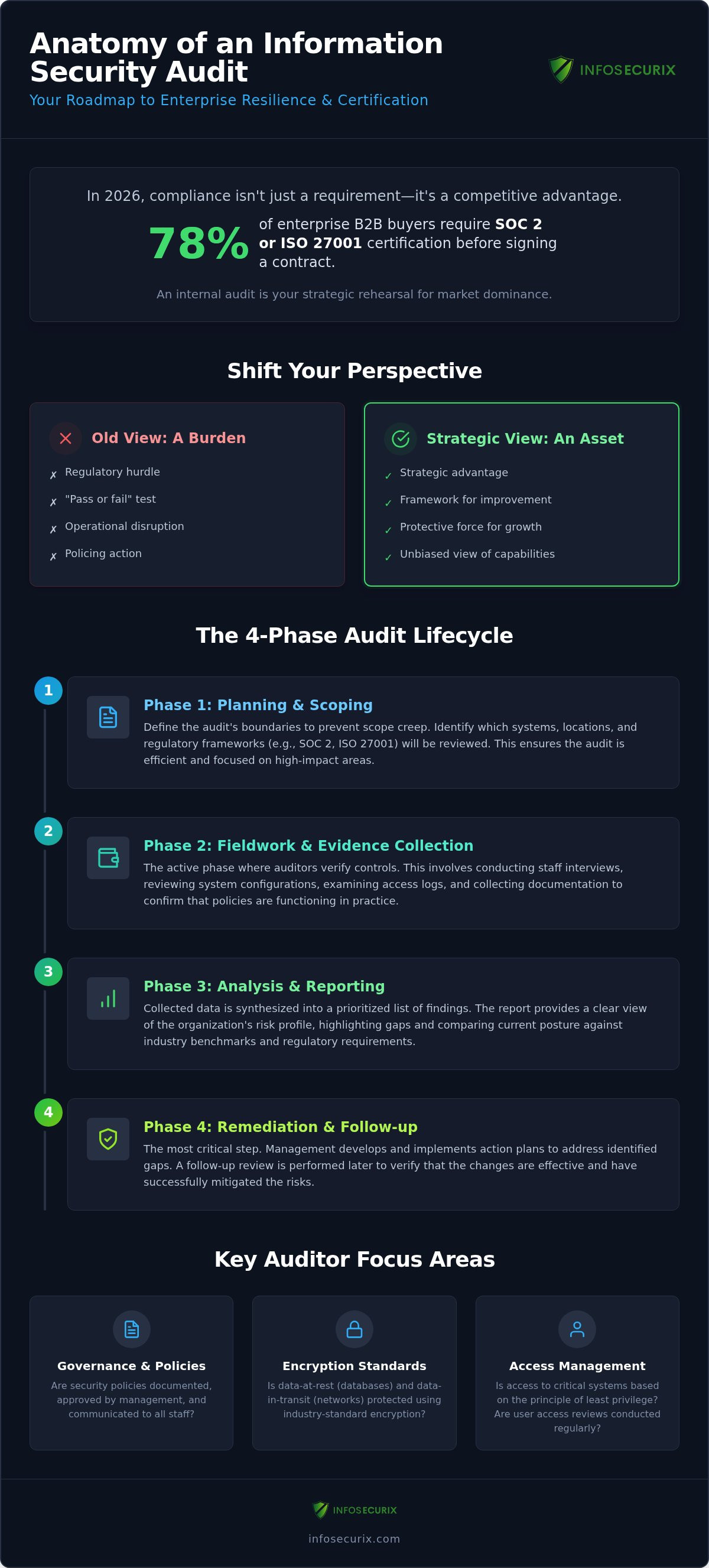
The most successful enterprises in 2026 don’t view internal audits as a regulatory hurdle; they treat them as a strategic rehearsal for market dominance. Since 78% of enterprise B2B buyers now require SOC 2 or ISO 27001 certification before signing a contract, knowing exactly what to expect from an information security internal audit has become a vital leadership competency. It’s common to feel anxiety regarding unknown vulnerabilities or the potential for operational disruption during the review process. We recognize that the distinction between internal readiness and external certification often creates confusion for even the most seasoned IT directors.
This guide provides a clear roadmap of the audit lifecycle to replace uncertainty with absolute confidence. Discover the systematic phases of a modern audit, the specific evidence requested under the latest IIA Cybersecurity Topical Requirements, and the strategic benefits of identifying gaps before they become liabilities. Following this framework allows you to transform compliance efforts into a protective force that enables growth and secures your path toward ISO 27001 or SOC 2 excellence.
Key Takeaways
- Shift the organizational perspective from a compliance burden to a strategic advantage that fosters continuous security improvement.
- Gain clarity on what to expect from an information security internal audit through a methodical four-phase roadmap designed to minimize operational disruption.
- Identify the specific administrative and technical controls that auditors prioritize, including governance policies, encryption standards, and access management.
- Prepare effectively by conducting proactive gap analyses and assigning control owners to facilitate a seamless evidence collection process.
- Leverage internal findings to accelerate your journey toward ISO 27001 or SOC 2 certification by building a robust Statement of Applicability.
Defining the Purpose: Why Internal Audits Are the Foundation of Enterprise Resilience
Understanding what to expect from an information security internal audit begins with recognizing it as a proactive, internal assessment of your organization’s controls and policies. Unlike a reactive response to a security incident, this process is a deliberate and methodical evaluation designed to ensure your security posture aligns with both regulatory requirements and your broader business objectives. It serves as a foundational pillar for enterprise resilience by providing a clear, unbiased view of your current defensive capabilities.
Modern leaders must shift the organizational mindset away from a binary “pass or fail” mentality. In the sophisticated regulatory environment of 2026, an audit is not a policing action but a framework for continuous improvement. It identifies critical blind spots within your infrastructure before they evolve into catastrophic breaches or compliance failures. This level of transparency satisfies the growing demands of stakeholders, board members, and clients who require documented proof of robust risk management and ethical data stewardship.
Internal vs. External Audits: Understanding the Strategic Distinction
Internal audits offer a level of flexibility and depth that external reviews simply cannot match. While external audits are typically rigid and focused on achieving a third-party certification, the Information security audit process conducted internally allows for deep-dive investigations into specific business units or high-risk processes. It creates a safe space for your team to identify and remediate weaknesses without the immediate pressure of a certification body’s judgment. This internal scrutiny ensures that when the external auditor arrives, your systems are already hardened and your documentation is impeccable.
The Business Case for Regular Security Reviews
Committing to regular security reviews significantly reduces long-term operational costs. By identifying gaps early in the fiscal year, you avoid the high price of emergency remediation or “fire drill” corrections during a formal external certification window. These audits also build a pervasive culture of security awareness that extends beyond the IT department. When every department head understands their role in the audit process, security becomes a shared responsibility rather than a siloed technical task. This cultural shift is essential for maintaining compliance with evolving standards like NIS2 or the EU AI Act.
An information security internal audit is a strategic asset that transforms technical compliance into a scalable engine for enterprise growth.
The Lifecycle of an Information Security Internal Audit: A 4-Phase Roadmap
A well-executed audit follows a disciplined lifecycle that ensures no critical vulnerability remains hidden. Understanding what to expect from an information security internal audit requires looking past the checklist to see the four distinct phases that drive enterprise improvement. This roadmap transforms a complex technical review into a manageable strategic exercise that protects your growth.
- Phase 1: Planning and Scoping. This initial stage defines the boundaries of the engagement, identifying which systems, physical locations, and regulatory frameworks require attention to ensure efficiency.
- Phase 2: Fieldwork and Evidence Collection. Auditors move into the active phase, conducting staff interviews and reviewing system logs to verify that theoretical controls are actually functioning in practice.
- Phase 3: Analysis and Reporting. The gathered data is synthesized into a prioritized list of findings, providing a clear view of the organization’s current risk profile compared to industry benchmarks.
- Phase 4: Remediation and Follow-up. This critical final step involves addressing identified gaps and performing a subsequent review to verify the effectiveness of the changes made.
Establishing the Audit Scope and Objectives
Precision during the scoping phase is paramount to prevent scope creep, which can dilute the audit’s effectiveness and drain internal resources. Defining clear boundaries ensures the team focuses on high-impact areas while aligning objectives with specific standards like ISO 27001 certification readiness. Selecting an audit team with the right technical expertise is equally vital. Whether using internal resources or a specialized internal audit partner, the team must possess the seniority to navigate complex infrastructure and the interpersonal skills to extract meaningful insights from personnel across all departments.
The Reporting Phase: Turning Data into Actionable Strategy
The reporting phase is where technical data matures into business intelligence. It’s essential to distinguish between a finding, which suggests a minor improvement, and a non-conformity, which indicates a direct failure to meet a required standard. Auditors assign risk ratings—High, Medium, or Low—to help leadership prioritize remediation budgets and effort. A high-quality report always includes a concise executive summary. This distilled view allows the board to grasp the strategic impact of technical risks without becoming lost in granular mechanics. It ensures that the audit’s value is understood at the highest levels of the organization.
Key Focus Areas: What Auditors Actually Scrutinize During the Review
Auditors move beyond surface-level checklists to examine the structural integrity of your security framework. When considering what to expect from an information security internal audit, you should anticipate a rigorous evaluation across four primary domains: governance, technical architecture, operational resilience, and human behavior. Each area is scrutinized not just for its existence; the auditor evaluates its maturity and alignment with your specific business risk profile.
- Governance and Policy: Verifying that written standards exist, receive regular updates, and carry the weight of executive approval.
- Technical Controls: Testing the efficacy of firewalls, encryption protocols, and vulnerability scanning tools to ensure they meet modern defense requirements.
- Operational Processes: Auditing change management workflows, incident response playbooks, and the management of third-party vendor risks.
- The Human Element: Assessing the effectiveness of employee awareness programs and physical security measures at corporate facilities.
Documentation and Policy Consistency
Precision in documentation serves as the bedrock of a successful audit. It’s often said that “saying what you do” is only half the battle; the auditor’s primary objective is to see you “doing what you say.” This means every procedure must have a corresponding trail of evidence. Critical documents typically requested include Business Continuity and Disaster Recovery (BCP/DR) plans, Acceptable Use Policies, and detailed system configurations. A cornerstone of this documentation is the information security risk assessment. This document is vital because it provides the logical justification for why certain controls were selected while others were deemed unnecessary for your specific environment.
Technical Infrastructure and Access Governance
The auditor’s technical review focuses heavily on the integrity of your perimeter and internal boundaries. They’ll scrutinize your implementation of the Principle of Least Privilege (PoLP) to ensure that users possess only the access levels necessary for their roles. Multi-Factor Authentication (MFA) is no longer a suggestion; it’s a mandatory scrutiny point for all critical systems. Beyond access, the review extends to your monitoring capabilities. Auditors examine system logs to verify that unauthorized activity is detected in real-time. They also test the resilience of backup systems, ensuring that data integrity is maintained and that restoration processes are both documented and regularly tested to guarantee operational continuity during a crisis.
Preparation Roadmap: Minimizing Friction and Maximizing Audit Value
Success in a security review is rarely the result of chance; it is the product of meticulous preparation and strategic alignment. Knowing what to expect from an information security internal audit allows your leadership team to orchestrate a process that is both efficient and enlightening. The goal is to transform the audit from a perceived intrusion into a streamlined validation of your operational excellence. This begins with a proactive approach to identification and organization.
- Conduct a Pre-Audit Gap Analysis. Performing an informal internal walkthrough helps identify and remediate obvious control failures before the formal auditor arrives.
- Designate Control Owners. Assigning specific individuals responsible for each domain ensures that evidence is provided promptly and questions are answered by the correct subject matter experts.
- Centralize Documentation. Organizing all requested logs, policies, and reports in a secure, central repository accelerates the fieldwork phase and minimizes administrative delays.
- Brief the Team on Audit Etiquette. Ensuring that staff members understand how to provide accurate, concise, and professional responses prevents unnecessary scope expansion.
Managing the Audit Timeline and Personnel
Effective logistics are the secret to a friction-free audit. Department heads must set clear expectations regarding time commitments, ensuring that key personnel are available for interviews without compromising daily operations. Establishing a communication plan that includes daily status updates keeps the audit on track and allows leadership to address any emerging concerns in real-time. Knowing what to expect from an information security internal audit helps you manage these timelines with precision, ensuring that the process remains a value-add rather than a burden. When “on-the-fly” requests for additional evidence occur, a seasoned team handles them with composure: validating the request against the original scope and retrieving the necessary data through established channels. Partnering with a specialized internal audit advisor can help you refine these logistical workflows to ensure total readiness.
Turning Audit Findings into Strategic Wins
View the final audit report as a powerful instrument for organizational change rather than a mere list of corrections. These findings provide the objective data needed to secure budget for critical security upgrades or to justify the implementation of more robust technical controls. Addressing gaps should be a collaborative effort between IT and business units, fostering a shared commitment to resilience. These internal results are particularly valuable for those scaling their compliance programs: they serve as the foundation for your soc 2 readiness checklist, ensuring that your path toward enterprise trust is both clear and achievable.
Beyond Compliance: Leveraging Internal Audits for Certification Readiness
Viewing the internal review as a mere box-ticking exercise ignores its most potent function: the dress rehearsal for global certification. For organizations pursuing ISO 27001 or SOC 2 Type II, a rigorous internal audit isn’t just a best practice; it’s a mandatory requirement defined within the standards themselves. Understanding what to expect from an information security internal audit at this level means anticipating a deep-dive into how your controls fulfill specific Trust Services Criteria or Annex A requirements. This stage allows you to refine your Statement of Applicability (SoA) by documenting exactly why specific controls are relevant to your unique risk landscape.
Refining the Statement of Applicability is perhaps the most strategic outcome of this process. The SoA serves as the definitive map of your security universe, detailing which ISO 27001 controls you’ve implemented and the justification for those you’ve excluded. When you know what to expect from an information security internal audit, you can use the fieldwork phase to gather the precise evidence needed to defend your SoA during the formal Stage 2 certification audit. This proactive documentation eliminates the ambiguity that often leads to major non-conformities during external reviews, positioning your firm as a mature, security-conscious enterprise.
Preparing for ISO 27001 and SOC 2 Success
Mapping internal controls directly to international frameworks transforms raw data into a roadmap for certification success. This alignment helps identify “certification killers”—critical gaps like inadequate risk treatment plans or inconsistent access reviews—long before an external registrar arrives. Integrating your efforts with an iso 20000 implementation further streamlines the process by ensuring your IT service management audits are already synchronized with your security objectives. Catching these discrepancies early ensures that the transition from internal remediation to external certification is a seamless, predictable progression rather than a period of high-stakes uncertainty. It’s about building a culture where compliance is the natural byproduct of excellent operations.
The InfoSecurix Advantage: From Audit to Excellence
InfoSecurix leverages 25+ years of experience to elevate the internal audit into a comprehensive readiness assessment. We don’t just identify failures; we provide a “Seasoned Guide” perspective that contextualizes every finding within your broader business strategy. Our approach prioritizes strategic corrective actions over temporary “quick fixes,” ensuring that your security posture remains resilient long after the certificate is issued. We function as a collaborative partner, investing in your long-term growth by meticulous future-proofing of your standards.
Our commitment to excellence means we look beyond the technical mechanics to evaluate the strategic impact of your security program. By focusing on root-cause analysis, we help your team implement corrective actions that enhance operational efficiency while simultaneously hardening your defenses. This visionary yet grounded approach ensures that your organization doesn’t just meet the standard; it sets the standard within your industry. Ready to stress-test your security? Consult with our audit experts today to transform your compliance journey into a powerful competitive differentiator.
Securing Your Enterprise Legacy Through Strategic Auditing
Transitioning from a reactive security posture to a proactive, resilient framework requires more than technical updates; it demands a cultural shift toward continuous excellence. By mastering the audit lifecycle and focusing on high-impact governance and technical controls, you transform compliance into a distinct competitive advantage. Understanding what to expect from an information security internal audit ensures your team is prepared to turn findings into strategic wins that future-proof the business against evolving threats.
Navigating this complexity requires a partner who brings both deep-rooted knowledge and a collaborative spirit. InfoSecurix offers 25+ years of specialized cybersecurity consulting to guide you through every phase of the process. Our expertise in ISO 27001, SOC 2, and ISO 22301 ensures your internal reviews function as high-level readiness assessments. We provide bespoke strategic corrective action plans designed to elevate your standards and secure your path to certification.
Partner with InfoSecurix for a Comprehensive Internal Audit and Readiness Assessment and begin building a legacy of trust and reliability today. Your journey toward operational excellence is an investment in your organization’s long-term success.
Frequently Asked Questions
How long does a typical information security internal audit take?
A typical audit generally spans two to six weeks, though the exact duration depends on the complexity of your infrastructure and the specific scope of the review. Smaller organizations might conclude the fieldwork in a matter of days. Larger enterprises with multiple locations or complex regulatory requirements often require a more extended engagement to ensure every control is meticulously verified and documented.
Will an internal audit disrupt our daily business operations?
Daily operations remain largely unaffected when the audit is managed by a seasoned guide. While key personnel will need to participate in interviews and provide evidence, these interactions are scheduled to respect their operational commitments. Strategic planning ensures that the active phase of the audit is focused and efficient, preventing the process from becoming a burden on your internal teams.
What is the most common reason organizations fail their internal audits?
The primary reason for audit failure is a lack of consistent documentation that proves controls are functioning as intended. Many organizations have robust technical defenses but fail to maintain the logs or records required to verify them. Understanding what to expect from an information security internal audit helps leadership recognize that doing the work is only half the battle; capturing the evidence is equally vital.
Can we perform our own internal audit, or should we hire an outside firm?
You can perform an audit internally if you have a team that is independent of the functions being reviewed. However, many organizations choose to hire an outside firm to ensure absolute objectivity and access to specialized expertise. External advisors bring a trusted perspective, identifying blind spots that internal teams might overlook due to familiarity with existing processes and organizational structures.
How often should an organization conduct an information security internal audit?
Most organizations conduct an audit at least once per year to maintain compliance with frameworks like ISO 27001 or SOC 2. High-growth companies or those in heavily regulated sectors often perform reviews more frequently to manage rapid changes in their risk profile. Regular auditing ensures that your security posture evolves alongside emerging threats and organizational shifts rather than remaining static.
What happens if the auditor finds a major security vulnerability?
Major vulnerabilities are reported immediately to senior leadership so that remediation can begin without delay. The auditor works with your team to develop a strategic corrective action plan that addresses the root cause of the issue. This proactive identification is exactly what to expect from an information security internal audit, as it allows you to fix critical gaps before they are exploited by malicious actors.
Is an internal audit report a public document?
No, an internal audit report is a confidential document intended for senior management and the board of directors. It is a strategic tool used for internal improvement and risk management rather than public disclosure. While you might share a summary of findings with key partners to demonstrate due diligence, the full report remains protected to safeguard your sensitive operational and technical data.
How does an internal audit differ from a vulnerability scan or penetration test?
An internal audit evaluates the entire governance framework, including policies, people, and processes, whereas a scan or test is a specific technical exercise. Vulnerability scans identify known software flaws, and penetration tests simulate active attacks. The audit provides the big-picture context, ensuring that those technical tools are part of a broader, well-managed security strategy that aligns with business goals.