
The most sophisticated automation platform on the market remains fundamentally silent when an auditor asks for the strategic “why” behind a specific control implementation. While the debate of compliance consultant vs software often centers on cost or speed, the real distinction lies in the gap between data collection and true architectural wisdom. You likely recognize the mounting anxiety that accompanies a looming SOC2 or ISO 27001 audit: the complexity of mapping controls across disparate frameworks can quickly overwhelm even the most diligent IT and legal departments.
It’s understandable to seek a solution that promises to remove the friction from this high-stakes process. This guide clarifies the strategic divide between automated tools and expert guidance to help you secure a guaranteed path to readiness while minimizing operational disruption. We’ll examine the critical differences between automated evidence gathering and the nuanced oversight of a seasoned partner; providing you with a clear roadmap to build a scalable security framework that evolves alongside your organization.
Key Takeaways
- Recognize the shifting regulatory landscape of 2026 and why simple automation no longer suffices for complex certification requirements.
- Analyze the critical trade-offs in the compliance consultant vs software debate, focusing on total cost of ownership and the depth of control mapping.
- Explore the advantages of an integrated model that pairs automated evidence collection with the seasoned guidance of a strategic partner.
- Identify why human expertise remains essential for conducting the nuanced internal audits and risk assessments required by ISO standards.
- Establish a scalable security framework that ensures certification readiness while protecting your organization’s long-term growth.
The Compliance Dilemma: Efficiency vs. Strategic Expertise
US enterprises in 2026 face a regulatory environment that is both dense and unforgiving. With new mandates like the California CARS Act taking effect in October and the EU Pay Transparency Directive reshaping global standards, the margin for error has narrowed significantly. This environment forces a critical decision: do you rely on a digital platform or a human partner? The debate of compliance consultant vs software isn’t just about budget; it’s a strategic pivot point that determines whether your security posture is a rigid checkbox or a flexible asset. You need the speed of modern technology, but you cannot afford the vulnerability of a missed nuance.
The Rise of Compliance Automation Tools
Automation has transitioned from an innovative luxury to a baseline operational requirement. These platforms promise continuous monitoring and real-time evidence collection, which are essential for maintaining a posture of readiness. Startups often gravitate toward software-first compliance because it offers a seemingly clear, accelerated path to initial certification. The ability to integrate via APIs directly into your tech stack allows for a level of visibility that manual spreadsheets simply cannot match. However, a dashboard can monitor a control without necessarily understanding if that control is effectively mitigating a specific business risk. While software excels at the repetitive task of gathering evidence, it often lacks the contextual awareness to interpret a control’s true effectiveness.
The Persistent Necessity of Professional Consulting
Complex frameworks like ISO 27001 or SOC2 require more than a binary “pass/fail” check. They demand a nuanced interpretation of security controls that software often misses. Professional consultants bridge this gap by navigating the gray areas where regulations and technical implementation meet. A cybersecurity internal audit firm provides the final layer of defense. They identify vulnerabilities that an automated scanner might overlook, such as cultural gaps in security awareness or complex vendor management risks. This human oversight ensures that your security framework isn’t just a static document; it’s a living, breathing strategy designed for longevity and resilience. Expert guidance transforms a stressful audit into a predictable, managed process that protects your reputation and your bottom line.
Understanding Compliance Automation Tools in 2026
By 2026, the technological baseline for Governance, Risk, and Compliance (GRC) has shifted from static checklists to dynamic telemetry. Software platforms now utilize sophisticated API integrations to ingest data directly from cloud environments, identity providers, and version control systems. This evolution has transformed the compliance consultant vs software conversation from a choice between manual or digital to a distinction between automated visibility and strategic validation. AI-driven control mapping now identifies technical configurations that satisfy complex framework requirements, which significantly reduces the administrative burden of evidence collection for IT departments.
These tools are designed to eliminate the “grunt work” of compliance documentation. Rather than manually capturing screenshots of firewall settings or user access lists, the software maintains a continuous stream of evidence. This shift allows teams to focus on remediation rather than just identification. However, the efficacy of these tools depends entirely on the precision of their configuration. An out-of-the-box setup rarely captures the unique operational nuances of a mature enterprise; it requires a seasoned perspective to ensure the digital map accurately reflects the physical reality of the security posture.
The Strengths of GRC Software
The primary value of modern GRC software lies in its ability to centralize disparate data points into a single source of truth. For organizations pursuing foundational certifications, these tools drastically reduce the time required to reach audit readiness. They excel at centralizing audit evidence: providing a curated repository that auditors can access without disrupting daily operations. Modern platforms also automate vendor risk management and employee training tracking, ensuring that these high-volume tasks are managed with consistency and longevity. If you find your dashboard is full of data but lacking strategic direction, a professional SOC2 readiness assessment can provide the necessary clarity to move forward.
The “False Sense of Security” Risk
Compliance Consultant vs. Software: A Strategic Comparison
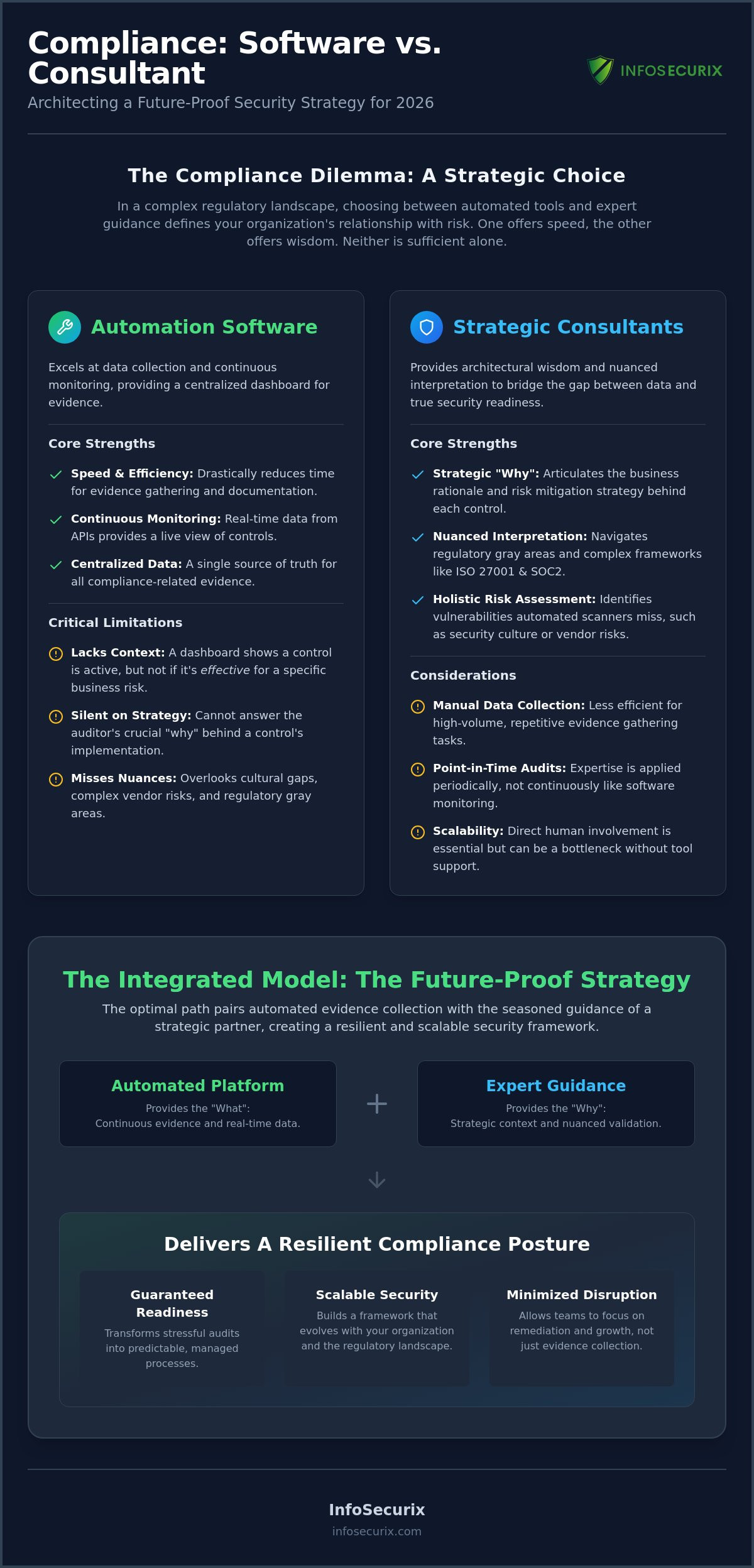
Evaluating the strategic divide requires a framework built on four foundational pillars: cost, speed, accuracy, and depth. While software provides immediate visibility, it often lacks the architectural depth that a human expert brings to a complex security posture. The debate of compliance consultant vs software often hinges on a misunderstanding of total cost of ownership (TCO). A platform’s TCO includes not just the license fee; it also encompasses the hundreds of internal man-hours required to configure integrations and remediate the gaps the software identifies. Conversely, a consultant represents a more focused investment that delivers a state of readiness, significantly reducing the likelihood of audit failure.
Audit day provides the ultimate test of your chosen strategy. When you rely solely on software, you present a dashboard and hope the auditor accepts the automated evidence mapping without further inquiry. When you partner with a consultant, you have a seasoned advocate who explains the rationale behind every control. This transforms a potential interrogation into a professional validation of your standards. Consultants bridge the gap between a “technical pass” and true business resilience, ensuring that your security framework actually protects your data rather than just populating a spreadsheet.
Scenario-Based Analysis: When Software Wins
Early-stage startups seeking a basic SOC 2 Type I often find software to be the most efficient path. These organizations typically have high internal IT resources but limited compliance knowledge. In these instances, software acts as a tactical tool for continuous monitoring. It provides a baseline level of security that satisfies early-stage investors and customers. It’s a pragmatic choice for companies with simple, cloud-native environments where API integrations can cover the majority of the required evidence collection without significant manual intervention.
Scenario-Based Analysis: When a Consultant is Essential
Complex organizations or those pursuing ISO 27001 certification readiness require a level of nuance that algorithms cannot replicate. If your environment includes legacy systems that lack modern API support, a platform will likely leave significant gaps in your evidence chain. Achieving a comprehensive information security risk assessment demands a deep understanding of business context that software doesn’t possess. A consultant identifies risks that exist between the systems. They ensure your framework is resilient enough to support long-term corporate excellence and future-proof your operations against emerging threats.
The Integrated Model: Architecting the Future-Proof Strategy
Market leaders in 2026 are increasingly abandoning the restrictive “either/or” mindset that characterized earlier approaches to governance. The most resilient organizations recognize that the debate of compliance consultant vs software is actually a conversation about integrated synergy. Software serves as the engine for continuous evidence collection: it provides the raw data required for visibility. However, a consultant acts as the architect who interprets this data to drive strategic corrective actions. This model ensures that routine tasks are automated for efficiency while critical risk decisions receive the professional scrutiny they deserve. By leveraging both, you maximize your return on investment: automating the mundane and consulting on the critical.
Adopting this integrated approach allows your organization to move beyond mere survival and toward competitive excellence. When software identifies a gap in your control environment, a seasoned partner doesn’t just note the failure. They analyze the root cause within your specific business context. This prevents the cycle of “dashboard whack-a-mole” where teams constantly fix symptoms without addressing the underlying structural weaknesses. It’s a shift from reactive remediation to proactive resilience: a strategy that future-proofs your business against the accelerating pace of regulatory change.
Evaluating Your Organizational Maturity
Determining if you’re ready for an integrated model requires an honest assessment of your current state. You must evaluate the complexity of your regulatory requirements alongside the technical maturity of your infrastructure. If your team lacks the internal expertise to interpret complex framework requirements, software alone will likely lead to misconfigurations. Consider this checklist to identify your organizational readiness:
- Assess if your current IT and legal departments have the capacity to manage a GRC platform effectively.
- Identify the “Expertise Gap” between automated data collection and strategic risk interpretation.
- Determine if your regulatory scope includes legacy systems that require manual oversight.
Understanding these variables allows you to build a roadmap that balances speed with absolute security.
The Role of the Seasoned Guide in an Automated World
Even in a highly automated environment, the human element remains the most critical component of a successful audit. A seasoned guide translates granular software findings into executive-level risk decisions that resonate with stakeholders. They also play a vital role in preparing your team for the qualitative aspects of an audit, such as auditor interviews. Ensuring that your SOC 2 readiness checklist is fully addressed involves more than just verifying technical logs; it requires validating that your policies are actually lived by your staff. This layer of professional validation is what transforms a standard compliance exercise into a badge of enterprise trust. To ensure your organization is truly prepared for the rigors of a 2026 audit, consider engaging with a professional readiness assessment today.
InfoSecurix: Elevating Compliance Beyond the Dashboard
The transition from a technical “pass” to true operational excellence requires more than just a functional dashboard. With over 25 years of institutional knowledge, InfoSecurix provides the seasoned perspective necessary to future-proof your organization against a volatile regulatory environment. While the compliance consultant vs software debate often focuses on immediate costs, our approach emphasizes the longevity of your security posture. We act as a collaborative ally, ensuring that your standards aren’t just met for a single audit but are woven into the very fabric of your corporate culture. This meticulous focus on strategic depth is what allows our clients to move beyond the simple act of “checking the box” and toward a state of resilient, scalable growth.
Our role is to serve as the seasoned guide who interprets the complex telemetry provided by modern automation tools. We understand that data without context is merely noise. By applying decades of experience across ISO 27001, SOC 2, and risk assessments, we transform raw evidence into a narrative of security and trust. This partnership enables your leadership team to remain calm under the pressure of high-stakes audits, knowing that every control has been architected with precision and validated by experts who have seen every possible scenario.
Bespoke ISO and SOC 2 Readiness
We believe that compliance should support your business objectives, not hinder them. Our methodology for ISO 27001 and SOC 2 readiness is entirely bespoke; we curate frameworks that align with your specific operational reality. To provide absolute financial predictability, we offer fixed-fee readiness engagements that eliminate the uncertainty of hourly billing. This structured approach is designed to ensure audit success on the first attempt, minimizing disruption to your IT and legal departments. We focus on the high-impact areas that auditors scrutinize most, providing a clear and guaranteed path to certification readiness.
Securing Your Legacy with InfoSecurix
The relationship we build with our clients extends far beyond the delivery of a certificate. As a trusted advisor, we remain invested in your long-term success, helping you navigate new frameworks as your company scales. We don’t ask you to abandon your existing compliance automation tools; instead, we integrate with them to provide the strategic oversight that software lacks. This synergy ensures that your internal audits and risk assessments are conducted with a level of nuance that algorithms cannot replicate. We invite you to experience the confidence that comes from a partnership rooted in professional excellence. Begin your journey toward a more secure future by scheduling a strategic readiness consultation with our team today.
Securing Your Strategic Advantage in 2026
The choice between a compliance consultant vs software shouldn’t be viewed as a binary competition; instead, it’s a decision about how you architect your organization’s long-term resilience. While automation tools provide the technical visibility needed to manage daily evidence, they cannot replace the strategic foresight required to navigate high-stakes audits with absolute confidence. Integrating digital efficiency with professional wisdom ensures your security framework is a robust asset that enables sustainable growth. You gain the ability to interpret complex data through the lens of business risk, transforming a standard requirement into a competitive advantage.
InfoSecurix brings over 25 years of specialized information security experience to your partnership. Our seasoned consultants have navigated hundreds of successful audits, providing expert guidance on ISO 27001, SOC2, and ISO 22301. We help you move beyond the dashboard to achieve a state of true certification readiness and operational excellence. Architect your strategic compliance roadmap with InfoSecurix. Your path to a secure and compliant future is within reach.
Frequently Asked Questions
Is compliance software enough to pass an ISO 27001 audit?
No, software alone is generally insufficient to satisfy the rigorous requirements of an ISO 27001 audit. While automation tools excel at evidence collection, the standard requires a functioning Information Security Management System (ISMS) that includes active risk management and leadership commitment. Auditors look for evidence of cultural adoption and strategic decision-making that a digital dashboard simply cannot replicate without human oversight.
How much does a compliance consultant cost compared to software?
The initial investment for a consultant is typically higher than a monthly software subscription, yet the total cost of ownership is often lower over time. Software licenses frequently hide the true cost of the internal labor required for configuration and remediation. A consultant provides a fixed-fee engagement that reduces the drain on your internal IT resources and minimizes the expensive risk of audit failure.
Can I use compliance automation tools for SOC 2 readiness?
Yes, automation tools are highly effective for gathering the technical evidence required for a SOC 2 assessment. They provide continuous monitoring of cloud configurations and user access logs, which streamlines the readiness process. However, you still need professional guidance to ensure these tools correctly map to the specific Trust Services Criteria that are relevant to your unique business model and customer commitments.
What happens if my software-generated evidence is rejected by an auditor?
If an auditor rejects your automated evidence, you must manually remediate the gap and provide alternative proof of control effectiveness immediately. This situation often leads to significant audit delays and increases the likelihood of a qualified opinion or a failed report. This risk is a primary consideration in the compliance consultant vs software debate, as a consultant validates evidence quality before the auditor sees it.
Do compliance consultants help with the actual implementation of controls?
Yes, seasoned consultants provide the architectural guidance necessary to implement controls that are both compliant and operationally efficient. They bridge the gap between complex regulatory theory and your specific technical environment. This ensures that your security measures protect the organization without creating unnecessary friction for your employees or disrupting your established workflows.
How long does it take to get audit-ready using a consultant vs. software?
Software can identify technical gaps within days, but reaching true audit readiness typically takes three to six months regardless of the tool used. Consultants often accelerate this timeline by preventing the common configuration errors that lead to rework. They focus your team on the most critical remediation tasks, ensuring that your path to certification is as direct and efficient as possible.
Can software replace the need for an internal audit firm?
No, software cannot fulfill the regulatory requirement for an independent internal audit. Standards like ISO 27001 mandate that a qualified professional who is independent of the process must assess the effectiveness of your controls. While software monitors data, it cannot provide the objective, professional opinion that is required to validate the maturity of your security program.
What is the best approach for a mid-sized company facing multiple frameworks?
The most effective strategy for managing multiple frameworks is an integrated model that leverages both technology and expertise. You should use software to centralize evidence across frameworks like SOC 2 and ISO 27001 while engaging a consultant to architect a unified control set. This hybrid approach to the compliance consultant vs software dilemma ensures maximum efficiency and absolute security for complex organizations.