
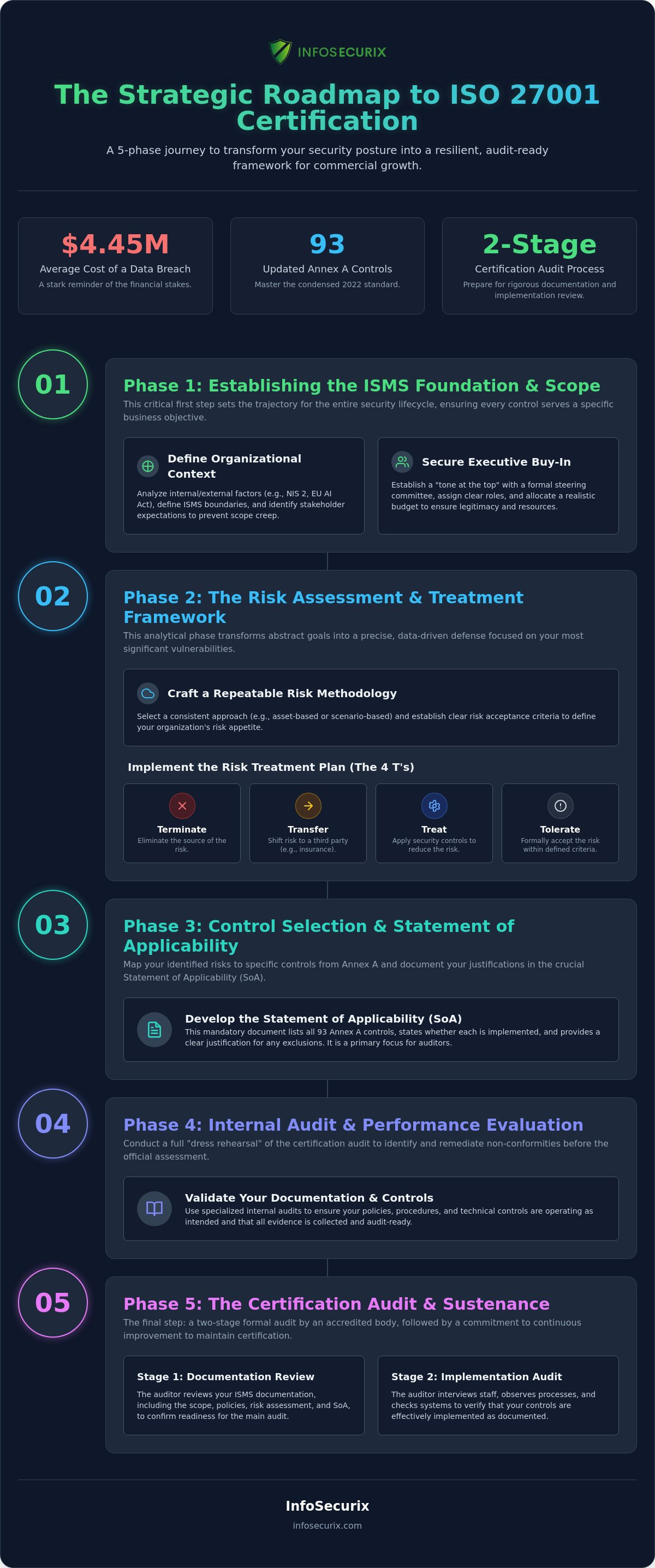
With the average cost of a data breach reaching $4.45 million, ISO 27001 certification has evolved from a defensive checkbox into a high-stakes engine for commercial growth. You likely recognize that achieving this standard is no longer optional for securing enterprise contracts; yet, the documentation overload and the nuances of the 93 condensed Annex A controls often create more confusion than clarity. Understanding the precise ISO 27001 implementation steps is the difference between a fragmented security posture and a resilient, audit-ready framework that satisfies both regulators and stakeholders.
This roadmap empowers you to master the systematic journey toward certification through a professional framework designed to balance rigorous security with operational agility. We’ve refined the process into a strategic sequence that eliminates the fear of audit failure while streamlining your compliance efforts. From navigating the 2022 Annex A revisions to aligning with the August 2026 EU AI Act requirements, this guide details every phase necessary to transform your security posture into a verified engine for global growth.
Key Takeaways
- It’s vital to define a precise ISMS scope to protect high-value assets; this ensures your security framework remains focused on critical business functions.
- Master the specific ISO 27001 implementation steps needed to align with the 2022 standard; this includes mapping the 93 updated security controls to your risk profile.
- Implement a robust risk treatment plan that bridges technical vulnerabilities with strategic business objectives; this creates a security posture that enables, rather than hinders, sales.
- Prepare for the two-stage certification audit process by conducting specialized internal audits. These serve as a final validation to ensure your documentation is fully audit-ready.
Phase 1: Establishing the ISMS Foundation and Scope
The initial phase of the ISO 27001 implementation steps is often the most critical; it sets the trajectory for the entire security lifecycle. Rather than viewing the standard as a static checklist, successful organizations treat the establishment of an Information Security Management System (ISMS) as a foundational shift in corporate culture. This stage requires a deliberate focus on the “why” behind your security posture. It ensures that every subsequent control serves a specific business objective. By defining a clear roadmap at the outset, you transition from a reactive security stance to one that is proactive, resilient, and inherently audit-ready.
Defining Your Organizational Context
Before deploying a single technical control, you must clearly articulate the environment in which your ISMS operates. Clause 4 of the ISO/IEC 27001 standard mandates this “Context of the Organization” as a prerequisite for certification. This involves analyzing internal and external factors that could influence your security outcomes. These might include evolving privacy regulations like the NIS 2 Directive, supply chain dependencies, or the specific requirements of the EU AI Act. You need to determine the physical, digital, and legal boundaries of your ISMS to prevent scope creep, which can lead to inefficient resource allocation and eventual audit failure. Identifying your stakeholders is equally vital. Their expectations for compliance, whether from customers, partners, or regulatory bodies, act as the North Star for your high-level Information Security Policy.
Securing Executive Buy-In and Resources
A resilient ISMS cannot survive in a vacuum; it requires the “tone at the top” to provide both legitimacy and the necessary capital. Securing executive commitment is less about explaining technical encryption and more about demonstrating how a mature security posture facilitates sales and protects market share. Establishing a formal security steering committee ensures that decision-makers are actively involved in the ISO 27001 implementation steps, rather than remaining distant observers. This committee is responsible for assigning clear roles and authorities, ensuring that accountability is distributed throughout the organization. Part of this commitment involves establishing a realistic budget for implementation tools and external ISO 27001 certification readiness support. Investing in objective validation early on prevents the costly rework that often follows a failed Stage 1 audit. By treating security as a strategic investment, you transform compliance from a burden into a competitive advantage.
Phase 2: The Risk Assessment and Treatment Framework
Phase 2 serves as the analytical engine of your security strategy. While the foundation was laid in the previous stage, this phase transforms abstract goals into a precise, data-driven defense. Executing the ISO 27001 implementation steps correctly here ensures that your resources are focused on the vulnerabilities that actually threaten your business continuity and reputation. It is a process of discovery that bridges the gap between technical flaws and strategic business impact.
Crafting a Repeatable Risk Methodology
Choosing a methodology is not a mere formality. It defines how you perceive and prioritize threats across your entire enterprise. You might select an asset-based approach, which focuses on protecting specific hardware and data sets, or a scenario-based model that anticipates complex threat sequences. Both are valid under the official ISO/IEC 27001:2022 standard. However, consistency is paramount. Setting clear risk acceptance criteria allows your organization to define its ‘Appetite for Risk’ with precision. This prevents the common pitfall of over-investing in minor threats while leaving critical gaps exposed. For those seeking a deeper dive into these frameworks, our information security risk assessment guide provides a detailed breakdown of how to align these models with your corporate culture.
The Risk Treatment Process
Once risks are identified and their “Inherent Risk” levels are evaluated based on impact and likelihood, they must be systematically addressed through a Risk Treatment Plan (RTP). This involves the “Four Ts” of risk management:
- Terminate: Eliminate the activity or technology that creates the risk.
- Transfer: Shift the risk to a third party, such as a cloud provider or through cyber insurance.
- Tolerate: Accept the risk if it falls within your pre-defined acceptance criteria.
- Treat: Apply specific security controls to reduce the risk to an acceptable “Residual Risk” level.
Accountability is the cornerstone of this process. Assigning Risk Owners beyond the IT department ensures that security remains a shared corporate responsibility. Every decision must be documented with a clear rationale. This level of detail satisfies auditors and provides a historical record for future reviews. If you find the complexity of these frameworks daunting, engaging a partner for a formal risk assessment can provide the objective clarity needed to move forward with confidence. By the end of this phase, you will have a prioritized list of actions that directly correlate to the 93 controls found in the 2022 Annex A, ensuring your ISO 27001 implementation steps remain both efficient and effective.
Phase 3: Control Selection and the Statement of Applicability
Once you’ve identified and prioritized your risks, the next of the ISO 27001 implementation steps involves selecting the specific safeguards that will mitigate them. This phase is where your security strategy becomes tangible. It’s no longer about identifying theoretical threats; it’s about deploying rigorous defenses that protect your organization’s integrity. In 2026, this process requires a sophisticated understanding of how the 93 controls within the ISO 27001:2022 Annex A function as a cohesive ecosystem. You aren’t just checking boxes. You’re institutionalizing trust through technical, physical, and organizational excellence.
Navigating the 2022 Annex A Control Themes
The 2022 update simplified the previous 114 controls into 93, but it also introduced a more logical, themed structure that’s essential for modern audits. Understanding these four themes is vital for ensuring your ISMS remains agile:
- Organizational Controls: These 37 controls focus on the broader framework, including policies, cloud service security, and the management of user end-point devices.
- People Controls: This group of 8 controls addresses the human element, ensuring that remote work policies, screening processes, and confidentiality agreements are robust.
- Physical Controls: These 14 controls secure your tangible environment; they cover everything from secure areas and entry controls to the protection of equipment, often requiring advanced systems from Empire State Security.
- Technological Controls: The remaining 34 controls dive into the digital architecture, mandating encryption, secure coding practices, and sophisticated logging.
Modern implementation requires bridging the gap between legacy processes and these updated requirements. For instance, the 2022 version places a much heavier emphasis on cloud services and data leakage prevention. If your organization still relies on security protocols designed for a pre-cloud era, this phase is your opportunity to modernize your infrastructure while maintaining compliance.
The Strategic Importance of the SoA
The Statement of Applicability (SoA) is arguably the most scrutinized document in your entire audit. It acts as the central nervous system of your ISMS, providing a comprehensive list of which Annex A controls you’ve implemented and, crucially, which you haven’t. For every control excluded, you must provide a rigorous, documented justification. Auditors don’t just look for what’s present; they look for the logic behind what’s missing.
Your SoA must link directly back to the Risk Treatment Plan (RTP) you developed in Phase 2. This creates a clear line of traceability: a risk was identified, a treatment was chosen, and a specific control was applied to manage it. This level of transparency instills confidence in the auditor and demonstrates that your security posture isn’t arbitrary. It’s a deliberate, strategic response to your organization’s unique threat landscape. By treating the SoA as a living document rather than a one-time requirement, you ensure your ISMS remains resilient as new threats emerge throughout 2026 and beyond.
Phase 4: Internal Audit and Performance Evaluation
Phase 4 represents the critical transition from implementation to validation. It’s the moment of truth within the ISO 27001 implementation steps where you prove the system you’ve built actually performs under scrutiny. This phase isn’t merely about finding faults; it’s about institutionalizing a culture of objective measurement and continuous improvement. By the time you reach this stage, your controls are active. Now, you must gather the evidence to demonstrate their effectiveness to both your leadership and future auditors.
The Role of the Independent Internal Audit
An internal audit is a mandatory requirement that serves as your final “pre-flight check” before the external certification body arrives. Independence is non-negotiable here. The standard requires that auditors do not audit their own work, which often creates a conflict for internal teams that handled the initial setup. Leveraging a specialized cybersecurity internal audit firm provides an unbiased readiness view that internal staff often miss. These experts map findings directly to the standard’s clauses and Annex A controls, identifying subtle non-conformities before they become expensive failures. This objective validation ensures your documentation is robust and your evidence is audit-ready.
Management Review and Continuous Improvement
The results of your internal audit culminate in a formal Management Review. This is a high-level evaluation where executive leadership reviews the system’s suitability and adequacy. It’s a strategic session, not a technical briefing. You’ll examine audit results, stakeholder feedback, and any shifts in the risk landscape, such as new requirements from the EU AI Act or NIS 2 Directive. Management must document decisions regarding ISMS updates and any necessary resource reallocations. To ensure ongoing security health, you should establish clear Key Performance Indicators (KPIs). These might include metrics on incident response times or the effectiveness of security awareness training. Every gap identified must be addressed through a formal corrective action process that targets the root cause, not just the symptom. This ensures the system remains resilient long after the certificate is on the wall.
Securing an objective perspective is the most effective way to guarantee your internal audit meets the standard’s rigorous demands. Contact our experts for a professional internal audit to validate your security posture today.
Phase 5: The Certification Audit and Long-Term Sustenance
Achieving the final seal of approval is the culmination of your meticulous ISO 27001 implementation steps. This final phase transitions your organization from the preparation stage to the reality of external validation. It’s here that your commitment to rigorous standards is independently verified, providing your clients and stakeholders with the ultimate assurance of your security posture. The certification process is structured in two distinct stages; each is designed to ensure that your Information Security Management System (ISMS) is both well-designed and consistently executed.
The External Audit Experience
The Stage 1 audit serves as a high-level documentation review. During this phase, the Certification Body (CB) examines your ISMS framework to ensure it meets the mandatory requirements of the standard. It’s a readiness review that identifies potential gaps before the more intensive Stage 2 audit begins. Once you pass Stage 1, the auditor returns for Stage 2: a deep, evidence-based dive into your operational effectiveness. They’ll interview staff, review logs, and observe processes to confirm that you’re actually following the policies you’ve documented.
During these audits, you may receive different types of feedback. Observations are suggestions for improvement that don’t impact your certification. Minor Non-conformities are small lapses that require a plan for correction but don’t prevent certification. However, a Major Non-conformity indicates a significant breakdown in a specific requirement and must be resolved before a certificate can be issued. Successfully navigating this process allows you to leverage your certificate as a powerful market advantage, signaling to global partners that your organization is a safe and reliable collaborator.
Maintaining Your Security Posture
Securing the certificate is only the beginning of a three-year cycle of operational excellence. To maintain your status, you’ll undergo annual surveillance audits, which focus on specific areas of the ISMS to ensure continued compliance. The third year culminates in a full recertification audit. Moving from “implementation mode” to “operational excellence” requires institutionalizing security into daily workflows. Regular internal audit services are essential during this period. They provide the objective oversight needed to adapt to new threats and business changes throughout 2026.
Visionary organizations often look beyond a single framework to achieve total service excellence. Integrating your security efforts with an ISO 20000 implementation creates a unified approach to IT service management and security. This synergy ensures that your technical processes remain as robust as your security controls. By treating your ISMS as a living, breathing system, you future-proof your business against the complexities of the modern digital landscape. Your ISO 27001 implementation steps don’t end with a certificate; they evolve into a permanent foundation for trust and growth.
For organizations looking to move beyond compliance and drive wider organizational performance and resilience, check out Formatour Incorporated for expert guidance on strategic transformation.
Future-Proofing Your Enterprise Through Institutionalized Trust
Navigating the complex landscape of modern cybersecurity requires more than just technical aptitude; it demands a strategic commitment to rigorous, globally recognized standards. By mastering the ISO 27001 implementation steps detailed in this roadmap, your organization moves beyond mere compliance. You’re building a resilient foundation that protects critical assets while enabling sustainable commercial growth. From the initial scoping to the final certification audit, each phase serves to transform security from a technical burden into a verified market advantage.
Success in this journey often hinges on having a seasoned guide who understands the nuances of the 2022 revisions and emerging 2026 regulations. With 25+ years of seasoned expertise and a legacy of national compliance leadership, InfoSecurix provides the objective validation necessary to avoid costly audit failures. Our bespoke readiness frameworks ensure your ISMS is not only audit-ready but also operationally agile. Secure your certification journey with InfoSecurix readiness services and gain the absolute confidence that comes from professional partnership. Your path to global recognition starts with a single, strategic step toward excellence.
Common Questions Regarding ISO 27001 Compliance
How long does the ISO 27001 implementation process typically take?
Implementation timelines vary based on organizational complexity and resource availability. For small businesses with fewer than 20 employees, the process generally spans three to six months. Medium-sized organizations typically require five to nine months, while large enterprises should prepare for a journey lasting eight to twenty months or more. These timelines depend heavily on your current security maturity and the speed of your internal decision-making processes.
What is the difference between ISO 27001:2013 and the ISO 27001:2022 revision?
The 2022 revision introduced a more streamlined control set; it reduced the total number of controls from 114 to 93. This update includes 11 entirely new controls focused on modern threats like cloud security and data leakage. Since the transition deadline passed on October 31, 2025, all organizations must now align with the 2022 standard. This shift ensures your ISMS addresses the sophisticated digital vulnerabilities prevalent in 2026.
Can a small business implement ISO 27001 without a full-time CISO?
Small organizations certainly can achieve certification without a dedicated, full-time CISO on staff. Many lean on external advisors or fractional security leadership to navigate the ISO 27001 implementation steps effectively. This approach provides the high-level expertise needed for the risk assessment and policy development phases without the overhead of a permanent executive role. It allows your team to focus on core operations while maintaining a professional security posture.
What are the most common reasons for failing an ISO 27001 audit?
Audit failures frequently stem from a lack of documented evidence showing that controls are actually operating as intended. Other common pitfalls include incomplete risk assessments that fail to map to the Statement of Applicability or a lack of visible commitment from top management. Without executive buy-in, the ISMS often fails to integrate into the company’s daily operations. This leads to non-conformities when staff aren’t aware of their security responsibilities.
Is a gap analysis the same as an internal audit?
A gap analysis and an internal audit serve two distinct purposes in the compliance lifecycle. The gap analysis is a “pre-flight” check performed at the start to identify what’s missing from your current posture. In contrast, the internal audit is a formal review conducted after implementation to verify that your controls are functioning correctly and meet the standard’s requirements. Both are essential for ensuring your organization is fully prepared for the external certification body.
How much does it cost to implement ISO 27001 in 2026?
Industry analysts report that certification costs in 2026 have risen by approximately 20 percent compared to the previous year. For a small organization, external audit fees alone typically start around $7,800, while total first-year investment for mid-sized firms can range from $15,000 to $40,000. These figures vary based on the complexity of your digital footprint and the depth of professional support required to achieve a resilient, audit-ready security posture.
Do I need to implement all 93 controls in Annex A?
You don’t need to implement every control listed in Annex A. The selection process is driven by your specific risk assessment; you only apply the controls that mitigate your identified threats. However, you must justify any exclusions within your Statement of Applicability to ensure the auditor understands your strategic rationale. This process ensures your security framework is bespoke to your business needs rather than being a generic, one-size-fits-all checklist.
What happens if we find a non-conformity during the internal audit?
Finding a non-conformity is actually a positive sign that your monitoring system is working. You must document the issue, conduct a root-cause analysis, and implement a corrective action plan to prevent it from happening again. Addressing these gaps internally before the external certification body arrives is a critical part of the ISO 27001 implementation steps. It demonstrates to the auditor that your organization is committed to continuous improvement.