
With 65% of enterprise buyers now demanding a SOC 2 Type II report before they even consider a contract, your security posture has officially become your most powerful sales tool. You likely feel the weight of the “alphabet soup” of standards like ISO 27001 and NIST. It’s easy to worry that choosing the wrong compliance framework for B2B SaaS will lead to a rigid engineering culture or an unsustainable cost structure. You want to satisfy stakeholders without compromising the agility that built your company.
We understand that compliance shouldn’t be a barrier to growth; it’s a strategic foundation. This article provides the clarity you need to select a framework that aligns with your specific revenue drivers and client trust requirements. You’ll gain the confidence to build a roadmap that reduces audit risk and protects your data for the long term. We’re going to break down the selection process into a clear, actionable roadmap designed for the unique challenges of 2026.
Key Takeaways
- Position security as a strategic asset: learn to transform compliance from a technical checklist into a powerful driver of enterprise trust.
- Distinguish between ISO 27001 and SOC 2 to ensure your chosen standard aligns with the specific geographic and industry expectations of your stakeholders.
- Master a multi-dimensional methodology for choosing a compliance framework for B2B SaaS that balances engineering agility with rigorous security controls.
- Streamline your path to certification by leveraging professional gap analyses to identify and remediate vulnerabilities before the formal audit begins.
- Future-proof your organization through a partnership model that prioritizes long-term resilience over simple, one-time audit readiness.
The Strategic Significance of Compliance Framework Selection
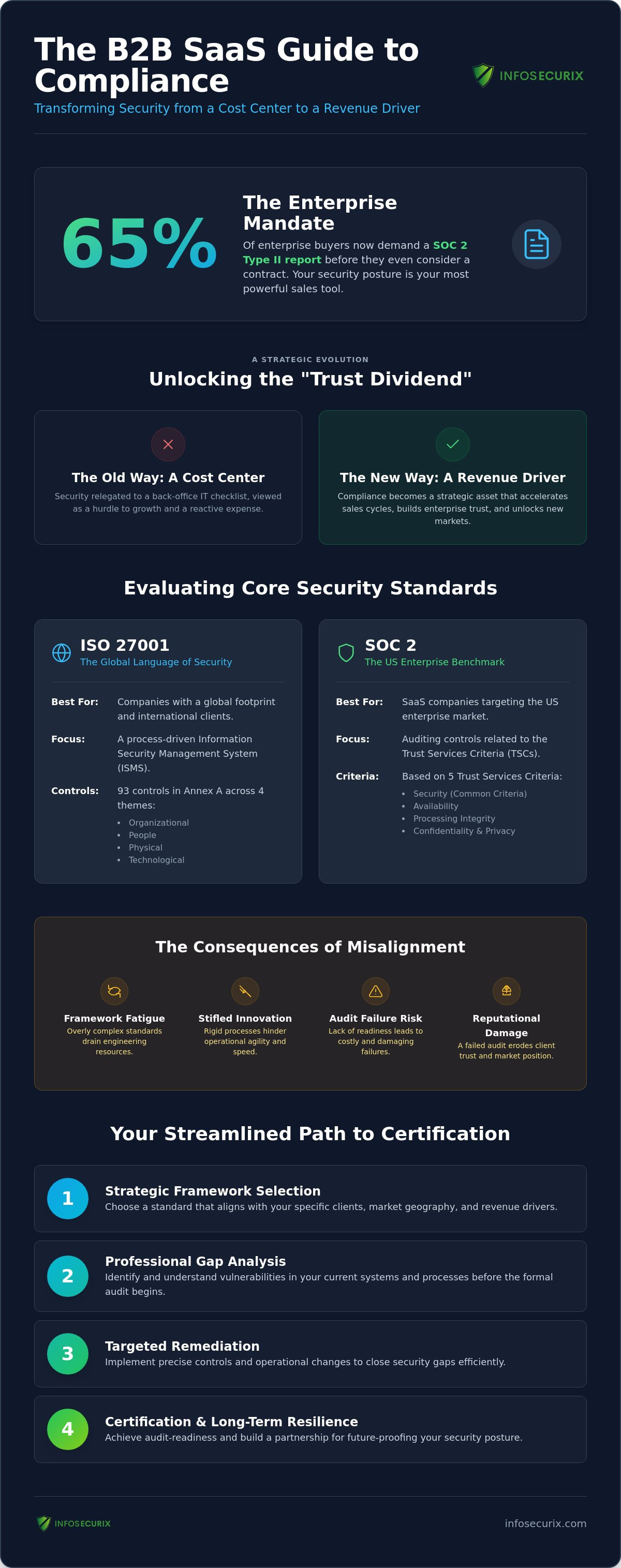
Selecting a compliance framework for B2B SaaS is no longer a peripheral technical requirement; it’s the architectural blueprint of your company’s operational integrity. In previous years, security was often relegated to a back-office IT checklist. Today, it’s a boardroom strategic priority that dictates market access, investment potential, and long-term valuation. When you view compliance as a foundational layer rather than a hurdle, you build a culture of verifiable excellence. This shift allows leadership to treat security as a proactive revenue driver rather than a reactive cost center.
We recognize this transformation as the “Trust Dividend.” By aligning with recognized Information security standards, you provide a clear, objective signal to enterprise stakeholders that your organization is built to withstand modern threats. This transparency accelerates sales cycles by removing the ambiguity that often stalls high-value contracts. It moves your team beyond “checkbox compliance” and establishes a sophisticated environment where security is woven into the very fabric of your engineering and operational workflows.
Compliance as a Market Differentiator
In the competitive B2B landscape, recognized standards act as a universal language of trust. Enterprise procurement teams are under immense pressure to vet every vendor thoroughly. A robust certification acts as a pre-validated credential, significantly shortening the vendor security assessment process. This efficiency doesn’t just save time; it positions your company as a mature partner capable of handling sensitive data. Utilizing a strategic compliance framework for B2B SaaS allows you to unlock new market segments and compete for higher-tier enterprise contracts that remain out of reach for uncertified competitors. Furthermore, maintaining operational compliance when scaling your workforce is essential; for instance, scaliify helps companies manage the complex legal risks associated with bogus self-employment in the European market.
The Consequences of Misalignment
Choosing an ill-fitting framework can be as damaging as having no framework at all. We often see “Framework Fatigue” in organizations that select overly complex standards that don’t align with their actual risk profile or size. This misalignment can stifle operational agility and innovation, forcing engineering teams into rigid processes that provide little actual security value. Perhaps most critically, selecting a framework without a comprehensive readiness plan creates a high risk of audit failure. Failing an audit is a strategic error that can damage your reputation and lead to significant financial loss; it underscores the necessity of a methodical, expert-led approach to selection and implementation.
Evaluating the Core Security Standards: ISO 27001 vs. SOC 2
Deciding on the optimal compliance framework for B2B SaaS requires a nuanced understanding of how different standards resonate with your target market. While several options exist, ISO 27001 and SOC 2 remain the two primary “gold standards” for securing enterprise trust. Each framework offers a distinct methodology for managing risk and demonstrating operational integrity. Your choice should reflect not just your current technical capabilities, but also the long-term expectations of your most valued clients. Many sophisticated organizations integrate the NIST Cybersecurity Framework as a high-level guide to ensure their security program covers the full spectrum of risk management functions.
Determining which standard carries more weight depends heavily on your geographic focus and industry vertical. While ISO 27001 is often the preferred choice for global operations, SOC 2 remains the de facto requirement for the US enterprise market. Selecting between these standards requires a deep understanding of your client’s expectations; starting with a professional SOC 2 readiness assessment can help clarify your path forward and ensure you don’t over-invest in unnecessary controls.
ISO 27001: The Global Language of Security
ISO 27001:2022 is the current international benchmark for security excellence. It’s built around the concept of an Information Security Management System (ISMS), which emphasizes a process-driven approach to security. This framework includes 93 controls in Annex A, organized into four key themes: Organizational, People, Physical, and Technological. Because it’s an international standard, it’s often the essential choice for SaaS companies with a global footprint. The longevity and universal recognition of ISO 27001 certification readiness ensures that your investment in compliance remains relevant across diverse jurisdictions and cultures.
SOC 2: Demonstrating Trust to the US Enterprise
SOC 2 is the definitive standard for service organizations operating in the United States. It evaluates your systems based on five Trust Services Criteria: Security, Availability, Processing Integrity, Confidentiality, and Privacy. You’ll need to choose between a Type I report, which validates your controls at a single point in time, and a Type II report, which assesses their effectiveness over a period of usually six to twelve months. Since 65% of enterprise buyers now demand a Type II report before signing, following a SOC 2 readiness checklist has become an essential prerequisite for market entry. This standard provides the granular detail that US auditors and procurement teams use to verify your security claims.
A Multi-Dimensional Framework Selection Methodology
Identifying the most effective compliance framework for B2B SaaS requires a deliberate, analytical process that transcends simple checklists. We utilize a structured 5-step methodology to ensure your security architecture aligns with your business objectives. First, analyze your primary revenue drivers and specific client contract requirements. If your growth depends on US-based enterprise deals, the SOC for Service Organizations standards will be your primary guide. Second, map your geographic footprint against regional regulatory expectations to avoid market access barriers. Third, assess the sensitivity and volume of the data you process. High-volume processing of personally identifiable information (PII) or protected health information (PHI) demands more rigorous controls than simple metadata storage. Fourth, evaluate your existing internal controls to identify the path of least resistance; this minimizes disruption to your engineering culture. Finally, project your future growth to ensure your chosen framework remains scalable as your organization matures.
Industry-Specific Considerations
Certain organizations find that a single standard isn’t enough to satisfy their entire stakeholder base. You might need to layer in ISO 20000 implementation to demonstrate IT service excellence to demanding enterprise partners. Similarly, companies managing critical infrastructure often prioritize ISO 22301 business continuity to prove they can maintain operations during significant disruptions. Navigating the intersection of HIPAA, PCI DSS, and broader security frameworks creates a comprehensive shield that protects both your reputation and your revenue. This layered approach ensures that specific regulatory requirements don’t become silos but rather integrated parts of a unified security posture.
Balancing Rigor with Resource Constraints
Determining your “Compliance Appetite” is a vital exercise for any leadership team. You must realistically assess how much operational overhead your team can manage without sacrificing innovation. Success in this area depends heavily on executive sponsorship; without it, framework adoption often falters at the implementation stage. Choose a compliance framework for B2B SaaS that complements your existing workflows. The goal is to create a seamless integration where security feels like a natural part of the development lifecycle, not an external imposition. This balance preserves your engineering culture while providing the verifiable proof of security that your enterprise clients demand.
Navigating Implementation: From Gap Analysis to Certification
Moving from the strategic selection of a compliance framework for B2B SaaS to its practical execution is where many organizations encounter their greatest challenges. This transition requires a shift from high-level vision to meticulous operational detail. We view the implementation phase as a process of refinement; it’s an opportunity to harmonize your security controls with your existing business processes. Success depends on a clear roadmap that begins with a comprehensive understanding of your current state and ends with a verifiable, audit-ready posture.
A professional gap analysis stands as the most critical first step in any compliance journey. It provides a baseline that highlights exactly where your current practices fall short of the framework’s requirements. Without this objective assessment, you risk wasting significant capital and engineering hours on controls that don’t address your actual vulnerabilities. Once gaps are identified, the focus shifts to a information security internal audit to verify that newly implemented controls are functioning as intended. This internal validation acts as a dress rehearsal, ensuring your team is prepared for the operational and psychological shift that a formal audit demands.
The Value of a Readiness Assessment
Identifying vulnerabilities before the official auditor arrives is a hallmark of a mature security program. A readiness assessment allows you to develop a strategic corrective action plan based on risk-prioritized findings. This ensures that your most critical data assets are protected first. One of the most common hurdles is the “Documentation Gap.” It’s not enough to have secure processes; you must ensure your written policies match your actual day-to-day practices. Bridging this gap early prevents the costly delays and reputational risk associated with a failed certification attempt. For expert guidance on starting your journey, consider our SOC2 Readiness Assessment services.
Building a Sustainable Internal Audit Program
Internal audits are far more than a regulatory requirement for ISO 27001 or a best practice for SOC 2. They serve as a mechanism for continuous improvement, driving security excellence long after the initial certification date. By conducting regular internal reviews, you ensure that controls don’t degrade over time. Engaging an external firm for these assessments provides an objective, expert-led perspective that internal teams might lack. This partnership allows you to leverage the experience of seasoned professionals who have seen hundreds of audit scenarios. It transforms compliance from a static achievement into a dynamic, sustainable advantage for your organization.
Future-Proofing Compliance: The InfoSecurix Partnership
Establishing a resilient compliance framework for B2B SaaS requires more than just technical aptitude; it demands a partner who understands the strategic nuances of enterprise trust. InfoSecurix leverages over 25 years of specialized experience to simplify the increasingly complex regulatory landscape. We move beyond the transactional nature of traditional consulting: we operate as a “Trusted Advisor” to ensure your security program is both rigorous and sustainable. Our meticulous approach to ISO 27001, SOC 2, and business continuity readiness empowers your organization to view security as a permanent pillar of corporate excellence. By prioritizing longevity and precision, we transform compliance from a seasonal burden into a continuous competitive advantage.
Choosing the right partner means gaining access to a seasoned veteran who remains calm under the pressure of shifting global standards. We don’t just provide a list of controls; we offer a collaborative alliance invested in your long-term success. This visionary yet grounded perspective ensures that your security investments are future-proofed against emerging threats and new regulatory requirements. Relying on our deep-rooted knowledge allows your leadership team to focus on core business growth while we handle the complexities of maintaining a world-class security posture.
Tailored Compliance Roadmaps
Generic templates often fail because they ignore the unique operational DNA of a modern enterprise. We focus on bespoke control sets that align with your specific risk profile and engineering culture. Integrating multiple standards into a single, cohesive security management system reduces redundancy and improves clarity for your team. This methodology provides strategic guidance on scaling your compliance program: ensuring that your security posture remains robust as your business expands into new markets or higher-tier contracts. A highly curated roadmap ensures that every control adds genuine value to your organization.
Ensuring Audit Success with Expert Guidance
Achieving certification is the result of methodical preparation and expert-led validation. Our proven methodology for information security risk assessment identifies potential pitfalls long before an external auditor enters the room. We prepare your leadership and technical teams for the rigors of external certification: providing the confidence needed to defend your controls under intense scrutiny. This comprehensive support ensures that your journey to compliance is predictable, successful, and strategically aligned with your long-term vision. Secure your enterprise future: Speak with an InfoSecurix compliance expert today.
Securing Your Enterprise Future Through Strategic Compliance
Selecting the ideal compliance framework for B2B SaaS marks the beginning of your organization’s journey toward lasting enterprise trust. We have explored how a methodical selection process, grounded in your specific revenue drivers and geographic footprint, transforms security from a technical hurdle into a strategic asset. Prioritizing a thorough gap analysis and a robust internal audit program ensures that your certification isn’t just a badge; it’s a reflection of operational excellence.
InfoSecurix brings over 25 years of information security excellence to your side. Our proven track record in ISO 27001 and SOC 2 readiness, combined with our expert internal audit and risk assessment services, provides the steady hand you need to navigate this complexity. We invite you to Partner with InfoSecurix for Expert Compliance Guidance and build a foundation that supports your most ambitious growth goals. Your commitment to these standards today will define your competitive advantage for years to come. We look forward to guiding you toward a secure and prosperous future.
Frequently Asked Questions
How do I know if ISO 27001 or SOC 2 is better for my B2B SaaS business?
Your target market and geographic footprint are the primary deciding factors. If your growth strategy focuses on the United States, SOC 2 is the expected standard for service organizations. For those expanding into European or global markets, ISO 27001:2022 provides the necessary international recognition. Many mature organizations eventually implement both to satisfy a diverse client base and ensure comprehensive coverage.
Can an organization implement multiple compliance frameworks simultaneously?
You can and should implement multiple frameworks if your business model demands it. Modern security programs often use a common control framework to map a single security practice to multiple standards like ISO 27001 and SOC 2. This approach reduces the documentation burden and prevents your engineering team from performing redundant tasks. It’s a strategic way to scale your security posture without doubling your operational overhead.
What is the typical timeline for achieving a security compliance certification in 2026?
Achieving a formal compliance framework for B2B SaaS generally requires a six to twelve month commitment. This window includes the initial gap analysis, control implementation, and the mandatory evidence collection period. Since 65% of enterprise buyers demand a SOC 2 Type II report before signing, you must factor in the monitoring period required to verify control effectiveness. Starting early ensures you don’t rush the process and risk an unfavorable audit result.
What is the difference between a readiness assessment and a formal audit?
A readiness assessment is a collaborative evaluation designed to identify gaps before the official auditor arrives. It’s a low risk environment where you can remediate issues without affecting your final report. In contrast, a formal audit is a rigorous, independent examination conducted by a certified registrar or CPA firm. The goal of the formal audit is to provide an objective opinion on whether your controls meet the standard’s requirements.
How much does it cost to implement a major compliance framework like ISO 27001?
Investment for a compliance framework for B2B SaaS is influenced by your security maturity and operational scope. You’ll need to account for internal personnel hours, technological enhancements, and the professional fees of the auditing body. Rather than focusing on a single number, consider the ROI generated by unlocking higher tier enterprise segments. A tailored gap analysis is the best way to determine the specific resources your organization will need to commit.
Do small B2B SaaS startups really need a formal security compliance framework?
Early stage companies often find that a formal framework is a prerequisite for signing their first enterprise contracts. While the initial investment is significant, it prevents the security bottleneck that often stalls high value sales cycles. For cybersecurity startups looking to scale, leveraging a specialized accelerator like incubou.com can provide the strategic support needed to balance growth with rigorous compliance. Implementing these standards early also helps you build a scalable culture of security that supports long-term success.
What happens if we fail a compliance audit?
An unsuccessful audit isn’t a permanent failure but a call for corrective action. Auditors will issue a report detailing specific non conformities or deviations from the standard. You’ll then have a designated window to implement remediations and undergo a follow up review. While it can delay your certification, addressing these findings ultimately results in a more resilient and secure organization.
How often do we need to renew our compliance certifications?
Maintenance schedules differ between standards to ensure ongoing control effectiveness. ISO 27001 operates on a three year cycle with annual surveillance audits to verify your management system remains active. SOC 2 reports are generally renewed every twelve months to provide clients with a contemporary view of your security posture. Regular renewals demonstrate your ongoing commitment to protecting sensitive data and maintaining enterprise trust.