
An ISO 27001 internal audit isn’t a mere rehearsal for the certification body’s arrival. It’s the strategic immune system of your Information Security Management System. While many organizations view Clause 9.2 as a hurdle to clear, the most resilient firms treat it as a high-level diagnostic tool to future-proof their operations. Mastering the ISO 27001 internal audit requirements ensures your security posture remains robust against a global threat landscape where the average cost of a data breach has reached $4.44 million. You shouldn’t settle for a checkbox exercise when you can build a culture of excellence that empowers your organization’s growth.
You’ve likely felt the tension of maintaining auditor independence within a small team or the fatigue that stems from constant compliance cycles. It’s a common challenge, yet the fear of missing a critical nonconformity shouldn’t dictate your security strategy. This article delivers a professional blueprint to master the complexities of Clause 9.2 with absolute confidence. We’ll explore how to establish a clear roadmap for compliance, integrate the latest climate action amendments, and secure your 2026 recertification through a methodical, risk-based approach.
Key Takeaways
- Distinguish between simple rule-following and true operational effectiveness: ensuring your ISMS achieves meaningful security outcomes.
- Master the ISO 27001 internal audit requirements by establishing a structured audit programme that defines clear intervals, scopes, and responsibilities.
- Resolve complex challenges regarding auditor independence and competence: ensuring that all reviews remain objective and technically proficient.
- Navigate a comprehensive two-phase roadmap for 2026 that bridges meticulous document review with rigorous on-site evidence gathering.
- Leverage specialized partnerships to identify hidden blind spots and transform the audit from a checkbox exercise into a driver of long-term resilience.
Understanding ISO 27001 Clause 9.2: The Mandate for Internal Verification
Clause 9.2 stands as the definitive mandate for internal verification. It requires your organization to conduct audits at planned intervals to ensure the ISMS conforms to the ISO 27001 internal audit requirements and the organization’s own specific security criteria. This process isn’t a passive exercise: it’s the primary engine of the “Check” phase within the Plan-Do-Check-Act (PDCA) cycle. By 2026, this mandate has matured to encompass not just technical controls but also the resilience of decentralized workforces and cloud-integrated environments.
High-level governance now dictates that we move beyond the binary of “pass or fail.” Modern audits focus on the strategic impact of technical processes. This shift mirrors the evolution of the standard itself. For a comprehensive ISO/IEC 27001 overview, it’s clear that the 2022 update and subsequent 2024 amendments require a more nuanced understanding of how environmental and operational changes impact security. You’re not just checking boxes; you’re validating the integrity of your entire business model.
Conformity vs. Effectiveness: The Dual Goal
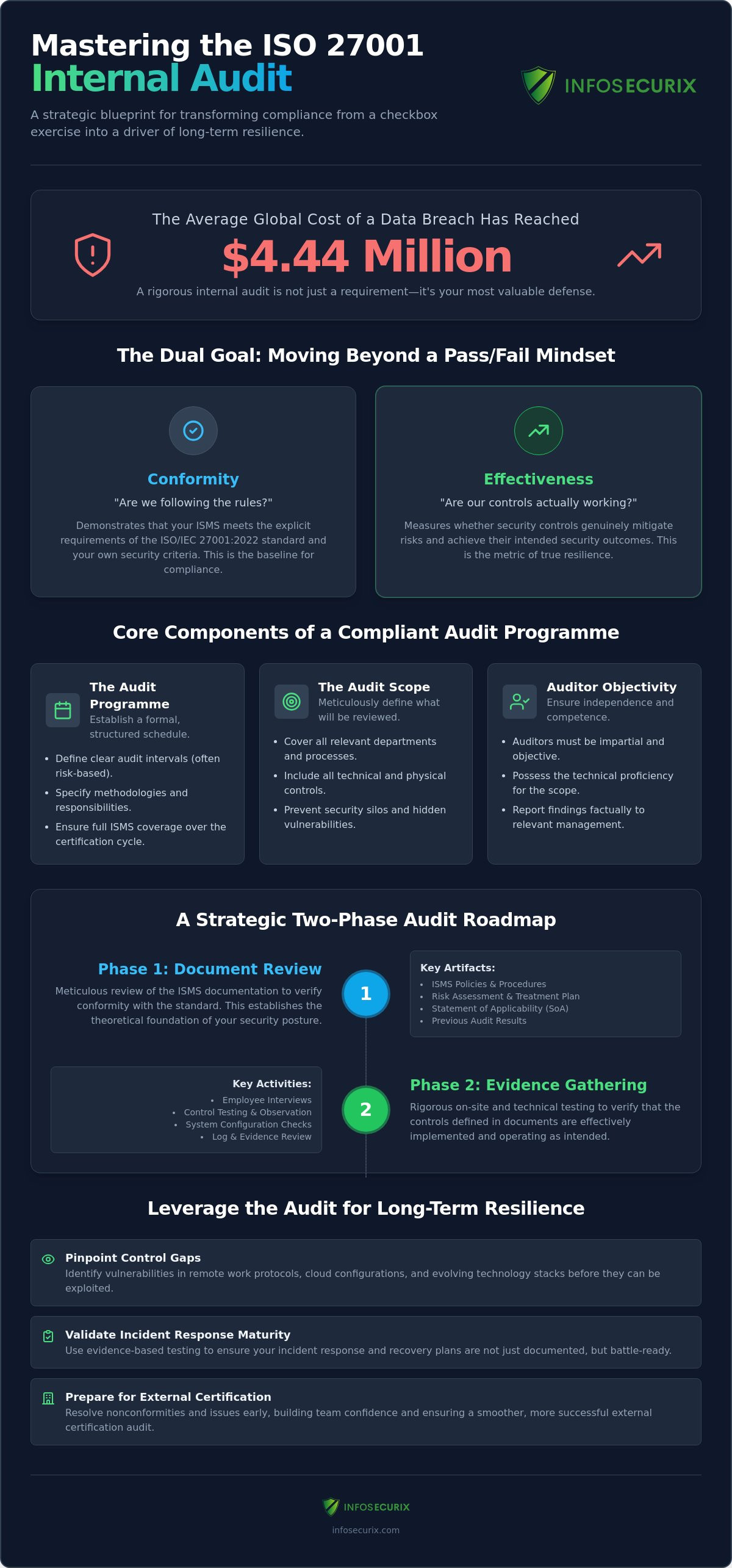
Conformity involves demonstrating that your ISMS meets the explicit requirements of the ISO/IEC 27001:2022 standard. Effectiveness, however, is a deeper metric: it measures whether those controls actually mitigate the risks they were designed to address. Successful organizations track specific Key Performance Indicators (KPIs) to prove that their security measures aren’t just present, but performing. ISMS effectiveness is the alignment of security controls with organizational risk appetite.
The Strategic Value of ‘Checking Yourself’
Internal audits provide a bespoke opportunity to identify vulnerabilities before they escalate into exploitable breaches or costly nonconformities. In an era where the average global cost of a data breach has climbed to $4.44 million, the internal audit serves as a high-value insurance policy. Executing a rigorous internal review ensures you meet the ISO 27001 internal audit requirements while simultaneously strengthening your operational core. It offers senior management objective, evidence-based insights into the organization’s security posture.
- Pinpoint control gaps in remote work protocols and decentralized access.
- Validate the maturity of incident response plans through evidence-based testing.
- Ensure the Statement of Applicability (SoA) remains accurate as your technology stack evolves.
- Prepare the team for the scrutiny of external certification bodies by resolving issues early.
Core Requirements for a Compliant ISO 27001 Internal Audit Programme
Developing a formal audit programme is the first step toward true organizational resilience. It isn’t enough to simply state that audits will occur; you must define the specific intervals, methodologies, and responsibilities that govern the entire process. Adhering to ISO 27001 internal audit requirements means creating a structured schedule that leaves no stone unturned over your certification cycle. By 2025, data showed that 58% of organizations conducted four or more audits annually to maintain this level of rigor. Your programme must be comprehensive enough to cover every aspect of the ISMS, from physical security to the governance of decentralized remote teams.
The audit scope must be meticulously defined to ensure that every department, process, and technical control is reviewed. This top-down approach prevents the development of security silos where vulnerabilities might hide. Reporting these findings to the relevant management tiers is equally critical. It ensures that senior leadership has the visibility needed to allocate resources and authorize corrective actions, transforming the audit from a technical exercise into a core component of business governance.
Designing a Risk-Based Audit Schedule
Your audit frequency should never be a matter of guesswork. It must be directly informed by your ISO 27001 risk assessment methodology. In 2026, this means prioritizing high-velocity change areas such as new cloud migrations or the integration of generative AI tools. These emerging technologies introduce unique data risks and automated threat vectors that traditional audit cycles often overlook. Balancing this depth with your operational capacity is essential for maintaining momentum without causing audit fatigue across the organization.
Documentation and Record-Keeping Standards
Evidence is the cornerstone of any successful verification process. If a control performance isn’t documented, an auditor will assume it doesn’t exist. You must maintain a precise trail of audit plans, checklists, and nonconformity reports to meet the ISO 27001 internal audit requirements for documented information. As discussed in the ISACA Journal, the discipline of record-keeping is what separates a mature ISMS from a reactive one. These artifacts are vital for your ISO 27001 certification readiness, providing the objective proof required by external certification bodies during their visit.
Maintaining the integrity and confidentiality of these records is a security requirement in itself. By treating your audit documentation with the same level of care as your primary data, you demonstrate a culture of security that goes beyond simple compliance. If you find the documentation burden challenging, focusing on a structured framework can simplify the path to a successful recertification.
Operationalizing Independence and Competence in the Audit Process
Maintaining objectivity is often the most significant hurdle for organizations with lean security teams. The “Independence” rule is non-negotiable: individuals must not audit their own work or area of responsibility. This requirement ensures that the review remains impartial and that findings aren’t clouded by personal bias or the desire to overlook one’s own oversights. In flat organizational structures where roles often overlap, fulfilling this aspect of ISO 27001 internal audit requirements requires careful strategic planning and a commitment to professional distance.
When internal resources are too intertwined with the systems they manage, objectivity becomes compromised. This is particularly prevalent in specialized IT departments where only a few individuals possess the technical knowledge to evaluate complex controls. In these scenarios, the most effective path forward is often to engage a cybersecurity internal audit firm. This partnership brings a fresh, external perspective that is inherently free from internal politics and systemic blind spots, ensuring your ISMS receives the rigorous scrutiny it deserves.
Navigating Conflicts of Interest
Cross-departmental auditing is a proven strategy for maintaining impartiality within a growing organization. For instance, a quality manager might audit the HR department’s onboarding controls, while the IT lead reviews physical security logs. The Audit Lead plays a vital role here: they must oversee the entire process to ensure that no auditor is placed in a position of conflict. Identifying and mitigating ‘auditor bias’ isn’t just about following rules. It’s about protecting the integrity of the entire verification process through deliberate oversight.
Defining Auditor Skillsets for 2026
Competence extends far beyond the ability to follow a checklist. By 2026, auditors must possess a deep understanding of the Annex A controls, specifically how they apply to modern cloud and AI environments. Technical proficiency is only half of the equation. Effective auditors also need refined soft skills, such as advanced interviewing techniques and the ability to gather objective evidence through observation. Training staff as peer auditors requires a commitment to developing both their technical knowledge and their professional skepticism. You’re looking for individuals who can translate granular mechanics into strategic security outcomes.
- Technical mastery of ISO/IEC 27001:2022 Annex A controls.
- Proficiency in evidence gathering and sampling methodologies.
- Exceptional communication skills for interviewing diverse stakeholders.
- The ability to remain objective under organizational pressure.
Executing the Audit: A Strategic Roadmap for 2026
Executing a successful audit requires a methodical transition from high-level preparation to granular remediation. Phase 1 centers on a rigorous document review: setting the stage for a thorough investigation by aligning your policies with current operational realities. Phase 2 moves into fieldwork, where gathering evidence through interviews and direct observation becomes the priority. Adhering to ISO 27001 internal audit requirements during these phases transforms the audit from a static event into a dynamic engine for improvement. It’s not about catching people in mistakes, but about validating the strength of your collective security posture.
Phase 3 involves the critical analysis of data to categorize findings into nonconformities or opportunities for improvement. This leads directly into Phase 4: Corrective Action and Follow-up. This final stage is the most vital for the long-term health of your ISMS. It’s where you bridge the gap between identifying a weakness and fortifying your defenses. If you’re ready to elevate your security posture, engaging professional Internal Audits can provide the seasoned guidance needed to navigate this roadmap with absolute confidence.
Evidence Gathering in a Modern Environment
Auditing cloud-native configurations and remote work security in 2026 requires more than a cursory glance at logs. You must employ sophisticated techniques to verify that encryption and access controls remain robust across decentralized environments. Sampling methodologies play a key role here. You need to determine how much evidence is sufficient to satisfy a certification body without creating unnecessary friction. For organizations pursuing multiple standards, leveraging a strategic SOC 2 readiness checklist provides a powerful cross-framework reference to ensure alignment across your entire compliance portfolio. This integrated approach reduces audit fatigue while maximizing the value of every evidence-gathering session.
Mastering the Nonconformity Lifecycle
Findings are typically categorized as Major Nonconformities, Minor Nonconformities, or Observations. A Major Nonconformity represents a significant breakdown in a control, while a Minor one suggests a localized issue that doesn’t compromise the entire system. Observations highlight areas where, although compliant, there is room for optimization. Root Cause Analysis is the essential tool for addressing these findings effectively. It’s important to remember that “human error” is never the final answer; it’s usually a pointer toward a deeper systemic need for better training or clearer workflows. Verifying the effectiveness of remediation is the final, non-negotiable step before closing the audit loop and ensuring your ISO 27001 internal audit requirements are fully satisfied. This rigorous follow-up ensures that vulnerabilities are permanently addressed rather than temporarily patched.
Elevating Compliance: Why Specialized Audit Partnerships Drive Long-Term Resilience
Achieving genuine operational security requires a perspective that transcends internal familiarity. When organizations treat ISO 27001 internal audit requirements as a simple administrative hurdle, they often overlook the very vulnerabilities that external threats exploit. A specialized partnership provides the objective scrutiny necessary to uncover these hidden blind spots. This external viewpoint transforms the audit from a reactive obligation into a proactive strategy for growth. It ensures that your ISMS remains a protective force that enables, rather than hinders, your organizational expansion.
InfoSecurix brings over 25 years of seasoned experience to every information security internal audit: ensuring that your management system is not only compliant but also resilient against the shifting regulatory landscape. By 2026, the integration of climate action amendments and the rapid adoption of AI have made the audit process more complex than ever. Future-proofing your business requires a partner who understands these nuances and can translate technical requirements into strategic business value. You don’t just need an auditor; you need a collaborative ally invested in your long-term success.
The InfoSecurix Advantage: Precision and Partnership
Precision is the hallmark of our approach. We deliver bespoke audit methodologies specifically tailored to your industry’s unique risk profile and operational scale. Our role extends from finding vulnerabilities to fixing them: providing clear, strategic guidance on corrective action plans that address root causes. InfoSecurix stands as a seasoned guide within complex compliance environments: navigating the intricate intersection of technical rigor and business growth. This commitment to thoroughness ensures that your ISO 27001 internal audit requirements are met with a level of detail that instills absolute confidence in your stakeholders.
Next Steps: Securing Your 2026 Certification
Preparing for your next certification cycle begins with a clear understanding of your current standing. Conducting a comprehensive gap analysis allows you to benchmark your audit maturity and identify areas requiring immediate attention. Establishing a sustainable internal audit rhythm with professional support ensures that compliance becomes a natural part of your corporate culture. This methodical approach reduces the stress of external audits and builds a foundation of continuous improvement. We invite you to consult with InfoSecurix for a comprehensive compliance review to ensure your organization remains a leader in information security excellence.
- Benchmark your current ISMS maturity against the latest 2022 standards.
- Develop a multi-year audit schedule that aligns with your strategic goals.
- Empower your internal teams with expert insights and evidence-gathering techniques.
- Secure your 2026 recertification with a robust, evidence-based audit report.
Future-Proofing Your ISMS for a Secure 2026
Mastering a resilient information security posture requires a shift from reactive compliance to proactive governance. Excellence is never accidental. By viewing Clause 9.2 as a strategic diagnostic tool, you transform the audit process into a mechanism for continuous improvement and long-term stability. You’ve explored the necessity of establishing a risk-based schedule and the vital role of maintaining absolute auditor objectivity. These elements collectively ensure that you meet the ISO 27001 internal audit requirements while fortifying your organization against the sophisticated threats of the modern landscape.
InfoSecurix integrates 25+ years of information security excellence into every engagement: providing the seasoned guidance needed to navigate complex compliance environments. Our approach extends beyond identifying gaps to delivering strategic corrective action plans that ensure your systems remain robust and audit-ready. With deep expertise across ISO 27001, SOC2, and ISO 22301, we provide the precision required for enterprise-level success. Secure your certification with InfoSecurix’s expert internal audit services and build a culture of security that empowers your growth. Your commitment to these meticulous standards today secures your organization’s reputation and operational integrity for years to come.
Frequently Asked Questions
Is an internal audit mandatory for ISO 27001 certification?
Yes, conducting an internal audit is a mandatory requirement under Clause 9.2 of the ISO/IEC 27001:2022 standard. You cannot achieve or maintain certification without demonstrating that you’ve performed these reviews at planned intervals. Certification bodies require evidence of a completed internal audit and the subsequent management review before they will conduct their own external assessment of your Information Security Management System.
Can we perform the ISO 27001 internal audit ourselves?
You can certainly perform the audit using internal staff, provided you strictly adhere to the principle of auditor independence. This means the person conducting the review must not have any responsibility for the specific processes or controls they are evaluating. For many organizations, maintaining this objectivity is difficult; they often choose to outsource these duties to a specialized firm to ensure a truly impartial assessment.
How often should we conduct an internal audit for ISO 27001?
The standard requires audits at “planned intervals” rather than a specific calendar frequency. Most organizations find that a full annual audit of the entire ISMS is the most effective way to meet ISO 27001 internal audit requirements. However, you might choose a rolling schedule where different departments are reviewed quarterly. This approach ensures continuous monitoring and prevents the significant operational strain associated with a single, massive year-end audit.
What happens if we find nonconformities during the internal audit?
Finding nonconformities is actually a positive sign of a healthy, functioning ISMS. It demonstrates that your internal verification process is rigorous and capable of identifying weaknesses. When a nonconformity is discovered, you must document it, perform a root cause analysis, and implement a corrective action plan. Proving that you can identify and remediate these issues is a key factor in successful recertification.
What is the difference between an internal audit and a gap analysis?
A gap analysis is typically a one-time exercise performed during the initial implementation phase to identify what’s missing compared to the standard. In contrast, an internal audit is a formal, recurring verification of an established ISMS. While the gap analysis tells you what you need to build, the internal audit confirms that your existing controls are operating effectively and conform to your documented policies.
How do we prove auditor competence to an external certification body?
You prove competence through documented evidence of the auditor’s skills, training, and experience. This includes formal ISO 27001 Lead Auditor certificates, records of previous audit participation, or internal training logs that demonstrate a deep understanding of Annex A controls. External certification bodies will scrutinize these records to ensure the individuals performing your internal reviews possess the technical and professional skepticism required for a valid assessment.
What should be included in an ISO 27001 internal audit report?
A comprehensive report must include the audit scope, the specific criteria used for evaluation, and a summary of the evidence gathered. It should clearly categorize findings into major nonconformities, minor nonconformities, and opportunities for improvement. Providing a clear narrative of the audit’s results ensures that senior management can make informed decisions regarding resource allocation and strategic security enhancements to satisfy ISO 27001 internal audit requirements.
Can the internal audit be done remotely in 2026?
Remote and hybrid audits have become a standard practice in 2026. Utilizing secure video conferencing and digital document sharing allows for an efficient review process without the need for extensive travel. While some physical security controls may still benefit from an on-site visit, the vast majority of technical and administrative controls can be thoroughly evaluated through virtual fieldwork and remote evidence gathering.