
Strategic readiness is the only variable that truly controls your compliance budget; while audit fees are often fixed, remediation is a variable trap that can double your initial investment. When calculating your total SOC 2 certification cost for 2026, looking only at the auditor’s quote is a mistake that leads to significant budget overruns. You likely feel the frustration of opaque pricing and the lingering fear that a single overlooked control could render months of preparation useless. It’s a common concern for leaders who want to secure their market position without draining their internal resources or stalling their growth.
This guide provides a definitive roadmap to help you manage these financial complexities with the absolute confidence of a seasoned veteran. We’ll break down the direct and indirect expenses so you can build a predictable budget and avoid the hidden costs of compliance failures. We will examine how strategic scoping and automation can streamline your path to success, ensuring your investment serves as a protective force for your company’s future.
Key Takeaways
- Understand that the total SOC 2 certification cost is a multi-dimensional investment spanning audit fees, readiness preparation, and technical remediation.
- Learn how to manage your budget by strategically scoping your Trust Services Criteria and addressing organizational complexities before the audit begins.
- Discover why a formal readiness assessment acts as a critical insurance policy; it’s the most effective way to prevent the high financial and reputational costs of a failed audit.
- Identify and quantify hidden expenses, such as the “Internal Resource Tax” on your engineering team, to ensure your financial roadmap is truly comprehensive.
- Leverage fixed-fee models and seasoned expertise to transform compliance from a variable expense into a predictable, strategic asset for your business growth.
The Landscape of SOC 2 Certification Costs in 2026
Approaching your SOC 2 certification cost as a single line item often leads to significant financial friction. In 2026, this expenditure has evolved into a multi-layered investment that encompasses audit fees, readiness assessments, and the technical remediation required to meet modern standards. The baseline for compliance is shifting. Regulatory bodies and enterprise partners now demand deeper scrutiny regarding artificial intelligence governance and supply chain vulnerabilities. These new requirements have effectively raised the floor for what constitutes a successful audit.
Distinguishing between an auditor’s “sticker price” and your total compliance budget is essential for accurate forecasting. While a quote from a CPA firm covers the attestation itself, it doesn’t account for the internal labor or the specialized tools needed to maintain a secure environment. Treat SOC 2 as a recurring operational commitment rather than a one-time transaction. Annual renewals typically cost between 75% and 90% of the initial audit fee, according to June 2026 industry data. This ongoing commitment ensures that your security posture remains resilient against emerging threats.
SOC 2 Type 1 vs. Type 2: A Pricing Comparison
Understanding the distinction between reporting types is vital for resource allocation. A Type 1 report examines the design of your controls at a specific point in time, making it a cost-effective entry point for teams in the early stages of compliance. However, enterprise vendors increasingly view Type 1 as insufficient for long-term partnerships. The System and Organization Controls (SOC) framework defines a Type 2 report as an evaluation of operational effectiveness over a period, usually three to twelve months. This longitudinal approach requires higher auditor hours and continuous evidence collection, which naturally commands a premium. Startups often use Type 1 as a strategic stepping stone to manage cash flow while demonstrating immediate security intent to prospective clients.
Small Business vs. Enterprise Budget Tiers
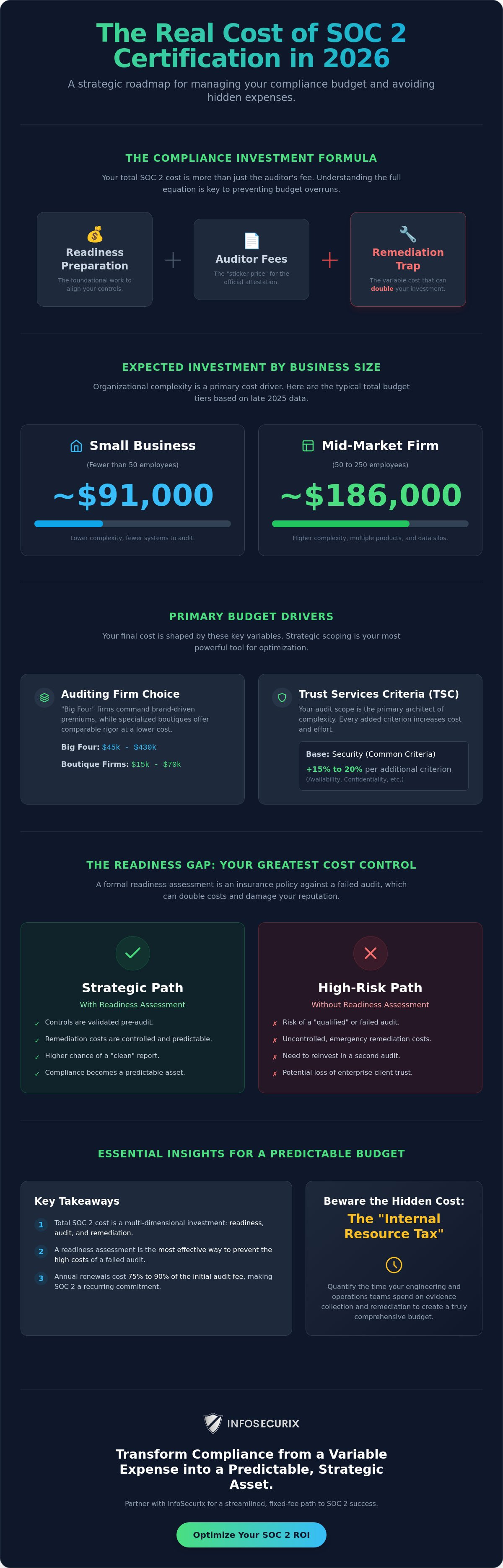
Organizational complexity scales your SOC 2 certification cost exponentially. For small businesses with fewer than 50 employees, total costs often hover around $91,000, while mid-market firms with 50 to 250 employees can expect to invest closer to $186,000. These figures, sourced from CyberArrow GRC in late 2025, reflect the reality of managing multiple products and global data silos. Opting for the lowest possible audit fee is a high-risk strategy. Inexpensive audits frequently result in “qualified” reports, which contain exceptions that many enterprise clients will reject. This failure forces you to reinvest in a secondary, more rigorous audit process, effectively doubling your initial expenditure.
Decoding the Primary Drivers of Your Compliance Budget
Identifying the variables that shape your SOC 2 certification cost requires a look beyond the surface of the auditor’s quote. The final figure is a reflection of your specific environment: your tech stack, your team size, and the breadth of the trust criteria you choose to evaluate. Strategic leaders recognize that these drivers aren’t just expenses; they’re levers that can be adjusted to optimize the return on your security investment. By understanding these components, you can transform an opaque financial requirement into a transparent, manageable roadmap for growth.
Selecting the right auditing firm is perhaps the most visible driver of your budget. According to June 2026 industry research, “Big Four” accounting firms often command fees between $45,000 and $430,000, reflecting their global brand equity and extensive resources. In contrast, specialized boutique firms frequently provide the same level of technical rigor for $15,000 to $70,000. While the prestige of a global firm may be necessary for some enterprise contracts, many organizations find that a seasoned, specialized partner offers a more bespoke experience at a sustainable price point.
Trust Services Criteria (TSC) and Scoping
The scope of your audit is the primary architect of its complexity. Every engagement begins with the Security criteria, often called the Common Criteria, but you may choose to add Privacy, Confidentiality, Processing Integrity, or Availability based on your clients’ needs. Each additional Trust Services Criterion typically increases audit fees by 15% to 20% due to the expanded testing and evidence requirements. Avoid the trap of over-scoping; excluding non-critical systems that don’t handle sensitive data can save thousands in both auditor hours and internal remediation efforts.
Infrastructure and Data Complexity
Your technical architecture plays a silent but significant role in determining costs. Operating in a multi-cloud environment, such as managing resources across both AWS and Azure, complicates the evidence collection process by requiring separate sets of controls and monitoring tools. Legacy systems also present a unique challenge. Older technology often lacks the native logging and security features required for modern compliance, making it more expensive to bring these systems up to standard. Engaging in a SOC2 Readiness Assessment allows you to identify these gaps early, transforming potential budget overruns into a controlled, predictable investment.
The maturity of your existing controls is the final piece of the puzzle. If your organization already practices disciplined risk management and maintains polished documentation, your “readiness” investment will be minimal. However, if you’re building a security program from the ground up, expect higher initial costs for policy development and staff training. Meticulous preparation today ensures that you don’t pay a premium for reactive fixes during the audit itself.
The Readiness Gap: Why Preparation is Your Greatest Cost Control
Investing in a preliminary review is the most effective way to safeguard your SOC 2 certification cost from spiraling out of control. Think of a readiness assessment as a strategic insurance policy. While an auditor’s fee is a known quantity, the financial fallout of a qualified report or a failed attestation is often catastrophic for a growing firm. Choosing to be proactive allows you to identify vulnerabilities in a controlled environment, ensuring that when the formal audit begins, your team is operating from a position of absolute strength. It’s the difference between a smooth, predictable process and a reactive scramble that drains both your budget and your internal morale.
A common pitfall is the belief that compliance software alone can bridge the gap. In reality, software tools act as diligent evidence collectors, while seasoned consultants serve as process architects. Software can flag a missing policy, but it cannot design a bespoke risk management framework that aligns with your unique business objectives. Relying solely on automation often leads to “Audit Friction,” where poor preparation results in endless, billable auditor follow-ups. Every hour an auditor spends untangling a disorganized control environment is an hour added to your final invoice. Meticulous preparation eliminates this friction, allowing the CPA to move through their testing with precision and speed.
The Value of an Independent Readiness Assessment
A formal gap analysis identifies “showstoppers” long before the CPA firm arrives on-site. Internal self-assessments, while well-intentioned, often suffer from a lack of independence and may overlook critical requirements that an external eye would catch immediately. Utilizing professional SOC 2 readiness assessment services provides a clear, documented roadmap for remediation. This structured approach ensures that your technical and administrative controls are not only present but are functioning exactly as the Trust Services Criteria require. It transforms the audit from a period of high-stakes uncertainty into a routine validation of your established excellence.
The Myth of the “Automation-Only” Approach
Automation platforms are excellent for monitoring technical controls, yet they frequently struggle with complex risk logic and nuanced business processes. This leads to the “False Positive” trap. Software-generated evidence can sometimes provide a skewed view of compliance, creating more work for auditors who must then manually verify the data. Human expertise remains indispensable for mapping controls to specific organizational risks. A seasoned advisor ensures that your security narrative is cohesive and defensible. By combining the efficiency of automation with high-level strategic guidance, you create a robust compliance program that stands up to the most rigorous scrutiny without unnecessary budget inflation.
Beyond the Audit Fee: Accounting for Indirect and Hidden Expenses
Calculating your total SOC 2 certification cost requires a transparent appraisal of the “Remediation Tax.” This represents the capital and labor required to bridge the gap between your current state and the rigorous Trust Services Criteria. Many leaders find that the auditor’s fee is actually the smaller portion of the total investment. Beyond the CPA’s invoice, you must account for specialized security tooling, legal reviews of vendor contracts, and the significant drain on your most valuable technical assets. These expenses are not merely hurdles; they are necessary investments in a resilient, enterprise-grade organization.
Continuous compliance also introduces recurring operational costs that must be factored into your long-term roadmap. Annual penetration testing, which generally costs between $5,000 and $15,000, is a standard requirement for most SOC 2 frameworks. You must also budget for ongoing security awareness training and the administrative time required for quarterly access reviews. Ignoring these recurring elements leads to a “compliance debt” that can make future audits significantly more expensive and stressful for your team.
Remediation: Tooling and Process Redesign
Achieving compliance often reveals a need for sophisticated security infrastructure that may not yet be fully implemented. You might need to invest in Multi-Factor Authentication (MFA), Mobile Device Management (MDM), or robust logging systems to meet specific control requirements. The administrative burden is equally substantial. Drafting the 20 or more policies required for a comprehensive framework takes dedicated expert time that few internal teams have to spare. For firms with physical locations, upgrades to access control systems or formal employee background check fees also add to the initial financial outlay.
Opportunity Cost: The Engineering Drain
The “Internal Resource Tax” is perhaps the most overlooked component of your SOC 2 certification cost. A CTO or Lead Engineer can easily spend hundreds of hours managing evidence collection and control implementation. This creates a “Product Delay” cost that is difficult to quantify but deeply felt. When your technical leadership is diverted toward compliance tasks, your primary product roadmap can slip by three months or more. This delay represents lost market opportunity and potential revenue that far exceeds the cost of professional support. Utilizing professional internal audit services allows your engineering team to remain focused on innovation while seasoned experts handle the complexities of the audit cycle.
By identifying these hidden drains early, you can build a predictable budget that supports your company’s growth rather than hindering it. Request a comprehensive budget consultation to identify and mitigate the hidden costs in your compliance journey.
Optimizing Your SOC 2 ROI with InfoSecurix
Mastering the financial complexities of compliance requires more than just a software license; it demands a partner with a proven legacy of success. InfoSecurix brings a 25 year history of professional excellence to your organization, ensuring that your SOC 2 certification cost remains a controlled, strategic investment rather than a runaway expense. Our philosophy is rooted in the principle of doing it right the first time. By leveraging our deep rooted knowledge, we help you eliminate the trial and error approach that often inflates the SOC 2 certification cost for unprepared firms.
We offer a fixed fee readiness model that provides absolute budget certainty from day one. This approach removes the risk of unexpected billable hours and ensures that your path to compliance is clear and predictable. Rather than acting as a distant auditor, we serve as a collaborative ally invested in your long term achievement. This partnership allows you to focus on your core business objectives while we handle the intricate details of the audit process.
Bespoke Corrective Action Plans
Our team doesn’t simply identify gaps; we design the most cost effective way to close them. We tailor controls to your specific business model to prevent compliance bloat, which often occurs when organizations implement generic, overly restrictive processes. Having a Seasoned Guide who understands exactly what auditors prioritize in 2026 ensures your security posture is both rigorous and efficient. This approach turns a complex technical hurdle into a streamlined operational advantage that protects your bottom line.
Future-Proofing Your Compliance Investment
Building a scalable framework allows your security program to grow alongside your revenue without a corresponding spike in overhead. We specialize in creating strategic alignment between SOC 2 and other international standards to maximize your efficiency. For example, integrating your efforts with ISO 27001 certification readiness can significantly reduce your total workload by leveraging overlapping controls. This holistic view extends to ISO 22301 business continuity, ensuring your organization is resilient against both technical failures and market shifts.
Transforming compliance from a mandatory cost into a competitive edge is the ultimate goal for visionary leaders. When your security standards are beyond reproach, you move from a position of defense to one of market leadership. Take the first step toward a predictable, successful audit today. Schedule a Strategic Consultation with InfoSecurix and secure your company’s future with confidence.
Securing Your Competitive Edge Through Strategic Compliance
Transitioning from a reactive to a proactive compliance posture is the hallmark of a mature enterprise. You’ve seen that the true SOC 2 certification cost is defined by your preparation rather than the auditor’s final invoice. By identifying hidden remediation taxes and accounting for the internal resource drain on your technical team, you can build a financial roadmap that supports sustainable growth. Strategic readiness ensures that your investment serves as a protective force for your company’s future; it’s a commitment to excellence that enterprise partners recognize and value.
InfoSecurix offers a steady hand to guide you through these technical and financial complexities. Utilizing over 25 years of compliance expertise and a proven track record with national enterprise clients, we provide the absolute confidence required to succeed. Our fixed fee readiness engagements eliminate budget uncertainty: they allow your team to focus on innovation while we manage the meticulous standards of the audit cycle. Secure Your SOC 2 Roadmap with InfoSecurix. Embarking on this journey with a seasoned guide ensures your security standards remain beyond reproach and your business stays future proof.
Frequently Asked Questions
How much does a SOC 2 audit typically cost in 2026?
Total SOC 2 certification cost for a small organization typically starts around $91,000 when considering all preparation and audit requirements. Mid-sized firms with 50 to 250 employees should budget closer to $186,000. These figures reflect the comprehensive nature of a successful engagement; they include the audit fee, technical remediation, and internal resource allocation.
Is a SOC 2 readiness assessment worth the extra cost?
A formal readiness assessment is an essential investment that prevents the much higher costs of a failed audit. It identifies critical control gaps in a controlled environment so you can fix them before the CPA firm begins their testing. This proactive step ensures your final report is clean and acceptable to enterprise partners.
What is the difference in cost between a Type 1 and Type 2 audit?
A Type 2 audit generally costs two to three times more than a Type 1 report because it requires significantly more auditor hours to verify control effectiveness over time. While a Type 1 audit provides a snapshot of your environment, a Type 2 evaluates performance over a 3 to 12 month period. This extended scope provides the high level of assurance that enterprise buyers demand.
Can software automation platforms replace a SOC 2 consultant?
Automation platforms serve as excellent evidence collectors, but they cannot replace the strategic oversight of a seasoned consultant. Software lacks the ability to design bespoke risk frameworks or write policies that align with your specific business objectives. A consultant acts as a process architect who ensures your security narrative is both cohesive and defensible during a rigorous audit.
What are the most common “hidden costs” in SOC 2 compliance?
The most frequent hidden expenses include the “Remediation Tax” for new security tools and the “Internal Resource Tax” on your engineering team’s time. You should also budget for annual penetration testing, which typically ranges from $5,000 to $15,000. Legal fees for reviewing vendor agreements and employee background check costs are other common surprises that can impact your total SOC 2 certification cost.
How long does the SOC 2 process take from start to finish?
Most organizations should expect the entire journey to span between 6 and 18 months depending on their initial maturity. The preparation and remediation phase often takes 3 to 9 months of focused effort. Once the audit begins, a Type 1 report is delivered quickly; however, a Type 2 report requires an observation period of at least 3 to 12 months.
Are SOC 2 costs tax-deductible for my business?
Professional fees related to security audits and compliance readiness are typically considered ordinary and necessary business expenses for tax purposes. While you should consult with a qualified tax advisor for your specific situation, these costs are generally deductible in the year they are incurred. This deduction can help offset the initial investment required to achieve a high standard of security.
How can a small startup reduce their SOC 2 certification expenses?
Startups can significantly lower their expenses by strictly limiting the audit scope to the “Security” Trust Services Criterion alone. Choosing a specialized boutique CPA firm instead of a “Big Four” giant can also save tens of thousands of dollars without sacrificing the quality of the report. Early preparation and clear documentation further reduce billable auditor hours by eliminating unnecessary friction during the testing phase.