

With the average cost of a U.S. data breach reaching $10.22 million in 2026, the margin for operational error has effectively vanished. You likely recognize that organizational resilience is the cornerstone of modern corporate excellence, yet mastering how to conduct a business impact analysis remains a significant challenge when faced with departmental silos and data fatigue. Many leaders find themselves caught between the confusion of a BIA versus a standard Risk Assessment and the persistent anxiety of setting recovery timelines that look impressive on paper but fail during a real-world crisis.
This guide introduces a sophisticated 2026 framework designed to identify critical dependencies while defining defensible Recovery Time Objectives (RTO) and Recovery Point Objectives (RPO). We’ll explore a methodical process for extracting accurate data from department heads and translating those insights into a strategic narrative for stakeholders. By following this repeatable methodology, you’ll secure the executive-level buy-in necessary to ensure your organization remains a steady, protective force in an era where global cybercrime costs are forecasted to exceed $10.5 trillion. Through this lens of precision and foresight, you can transform mandatory compliance into a visionary advantage.
Key Takeaways
- Distinguish between risk identification and impact analysis to ensure your resilience strategy addresses actual operational consequences rather than just hypothetical threats.
- Implement a meticulous five-step framework on how to conduct a business impact analysis to identify critical dependencies and satisfy ISO 22301 standards.
- Establish defensible recovery metrics, including RTO and RPO, that accurately reflect your organization’s true threshold for downtime and data loss.
- Streamline the data collection process by utilizing structured engagement techniques that secure accurate information and long-term buy-in from department leaders.
- Bridge the gap between technical recovery and strategic growth by aligning your business continuity efforts with executive-level resilience and investment objectives.
What is a Business Impact Analysis (BIA) in the Modern Enterprise?
A Business Impact Analysis (BIA) serves as the strategic blueprint for organizational survival. It is a systematic, data-driven process used to determine the potential effects of an interruption to critical business operations. While many leaders understand the broad concept of preparedness, knowing exactly how to conduct a business impact analysis is what separates a resilient enterprise from one that merely reacts to chaos. It functions as the foundational pillar of any robust Business Continuity Management System (BCMS), providing the empirical evidence needed to justify every subsequent recovery effort.
It’s vital to distinguish the BIA from a disaster recovery plan. The BIA provides the “why” and the “when” by identifying which processes are most critical and how quickly they must return to service. The recovery plan, by contrast, provides the “how” through technical steps and logistics. In 2026, this distinction is more critical than ever. As supply chains become increasingly fragmented and digital interdependencies deepen, a failure in one obscure vendor can trigger a cascade of operational collapses. The BIA clarifies these hidden links, ensuring that your resilience strategy isn’t built on guesswork or outdated assumptions.
The Strategic Imperative for Resilience
A well-executed BIA isn’t just a compliance checkbox; it’s an executive roadmap for intelligent capital allocation. By quantifying the financial and operational fallout of downtime, the analysis allows leadership to prioritize investments in high-impact areas. This shift moves the organization away from expensive, reactive firefighting and toward a posture of proactive resilience. Beyond internal efficiency, the BIA builds indispensable stakeholder trust. In an era of heightened transparency, showing that your business can withstand severe ICT disruptions is a competitive advantage that satisfies both board members and modern regulatory mandates like the Digital Operational Resilience Act (DORA). For companies managing international footprints, CiDATax SRL provides the specialized tax and regulatory services required to ensure fiscal compliance remains intact even during significant operational challenges.
BIA as a Requirement for ISO Standards
For organizations pursuing international recognition, the BIA is a non-negotiable requirement. ISO 22301 Clause 8.2.2 specifically mandates a formal BIA process to establish the context for business continuity. This rigorous data collection also supports ISO 27001 certification readiness by identifying the critical information assets that require the highest levels of protection. When an auditor reviews your BCMS, they’ll scrutinize the BIA first. It serves as the primary evidence for your recovery time objectives, proving that your resilience targets are based on operational reality rather than optimistic assumptions. Mastering how to conduct a business impact analysis ensures that your certification journey is grounded in defensible, high-quality data.
A Meticulous 5-Step Framework to Conduct a BIA
The transition from theoretical resilience to operational reality requires a structured approach. Understanding how to conduct a business impact analysis involves more than distributing a few spreadsheets; it demands a disciplined framework that mirrors the complexity of your business. By following a methodical sequence, you ensure that no critical dependency is overlooked and that the final output is both defensible and actionable.
- Step 1: Project Initiation and Scoping. Defining the boundaries is the first critical hurdle. You must determine which business units or geographical locations are within the scope to ensure the data remains manageable yet comprehensive.
- Step 2: Information Gathering. This phase involves utilizing bespoke surveys and structured interviews with process owners. According to the guidance on Business Impact Analysis (BIA), identifying the timing and duration of impacts is essential for an accurate assessment.
- Step 3: Impact Analysis. Here, you quantify the consequences of disruption. This includes financial loss, operational backlogs, legal non-compliance, and the often-overlooked erosion of brand reputation over time.
- Step 4: Reporting and Prioritization. Raw data is synthesized into a strategic ranking of critical business functions. You aren’t just listing functions; you’re identifying the vital few that sustain the organization’s core mission.
- Step 5: Executive Approval. The final step is formalizing findings to secure resource commitment. Without leadership’s signature, the analysis remains a theoretical exercise rather than a pillar of organizational policy.
Mastering the Information Gathering Phase
Designing surveys that capture interdependencies is vital. You need to look at upstream suppliers and downstream customers to see the full picture. While surveys provide a broad baseline, face-to-face interviews often reveal the nuanced risks that digital forms miss. These conversations frequently unearth “Single Points of Failure,” such as a proprietary software process known only to one retiring engineer or a specific hardware component with no secondary source. Engaging with experts who specialize in Business Continuity can help refine these discovery sessions to ensure no stone is left unturned.
Synthesizing Data into Actionable Intelligence
Normalizing data across diverse departments requires an impact rating scale, typically ranging from 1 to 5. This allows a direct comparison between a manufacturing delay and a payroll failure. To reconcile conflicting priority claims from different department heads, leadership must apply a standardized corporate lens that weighs each function against the organization’s overarching strategic objectives. Documenting every assumption is equally important. This practice maintains audit-readiness, ensuring that when regulators or partners review your work, they see a logical, defensible path. Mastering how to conduct a business impact analysis means creating a narrative of resilience that survives even the most rigorous scrutiny.
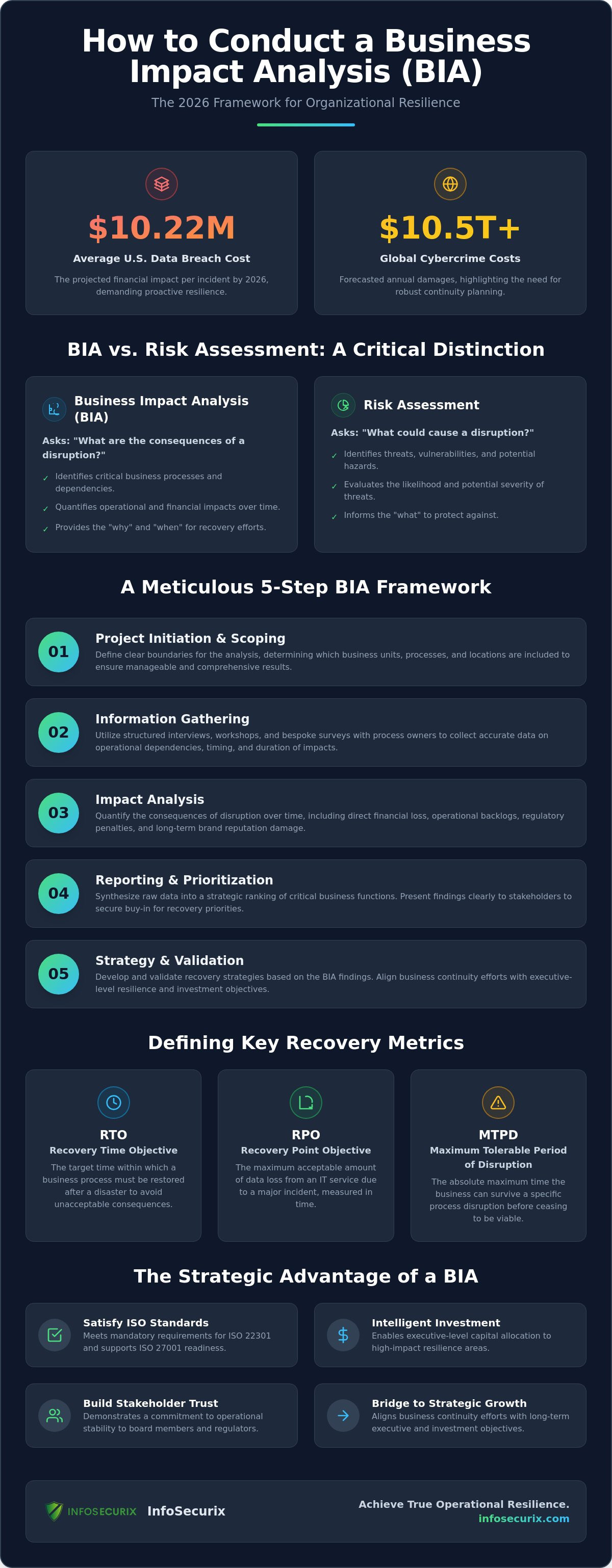
BIA vs. Risk Assessment: Deciphering the Interdependencies
Many organizations conflate Risk Assessment with Business Impact Analysis, yet they serve as two distinct sides of the same resilience coin. A Risk Assessment essentially asks, “What could happen?” by identifying specific threats like ransomware, supply chain failures, or natural disasters. Conversely, the BIA asks, “What happens if a process stops?” This distinction is vital because the BIA remains agnostic to the cause: whether a server room floods or a cyberattack occurs, the impact on payroll or customer service remains the same. Understanding this nuance is a prerequisite for anyone learning how to conduct a business impact analysis that actually withstands the scrutiny of a rigorous audit.
Conducting a BIA without a prior Risk Assessment creates a strategic blind spot where you might prepare for the wrong scenarios. Conversely, a Risk Assessment without a BIA lacks the context of time: you might know a risk is likely, but you won’t know how long you can afford to let it persist. By focusing on the consequence rather than the catalyst, the BIA provides a steady baseline for recovery that isn’t swayed by the shifting threat landscape of 2026.
Comparison Framework: Purpose, Scope, and Outcomes
The relationship between these two disciplines is defined by their unique focus areas and the specific intelligence they provide to leadership.
- Scope: The BIA focuses exclusively on business functions and their internal or external dependencies, while the Risk Assessment scrutinizes specific threats and vulnerabilities within the environment.
- Outcome: A BIA defines the recovery timelines, such as RTO and RPO, necessary for survival. A Risk Assessment defines the mitigation strategies and controls used to prevent or reduce the likelihood of an event.
- Timing: Ideally, the BIA follows an initial high-level risk identification phase. This sequence allows you to focus the deep-dive analysis on the areas already flagged as potentially vulnerable or high-priority.
The Feedback Loop: How BIA Informs Risk Mitigation
The BIA doesn’t exist in a vacuum; it creates a powerful feedback loop that informs your broader risk strategy. By quantifying the financial and operational fallout of a disruption, the BIA provides the empirical data needed to justify the ROI of specific risk controls. It effectively identifies the “Criticality” component of the risk equation, helping leadership understand which systems deserve the most robust safeguards. Integrating these insights with modern risk assessment strategies ensures that your security investments are aligned with actual business needs rather than technical assumptions.
Mastering how to conduct a business impact analysis within this integrated ecosystem ensures a comprehensive defense-in-depth posture. This synergy is exactly what seasoned consultants look for when evaluating an organization’s maturity. It transforms the BIA from a standalone data collection exercise into a visionary tool that future-proofs the entire enterprise against both known and unknown disruptions.
Defining Recovery Metrics: RTO, RPO, and MTPD
The success of your resilience strategy hinges on the precision of your recovery metrics. As you refine your approach to how to conduct a business impact analysis, you must move beyond vague estimates and toward rigorous, time-bound objectives. These metrics aren’t merely technical targets; they’re the contractual promises you make to your stakeholders, customers, and regulators. To build a defensible framework, you must define three core variables: the Recovery Time Objective (RTO), the Recovery Point Objective (RPO), and the Maximum Tolerable Period of Disruption (MTPD).
- Recovery Time Objective (RTO): This represents the maximum duration of time within which a business process must be restored after a disruption to avoid unacceptable consequences.
- Recovery Point Objective (RPO): This defines the maximum age of files that must be recovered from backup storage for operations to resume. It essentially dictates your data loss tolerance.
- Maximum Tolerable Period of Disruption (MTPD): This is the point where the disruption becomes terminal. If a process is not restored before reaching the MTPD, the organization may face irreparable harm or total collapse.
The hierarchy among these metrics is uncompromising: your RTO must always be significantly shorter than your MTPD. If your recovery timeline exceeds the window of survival, your continuity plan exists only on paper. Ensuring this buffer allows for the inevitable friction that occurs during a real-world crisis.
Calculating the Financial Threshold of Survival
Determining your MTPD requires a cold, analytical look at your organization’s vital signs. You must calculate the point at which liquidity dries up, contractual penalties become insurmountable, or regulatory fines exceed your capital reserves. A seasoned guide will tell you to avoid the common trap of demanding “Zero RTO” for every department; such an approach is prohibitively expensive and often unnecessary. For cloud-native enterprises, the RPO defines the absolute threshold of data loss that the organization can sustain before the integrity of its digital ecosystem is permanently compromised. Balancing these costs against the reality of your budget is a hallmark of sophisticated leadership.
Aligning IT Capabilities with Business Requirements
There is often a significant gap between what the business “wants” in terms of recovery and what the current IT infrastructure can actually “deliver.” You should use the BIA as a high-level advocacy tool to bridge this divide, using data to secure investments for redundant systems or infrastructure upgrades. Regular internal audits play a vital role here: they validate that your stated RTOs are achievable in a live environment rather than just being optimistic projections. If your current capabilities don’t match your survival requirements, it’s time to engage with a partner who specializes in ISO 22301 Business Continuity to fortify your operational foundation. Mastering how to conduct a business impact analysis ensures that your organization doesn’t just survive a disruption but emerges from it with its reputation and assets intact.
Achieving Operational Resilience with InfoSecurix
Mastering the technical nuances of how to conduct a business impact analysis is a vital prerequisite for survival, yet implementing that knowledge within a complex corporate structure requires a seasoned perspective. InfoSecurix stands as the authoritative partner for organizations navigating these high-stakes resilience landscapes. Our readiness assessments are designed to identify critical BIA gaps long before they manifest as audit failures or, worse, operational collapses during a crisis. We provide the clarity needed to transform raw data into a strategic shield for your enterprise.
With over 25 years of specialized expertise in ISO 22301, ISO 27001, and SOC2 compliance, we bring a level of precision that generic templates cannot match. Our team has seen every possible disruption scenario, allowing us to remain unfazed by complexity while projecting a sense of absolute security for our clients. We don’t just offer a service; we offer a protective force that enables your organization to grow with confidence, knowing your foundational standards are meticulous and future-proof.
Bespoke Business Continuity Consulting
Sustainable growth is only possible when your Business Continuity Management System (BCMS) is a custom fit for your specific operational DNA. We move beyond the superficial to help leaders quantify the deep reputational and legal impacts that occur in an interconnected, globalized market. Our strategic corrective action planning is designed to bridge the divide between your current state and the ambitious RTOs required for modern survival. By aligning your recovery objectives with your overarching business mission, we ensure your resilience strategy is both visionary and grounded in reality.
The InfoSecurix Advantage
Our approach is rooted in a collaborative partnership that prioritizes long-term operational resilience over the mere act of “passing the audit.” With a national reach and a legacy of success across diverse industries, our authoritative guidance instills absolute confidence in board-level stakeholders. We act as a seasoned guide, ensuring that your resilience investments are prioritized correctly and defended with empirical evidence. This methodical, top-down approach ensures that every stakeholder understands the value of the standards being implemented.
Future-proofing your operations against unforeseen disruptions requires more than a checklist. It requires a partner who is invested in your long-term success and capable of navigating the most complex regulatory environments. We invite you to engage in a strategic consultation to see how our expertise can fortify your organization against the uncertainties of 2026 and beyond.
Partner with InfoSecurix for Expert BIA and Resilience Planning
Future-Proof Your Enterprise Through Strategic Resilience
Establishing a robust Business Continuity Management System is no longer a luxury for the modern enterprise; it’s a fundamental requirement for longevity. By mastering the nuances of how to conduct a business impact analysis, you provide your organization with the empirical data necessary to survive severe ICT disruptions. This strategic framework ensures that your recovery metrics are not just optimistic goals but are instead defensible targets grounded in operational reality. When you align these insights with a comprehensive risk assessment, you create a seamless loop of identification and mitigation that protects your brand’s reputation and financial stability.
InfoSecurix brings over 25 years of specialized security and compliance experience to your side. Our national expertise in ISO 22301, ISO 27001, and SOC2 ensures your business meets the most rigorous international standards: we utilize a proven methodology for executive-level risk and impact reporting. We invite you to Secure Your Organizational Resilience with InfoSecurix and transform your compliance obligations into a visionary advantage. Your path to a steadfast and secure future begins with a single, deliberate step toward excellence.
Frequently Asked Questions
Is a Business Impact Analysis mandatory for ISO 22301?
A Business Impact Analysis is a mandatory requirement for ISO 22301:2019 compliance. Specifically, Clause 8.2.2 requires organizations to implement and maintain a formal process to determine the impacts of disruptive incidents over time. This data provides the objective evidence auditors need to verify that your recovery strategies are based on actual business requirements rather than arbitrary technical guesses.
What is the first step in conducting a BIA?
The first step in how to conduct a business impact analysis is project initiation and scoping. This phase involves defining the boundaries of the analysis, identifying which business units are included, and securing formal executive support. Establishing a clear scope prevents the analysis from becoming an unmanageable data collection exercise while ensuring that all critical dependencies are captured within the final report.
How often should a Business Impact Analysis be updated?
You should update your Business Impact Analysis at least annually or whenever significant changes occur within your organizational structure. Major shifts in technology stacks, supply chain partners, or internal business processes can quickly render previous data obsolete. Regular reviews ensure that your recovery objectives remain aligned with your current operational reality and continue to satisfy international standards.
What is the difference between RTO and MTPD?
The Recovery Time Objective (RTO) is the target duration for restoring a process, while the Maximum Tolerable Period of Disruption (MTPD) is the point where failure becomes terminal for the organization. Your RTO must always be shorter than the MTPD to provide a necessary buffer for survival. This hierarchy ensures that even if recovery takes longer than planned, the organization stays within its survival window.
Who should be involved in the BIA process?
Successful BIA execution requires collaboration between department heads, process owners, IT specialists, and executive leadership. Department heads provide the granular data on operational dependencies, while IT evaluates the technical feasibility of proposed recovery targets. Executive involvement remains crucial for final approval, ensuring that the prioritized recovery list reflects the organization’s strategic mission and long-term goals.
Can a BIA be used to justify cybersecurity budgets?
A BIA is an exceptionally effective tool for justifying cybersecurity and resilience budgets to board-level stakeholders. By quantifying the financial and operational consequences of downtime, you provide leadership with a clear ROI for security investments. It transforms technical requests into a strategic narrative that decision-makers can easily understand, facilitating the capital allocation needed for redundant systems or infrastructure upgrades.
What are the most common mistakes in BIA documentation?
Common mistakes include assigning a “critical” priority to every business function and failing to document upstream or downstream dependencies. When every process is labeled as a top priority, the organization’s ability to respond effectively during a crisis is compromised. Another frequent error is using vague qualifiers instead of precise, time-bound objectives, which often leads to audit non-conformities and unrealistic recovery expectations.
How does a BIA differ from a Risk Assessment?
While a Risk Assessment identifies specific threats and their likelihood, a BIA focuses exclusively on the consequences of a disruption regardless of its cause. The BIA remains agnostic to the catalyst of the failure, concentrating instead on how long a process can be offline before the impact becomes unacceptable. Mastering how to conduct a business impact analysis alongside a risk assessment creates a comprehensive, defense-in-depth strategy for the modern enterprise.