

Nearly 70% of global organizations depend on structured IT service management frameworks to ensure reliability; however, many still struggle to translate technical checklists into tangible business outcomes. You likely understand the frustration of inconsistent service quality or the daunting weight of rigorous documentation. Maintaining excellence across hybrid cloud environments and AI-driven workflows requires more than just effort. It demands a sophisticated, standardized approach. We recognize that an iso 20000 implementation can feel like a hurdle rather than a catalyst. It’s a complex undertaking, but it remains the definitive path to establishing a truly predictable, scalable operation.
This strategic guide provides a professional roadmap to master these complexities and transform your IT department into a high-value service delivery engine. Adopting this curated framework allows you to establish a globally recognized benchmark for excellence while improving customer satisfaction through precise service levels. We will examine the methodical steps required to future-proof your organization, moving from a high-level vision of service maturity to the systematic realization of a resilient, world-class IT infrastructure.
Key Takeaways
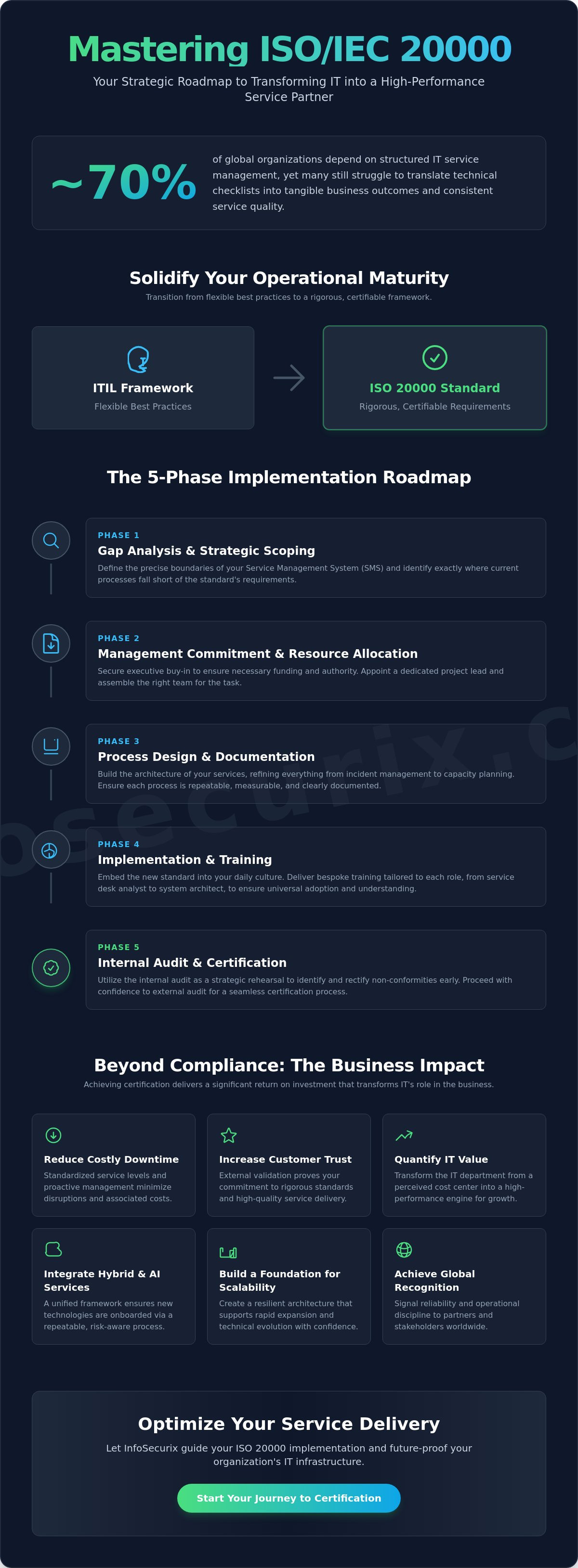
- Master the 5-phase roadmap to define your Service Management System boundaries and secure critical executive alignment from the outset.
- Transition from the flexible best practices of ITIL to the rigorous, certifiable requirements of ISO 20000 to solidify your operational maturity.
- Utilize the internal audit as a strategic rehearsal: identifying non-conformities early to ensure a seamless certification process.
- Execute a professional iso 20000 implementation to transform your IT department from a technical cost center into a high-performance service partner.
- Leverage bespoke strategies designed to integrate hybrid cloud and AI-driven services into a unified, globally recognized benchmark of excellence.
The Strategic Value of ISO 20000 Implementation in 2026
Elevating IT service management requires a decisive shift from reactive fire-fighting to a structured, outcome-oriented model. The ISO/IEC 20000 standard serves as the premier international benchmark for Service Management Systems (SMS), providing a rigorous framework that ensures IT services align perfectly with business objectives. Executing a successful iso 20000 implementation isn’t merely a box-ticking exercise for the IT department. Instead, it represents a fundamental paradigm shift. Organizations move away from basic technical troubleshooting toward a model of professional service delivery that mirrors the sophistication of the global enterprises they serve. This transition fosters a sense of absolute confidence, positioning the IT function as a steady, reliable partner that enables rather than hinders growth.
The operational demands of 2026 make this standard an absolute necessity for forward-thinking enterprises. Modern IT leaders face the daunting task of managing sprawling hybrid cloud environments while simultaneously integrating complex AI-driven services. Without a standardized framework, these layers of technology create friction, fragmented workflows, and unpredictable service gaps. Certification acts as a powerful signal of reliability in a crowded market. It demonstrates to global partners that your operations are governed by discipline and precision. Achieving this benchmark proves you’ve moved beyond the “break-fix” mentality to embrace a visionary approach to service excellence.
Beyond Compliance: The Business Impact
Focusing on the strategic impact of technical processes reveals a significant return on investment that goes far beyond simple compliance. Standardized service levels directly reduce costly downtime and eliminate the redundant, fragmented processes that often plague growing organizations. When service management is externally validated, customer trust increases significantly. They don’t have to take your word for it; the certification proves your commitment to rigorous standards. This clarity allows executive leaders to quantify the value of IT, transforming a perceived cost center into a high-performance engine for growth and customer satisfaction.
ISO 20000 as a Foundation for Scalability
A formal SMS creates a resilient architecture that supports rapid expansion and technical evolution. As new technologies emerge, a structured iso 20000 implementation ensures that onboarding follows a repeatable, risk-aware process rather than an ad-hoc scramble. This future-proofs your operations against evolving regulatory demands and shifting market pressures. By integrating service management with broader corporate governance frameworks, you ensure that IT isn’t a siloed function. Instead, it becomes a deeply embedded, collaborative ally invested in the company’s long-term success and stability.
The 5-Phase Roadmap to a Certified Service Management System
Achieving certification requires a methodical, top-down strategy that transforms abstract standards into operational reality. This journey isn’t a sprint; it’s a deliberate progression through five distinct phases designed to ensure your Service Management System (SMS) remains both robust and flexible. By following this roadmap, you’ll avoid the common pitfalls of fragmented execution and ensure every team member understands their role in the new service culture. It’s about building a legacy of excellence that survives long after the initial audit is complete.
- Phase 1: Gap Analysis and Strategic Scoping. You must define the precise boundaries of your SMS and identify exactly where current processes fall short of the standard’s requirements.
- Phase 2: Management Commitment and Resource Allocation. Securing executive buy-in is the only way to ensure the project has the necessary funding and authority. This phase involves appointing a dedicated project lead and ensuring the “right” people are assigned to the task, not just those who are currently available.
- Phase 3: Process Design and Documentation. This involves building the actual architecture of your services. You’ll refine everything from incident management to capacity planning, ensuring each process is repeatable and measurable.
- Phase 4: Implementation and Training. You embed the standard into daily culture. Training must be bespoke; a system architect requires a different level of detail than a service desk analyst to ensure everyone understands how their specific work impacts the broader SMS.
- Phase 5: Internal Audit and Continual Improvement. This final check identifies any remaining non-conformities before the formal certification body arrives, allowing you to refine your approach based on real-world performance data.
If you’re looking for a partner to navigate these phases with precision, our team provides professional implementation support tailored to your enterprise’s unique scale and technical scope.
Executing the Gap Analysis
The first step in any iso 20000 implementation involves a deep dive into your existing maturity level. While many organizations already use ITIL best practices, there’s often a significant delta when moving toward a certifiable requirement. Scholarly research on ITIL and ISO 20000 implementation highlights that the transition requires shifting from “suggested” activities to “mandatory” controls. You must map your existing controls against the 2026 version of the standard, prioritizing remediation efforts based on business risk. This ensures you address the most critical service impacts first, creating immediate value for stakeholders and building momentum for the rest of the project.
Documentation and Process Maturation
Effective documentation shouldn’t be a burden; it should be a lean set of tools that support your staff. We focus on creating a documentation set that provides absolute clarity without adding unnecessary bureaucracy. A key part of this maturation is linking your Service Level Agreements (SLAs) directly to business outcomes rather than just technical uptime. This helps everyone see the strategic impact of their work. Finally, you must establish a culture of “Plan-Do-Check-Act” (PDCA). This iterative cycle ensures your IT functions don’t just reach a benchmark and stop, but instead enter a state of perpetual improvement and resilience.
Core Requirements: Bridging the Gap Between ITIL and ISO 20000
While ITIL provides a comprehensive library of best practices, it doesn’t demand strict adherence. The ISO/IEC 20000-1:2018 standard, however, mandates specific, auditable outcomes. During an iso 20000 implementation, your team must shift their mindset. They’re no longer just following suggestions; they’re meeting requirements that will be scrutinized by external experts. The Service Management System (SMS) functions as the centralized hub for this effort. It ensures that every process, from capacity planning to information security, is interconnected and governed by a single, cohesive vision. This structural integrity is what separates a world-class IT operation from one that is merely functional.
Managing the Service Portfolio requires a holistic view of the entire lifecycle. You aren’t just maintaining current services. You’re governing them from initial design through to retirement. This ensures that new offerings are properly vetted for risk and resource impact before they go live. For organizations relying on external partners, SpaceCenter Systems offers expert guidance on aligning vendor performance with these rigorous service standards. Don’t overlook the human element. The standard requires concrete evidence of competence and awareness. Your staff must understand how their individual actions contribute to the success of the SMS. Clear, consistent communication is the bedrock of this cultural shift. It builds trust and ensures everyone is pulling in the same direction.
Mapping ITIL Processes to ISO 20000
Many organizations find that their existing Service Desk and Incident Management processes are already mature. However, certification demands a higher level of rigor and traceability. You’ll need to integrate specific ISO 20000 requirements into these daily workflows. Change, Release, and Deployment management often require the most adjustment. These processes must be tightly controlled to prevent unauthorized modifications that could destabilize the service environment. It’s about creating a predictable, high-performance delivery engine that stakeholders can rely on without hesitation.
The Documentation Hierarchy
Establishing a clear documentation hierarchy is essential for operational clarity. Policies set the rules of engagement, while procedures provide the step-by-step instructions for execution. Service Level Management should move beyond simple uptime metrics. It’s better to focus on service quality indicators that reflect actual business value. Your documentation must remain “live” to be effective. If it doesn’t reflect your operational reality, it’s just paper. Keeping these records updated ensures your team always has a reliable source of truth to guide their decisions and maintain service excellence.
Preparation and Internal Audit: Ensuring Certification Success
The internal audit serves as a critical strategic rehearsal for your organization. It’s the moment where the theoretical design of your iso 20000 implementation meets the reality of daily operations. By identifying non-conformities early, you prevent costly delays during the formal certification process. This objective assessment is a cornerstone of a successful iso 20000 implementation, providing the clarity needed to proceed with confidence. Selecting the right team is paramount; auditors must possess both technical proficiency and absolute independence to provide an unbiased assessment of the SMS. A developer should not audit their own deployment processes, just as a service desk manager should not evaluate their own incident logs. This objectivity ensures that the audit findings are credible and actionable.
Management Review meetings provide the necessary evidence of leadership involvement that external auditors specifically look for. These sessions aren’t mere status updates. They’re high-level evaluations of the system’s effectiveness and alignment with corporate strategy. When gaps are found, moving beyond quick fixes is essential. Implementing a rigorous Root Cause Analysis (RCA) ensures that systemic improvements are made, preventing the same issues from resurfacing. This methodical approach reflects the maturity of a seasoned IT organization that remains calm under the pressure of external scrutiny.
The Pre-Certification Checklist
Ensuring absolute readiness requires a granular approach to detail. You must verify that all ISO 20000 audit preparation steps are complete and documented. Conduct brief staff interviews to ensure everyone, from junior technicians to senior architects, understands the SMS policies. Auditors will look for evidence of continual improvement and corrective actions. They want to see that your organization doesn’t just follow rules, but actively seeks to refine them through a structured, data-driven process.
Navigating the External Audit
The formal certification process typically unfolds in two distinct stages. Stage 1 focuses on a documentation review to confirm the SMS meets the standard’s requirements. Stage 2 is the operational audit, where the registrar verifies that you actually do what your documents say you do. Manage this process with transparency and professional conduct. If findings occur, treat minor non-conformities as growth opportunities rather than failures. Addressing these with a proactive mindset demonstrates a commitment to long-term excellence and a legacy of success.
If you’re ready to validate your service maturity, our experts provide comprehensive Internal Audit services to ensure your organization is fully prepared for certification success.
Optimizing Your Service Delivery with InfoSecurix
Achieving a state of operational excellence in 2026 requires a partner that understands the nuances of decentralized IT and AI-integrated workflows. InfoSecurix brings over 25 years of compliance expertise to your iso 20000 implementation; this ensures that your journey is guided by a seasoned veteran who remains unfazed by technical complexity. We don’t just help you reach the finish line of certification. We build a foundation for long-term resilience that protects your organization against future market disruptions. By leveraging our deep-rooted knowledge, you can transform your service management from a necessary requirement into a competitive advantage that resonates with global enterprise partners.
Bespoke implementation strategies are essential for modern enterprises that operate across sprawling hybrid cloud environments. We tailor our approach to your specific scope, ensuring that the framework we build supports your unique business goals. Our strategic readiness assessments are designed to identify potential roadblocks before they become costly delays, significantly reducing the pressure on your internal staff. This methodical preparation allows your team to maintain their focus on core business objectives while we secure your operational legacy. It’s about creating a protective force that enables your growth without sacrificing the precision required by the standard.
Our Collaborative Approach
We act as a trusted advisor to your IT leadership, driving meaningful change that goes beyond surface-level adherence. Our process moves your organization from basic readiness to true excellence through targeted corrective actions and meticulous process refinement. Choosing a specialized information security consulting firm provides you with access to a higher register of expertise that generalist auditors cannot match. This partnership is built on trust, reliability, and a shared commitment to your long-term success. We remain a collaborative ally, invested in ensuring your iso 20000 implementation delivers measurable value to your stakeholders.
Securing Your Future
True resilience is found in the integration of various management standards. We help you align your service delivery with other critical frameworks, such as ISO 27001 certification readiness, to create a unified protective force for your business. This holistic view ensures you maintain a state of constant audit-readiness, allowing you to respond to new regulatory requirements with absolute confidence. Complementing your service management framework with a robust iso 22301 business continuity strategy further strengthens your organization’s ability to withstand major disruptions and satisfy the growing demands of global regulators. Your journey toward IT service excellence is an ongoing commitment to quality. Contact InfoSecurix for a confidential consultation to discuss your service management goals and begin the process of future-proofing your enterprise through meticulous current-day standards.
Securing Your Operational Legacy Through Standardized Excellence
Establishing a world-class IT service management system isn’t a one-time project. It’s a continuous journey toward operational maturity and deep-rooted customer trust. You’ve seen how a structured iso 20000 implementation transforms reactive troubleshooting into professional service delivery. By bridging the gap between ITIL best practices and certifiable requirements, your organization gains a scalable framework designed for the AI-driven landscape of 2026. This methodical approach ensures your IT operations remain a high-value engine for business growth.
Navigating this complexity requires a seasoned guide. InfoSecurix brings over 25 years of specialized compliance expertise to every engagement. Our proven track record with ISO 27001, 20000, and SOC2 standards ensures your path to certification is steady and predictable. We utilize a collaborative, partnership-driven consulting model that prioritizes your unique enterprise goals and future-proofs your operations. Our expertise allows your team to focus on innovation while we secure your compliance foundation.
Contact InfoSecurix for a Strategic ISO 20000 Readiness Assessment.
Your commitment to these rigorous standards today secures your organization’s growth and reputation for years to come. We look forward to helping you achieve a new benchmark of IT excellence.
Frequently Asked Questions
What is the primary difference between ITIL and ISO 20000 implementation?
ITIL provides a comprehensive library of best practices that suggest how to manage services, whereas ISO 20000 establishes a certifiable standard with mandatory requirements. While ITIL offers flexibility in adoption, an iso 20000 implementation requires strict adherence to specific controls that an external auditor must verify. Many organizations utilize ITIL as a foundational framework to mature their processes before seeking the formal recognition that only ISO certification provides.
How long does a typical ISO 20000 implementation project take for an enterprise?
An enterprise implementation typically spans six to eighteen months depending on the organization’s size and current process maturity. This timeline allows for a methodical progression through gap analysis, documentation, and staff training without disrupting daily operations. A deliberate pace ensures that new service management habits are deeply embedded into the corporate culture, which is essential for passing the initial certification audit.
Is ISO 20000 certification mandatory for IT service providers?
Certification is not legally mandatory, but it’s frequently a prerequisite for high-value government and enterprise contracts. It serves as a powerful signal of reliability and professional excellence to global partners. Organizations in sectors like finance and healthcare often seek certification to provide stakeholders with absolute confidence in their service delivery and risk management capabilities.
Can ISO 20000 be implemented alongside ISO 27001 for information security?
Yes, implementing these standards together is highly efficient because they share a common high-level structure designed by ISO. This alignment allows you to integrate service management with security controls, reducing redundant documentation and streamlining internal audits. A unified approach ensures that information security is a core component of every IT service you deliver rather than an isolated function.
What are the most common pitfalls during the ISO 20000 implementation process?
The most frequent pitfalls include a lack of executive buy-in and the creation of overly complex documentation that hinders rather than helps staff. Some organizations fail by treating the project as a one-time technical task instead of a long-term cultural shift toward excellence. Success requires clear communication and a commitment to the Plan-Do-Check-Act cycle to ensure the system remains effective after the auditor leaves.
How much does it cost to implement ISO 20000 in a mid-sized organization?
The total investment depends on factors such as the complexity of your IT services, the maturity of existing processes, and the fees of your chosen certification body. Costs generally include training, internal resource allocation, and the purchase of the official standard documents. Engaging a seasoned guide can often reduce long-term expenses by identifying the most efficient path to compliance and avoiding costly remediation of non-conformities.
What role does executive leadership play in the success of an SMS implementation?
Executive leadership is the essential force that provides the resources and authority needed to break down departmental silos. Auditors specifically look for evidence of management’s commitment during the certification process, such as their involvement in regular management reviews. Without top-down support, an iso 20000 implementation often lacks the momentum required to achieve and maintain the standard’s rigorous requirements.
How often do we need to undergo re-certification for ISO 20000?
Full re-certification is required every three years to ensure the Service Management System continues to meet international standards. In the intervening years, the certification body will conduct annual surveillance audits to verify that you’re maintaining your processes and pursuing continual improvement. This regular cycle of evaluation ensures that your organization remains a steady and reliable partner in an ever-evolving technical landscape. To deepen your understanding of the framework underpinning these requirements, explore our detailed overview of what is the ISO 20000 standard for IT service management and how it functions as a strategic engine for enterprise growth.