
In 2026, a compliance audit isn’t just a technical hurdle; it’s a high-stakes stress test of your organization’s market credibility. With the SEC’s cybersecurity disclosure rules now fully mature and the EU Cyber Resilience Act’s reporting deadlines arriving this September, the margin for error has effectively vanished. You likely feel the weight of these evolving mandates, perhaps fearing that a single oversight in your SOC 2 or ISO 27001 readiness could derail your growth. Choosing the right information security consulting firm is no longer about finding a vendor to check boxes; it’s about securing a partner that translates complex global standards into a clear roadmap for operational resilience.
We understand that the complexity of international standards can feel overwhelming, especially when your reputation is on the line. This guide provides a strategic framework to help you distinguish between generalist providers and specialists who understand your specific regulatory nuances. You’ll learn how to evaluate a firm’s mastery of the NIST Cybersecurity Framework 2.0 and their ability to deliver a stress-free certification experience. We’ll explore the essential criteria for selecting a guide that moves beyond technical mechanics to future-proof your business against an increasingly sophisticated threat landscape.
Key Takeaways
- Identify the strategic advantages of partnering with a specialized consultancy over a generalist firm to meet the rigorous enforcement of international standards.
- Master the criteria for evaluating an information security consulting firm: focusing on proven, systematic methodologies rather than reactive, ad-hoc security measures.
- Clarify the critical distinction between ongoing managed security operations and the high-level strategic consulting necessary to achieve verified compliance readiness.
- Apply a structured executive framework to define your risk scope and vet prospective partners against specific standards like ISO 27001 or SOC 2.
- Recognize why software solutions alone cannot replace the seasoned expertise required for successful certification and long-term business continuity.
Navigating the Regulatory Landscape: Why Specialization Matters in 2026
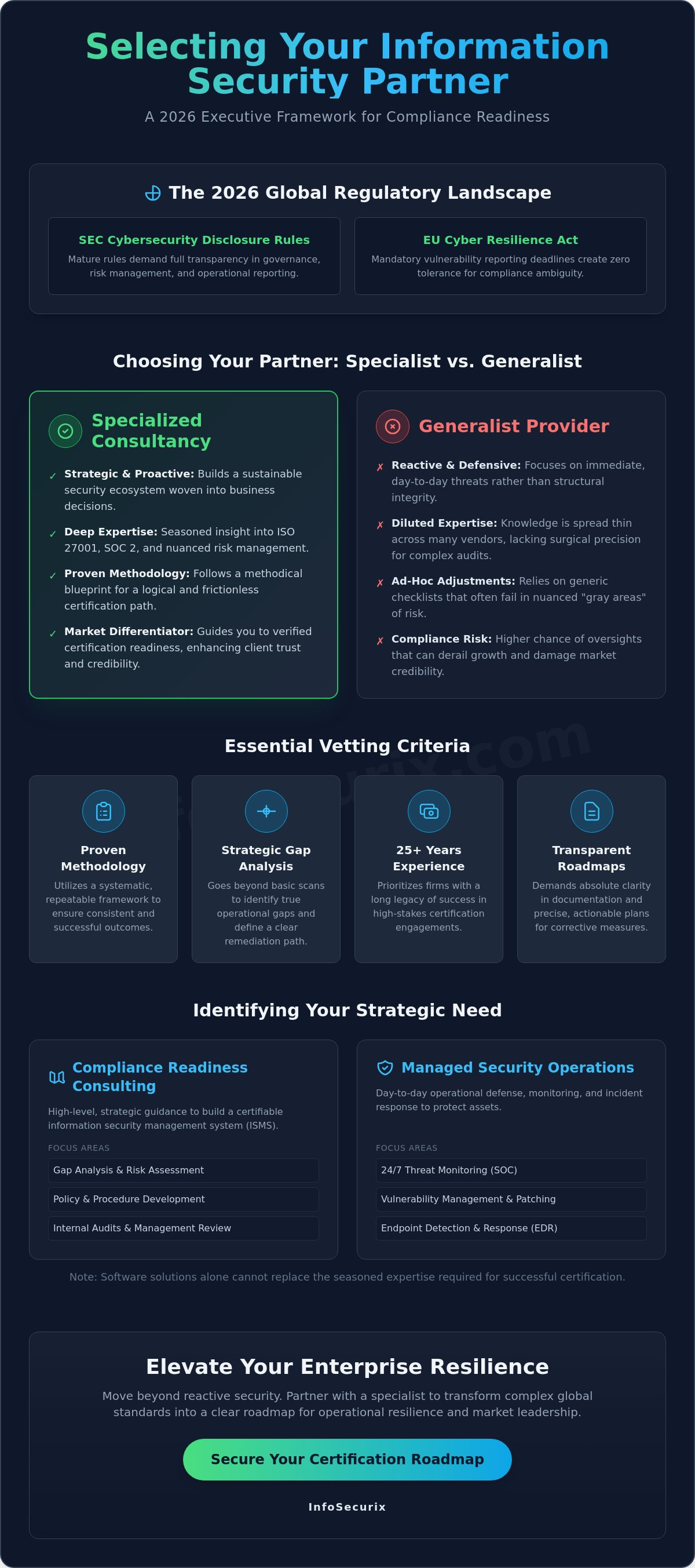
The regulatory environment in 2026 has reached a level of unprecedented sophistication. It’s no longer sufficient to maintain a simple perimeter; you must now demonstrate the integrity of every internal process and reporting structure. With the EU Cyber Resilience Act’s mandatory vulnerability reporting requirements taking effect this September, the margin for ambiguity has effectively vanished. Choosing a specialized information security consulting firm is the only way to ensure your organization doesn’t just survive an audit, but uses it as a catalyst for market leadership. These mandates require more than technical patches; they demand a strategic alignment of governance, risk management, and operational transparency.
The Evolving Complexity of International Standards
ISO 27001 and ISO 22301 have matured into the definitive benchmarks for global corporate excellence. These frameworks provide a structured approach to resilience that goes far beyond the core principles of computer security by integrating business continuity directly into the corporate DNA. As regulatory overlap between SEC disclosure rules and international mandates intensifies, a unified compliance strategy becomes a necessity rather than a luxury. Achieving “Certification Readiness” serves as a powerful market differentiator. It signals to your most valuable clients that your security posture is verified by rigorous, independent standards rather than mere internal assertions.
The Risk of Generalist Security Partnerships
Many providers attempt to be everything to everyone, often diluting their expertise across hundreds of different technology vendors. While a generalist approach might work for basic hardware procurement, it frequently lacks the surgical precision required for a complex SOC 2 readiness assessment or a deep-dive internal audit. There’s a significant risk in trusting your compliance roadmap to new market entrants who lack a proven legacy of success. A specialized information security consulting firm brings a level of seasoned insight that only comes from decades of navigating high-stakes certification requirements. This depth allows them to act as a trusted advisor, guiding you through the nuanced “gray areas” of risk management where generic checklists often fail.
Mastering compliance requires a fundamental shift in perspective. Defensive cybersecurity is often reactive, focusing on the immediate threat of the day. In contrast, certification readiness is proactive and structural. It’s about building a sustainable ecosystem where security is woven into every business decision. By partnering with a firm that possesses over 25 years of specialized experience, you gain access to a methodical blueprint for success. This partnership ensures that your path to ISO or SOC 2 certification is logical, steady, and entirely free of the friction that typically plagues less organized engagements.
Essential Criteria for Evaluating an Information Security Consulting Firm
Selecting an information security consulting firm requires a discerning eye for more than just technical certifications. It’s about identifying a partner whose credentials reflect a deep commitment to institutional excellence. Quality firms distinguish themselves through absolute transparency in their documentation and the precision of their corrective action plans. When you review a potential partner, look for a systematic approach to risk that prioritizes your organization’s long-term operational health. Providing a clear roadmap for remediation isn’t just a service; it’s a hallmark of a firm that understands the strategic weight of your compliance objectives.
Proven Methodology and Strategic Frameworks
Adopting a standardized approach to ISO 20000 requirements ensures that outcomes are consistent and repeatable. A superior firm doesn’t rely on ad-hoc adjustments; instead, it utilizes a rigorous strategic framework to guide your organization through the complexities of service management. Utilizing a comprehensive gap analysis is the first step in this journey. This process identifies exactly where your current posture falls short of the standard, allowing for an efficient and targeted roadmap to compliance. Understanding how to pick the right security service involves looking for these structured pathways. Engaging in an internal audit before your official assessment can illuminate these critical path items, ensuring that no detail is overlooked before the final certification audit.
Industry-Specific Expertise and Longevity
Verifying a firm’s experience with specific standards like ISO 22301 is essential for maintaining business continuity in an era of constant disruption. Consultants who’ve spent decades navigating the evolution of these standards bring a level of intuition that newer entrants simply cannot replicate. They’ve seen every possible scenario and remain unfazed by the technical mechanics of a new regulation. This longevity translates into a bespoke service model that addresses your unique operational nuances. Highlighting the strategic impact of technical processes is where these seasoned guides truly shine. They don’t just tell you what to fix; they explain how those fixes future-proof your organization against emerging risks. Choosing an information security consulting firm with this level of historical depth ensures that your security posture remains resilient, regardless of how the global landscape shifts. Organizations seeking to elevate their IT service delivery should also explore a structured ISO 20000 implementation roadmap to transform their IT department into a high-value, standards-aligned operation.
Compliance Readiness vs. Managed Security: Identifying Your Strategic Needs
Distinguishing between operational security and strategic compliance is a vital step for executive leaders. While a Managed Security Operations Center (SOC) provides essential 24/7 monitoring—often through dedicated MXDR providers like CyberOne—it doesn’t build the governance structures required for international certification. An information security consulting firm serves as the architect of your security program. They design the blueprint that ensures your organization meets the rigorous demands of ISO 27001 or SOC 2. Buying a subscription to a compliance automation platform isn’t a shortcut to success. These tools often provide a false sense of security by checking boxes without addressing the underlying procedural integrity that auditors demand.
Prioritizing a readiness assessment before investing in expensive new tooling ensures that your technology stack actually supports your long-term compliance goals. Fixing vulnerabilities before a formal auditor arrives is far more cost-effective than attempting to remediate a failed certification attempt under pressure. A strategic partner helps you allocate resources where they’ll have the most significant impact on your risk posture. This proactive approach transforms compliance from a burdensome expense into a documented asset that enhances your market reputation.
The Human Element in Compliance Audits
Automated compliance tools frequently fail to capture the nuanced organizational context that auditors look for during a formal assessment. They can flag a missing policy file, but they can’t evaluate the effectiveness of your risk management culture. Expert-led internal audits remain the gold standard for uncovering hidden gaps before they become liabilities. Professional judgment is indispensable when interpreting how a specific control applies to your unique business model. A seasoned information security consulting firm brings decades of experience to the table, providing a level of qualitative analysis that algorithms simply can’t replicate.
Strategic Alignment: When to Choose a Consultancy
Deciding where to allocate your security budget depends on your primary objective. If your team is struggling with daily threat detection and log management, an MSSP is the logical choice. However, if your goal is to enhance your reputation with clients through verified security postures, you need the strategic guidance of a consultancy. For a deeper dive into this process, consult our ISO 27001 certification readiness guide. High-level consulting firms provide the strategic roadmap, while managed providers act as the day-to-day watchmen. This distinction ensures you don’t waste budget on tools that lack the strategic alignment necessary for your specific regulatory journey.
The Executive Framework for Selecting a Security Consulting Partner
Selecting the right information security consulting firm is a strategic investment in your organization’s future. It requires a structured approach that moves past surface-level marketing to uncover the true depth of a provider’s capabilities. A methodical selection process ensures that your chosen partner doesn’t just identify risks, but provides the leadership necessary to remediate them effectively. This executive framework serves as your blueprint for vetting potential partners with precision and confidence.
- Step 1: Define the Specific Scope. Before engaging external experts, clarify whether your primary objective is a comprehensive SOC 2 readiness assessment or a targeted ISO 22301 business continuity plan.
- Step 2: Vet Standards-Based Experience. Confirm the firm’s history with your specific target standard. A firm that excels in ISO 27001 may not have the same depth in ISO 20000 implementation.
- Step 3: Evaluate Audit Depth. Examine their internal audit and gap analysis process. It must be rigorous enough to uncover the procedural nuances that a distant, checklist-based auditor might miss.
- Step 4: Review Strategic Clarity. Request a sample corrective action plan. This document should be logical, prioritized, and easily understood by both technical teams and executive leadership.
- Step 5: Confirm Senior Engagement. Ensure your project will be led by seasoned veterans rather than junior associates. The value of a consultancy lies in the professional judgment of its most experienced minds.
Vetting the Readiness Process
A high-quality firm provides more than just a list of findings; they deliver a roadmap for achievement. When evaluating their approach, ask specifically about their ISO 20000 audit preparation tactics to ensure they understand the complexities of service management. The reports you receive must be actionable for your internal IT teams, providing clear instructions for remediation. Crucially, verify if the firm offers support through the final certification audit phase. A true partner remains invested in your success until the certificate is in your hands. To begin this journey with a proven leader, consider scheduling a comprehensive risk assessment to establish your baseline posture.
Assessing Cultural and Strategic Fit
The relationship between your organization and an information security consulting firm should be one of collaborative partnership rather than distant oversight. Evaluate their communication style during the initial consultation. A seasoned guide uses clear, professional language that instills confidence, avoiding the fear-based jargon that often characterizes the industry. They should demonstrate a visionary yet grounded perspective, focusing on how compliance enables your organization’s growth. Finally, check for their ability to scale. As your business expands, your security partner must possess the national coverage and resource depth to support your evolving needs without sacrificing the bespoke quality of their service.
InfoSecurix: Elevating Enterprise Resilience Through Specialized Compliance
InfoSecurix stands as the premier boutique information security consulting firm: a partner that has defined the standard for excellence for more than 25 years. We recognize that true security isn’t found in a box or a software subscription. It’s built through the meticulous alignment of your internal processes with the world’s most rigorous standards. Our focus remains sharp and specialized, centering on ISO 27001, SOC 2, and ISO 22301 certification readiness. By positioning our expertise as a protective force, we enable your organization to pursue aggressive growth with the confidence that your security posture is both verified and resilient.
Our methodology follows a logical, steady progression designed to eliminate the friction typically associated with compliance. It begins with a comprehensive Risk Assessment to identify the unique threats facing your specific business model. We then move into a surgical Gap Analysis, pinpointing exactly where your current controls diverge from your target standard. This process concludes with Strategic Remediation: a prioritized roadmap that ensures every resource you spend contributes directly to your certification success. This methodical approach transforms a complex regulatory requirement into a clear, manageable path toward operational excellence. For organizations looking to understand how IT service management standards fit into this broader compliance picture, our detailed overview of what is the ISO 20000 standard for IT service management provides essential context for aligning technical delivery with enterprise governance goals.
The Advantage of 25+ Years of Expert Guidance
Managing thousands of audit cycles has instilled in us a calm, steady expertise that newer market entrants simply cannot match. We’ve seen the evolution of global standards from their inception, allowing us to remain unfazed by the technical complexities of 2026. This legacy of success allows us to provide a bespoke information security internal audit service that is tailored to your organizational culture. We act as your seasoned guide, navigating the nuanced gray areas of international law to ensure your documentation and evidence are beyond reproach. Our goal is to instill a sense of absolute confidence in your team, turning the audit process from a source of stress into a moment of verified achievement.
Securing Your Future with InfoSecurix
Choosing a readiness-first approach provides the peace of mind that comes from knowing you’re prepared for any scenario. We don’t just help you pass an audit; we help you build a sustainable framework for long-term business continuity. This commitment to future-proofing ensures that as your organization scales, your security standards remain a fundamental asset rather than a growing liability. Empowering your business to meet tomorrow’s standards today requires a partner who values precision as much as you do. We invite you to engage with our senior consultants for a strategic assessment and discover how a specialized information security consulting firm can elevate your enterprise resilience. Let’s build a foundation of trust that enables your next decade of growth.
Securing Your Competitive Advantage in a Sophisticated Regulatory Landscape
Mastering the complexities of 2026’s compliance mandates requires a fundamental shift from reactive defense to proactive governance. The distinction between a generalist vendor and a specialized information security consulting firm is often the difference between a failed audit and a seamless certification. By prioritizing a readiness-first methodology and utilizing a structured executive framework, you transform regulatory hurdles into documented proof of your organization’s integrity. This strategic alignment doesn’t just protect your data; it enhances your reputation with global clients who demand verified security postures.
InfoSecurix brings more than 25 years of industry-leading expertise to every engagement, offering specialized ISO and SOC 2 readiness programs tailored to your unique operational nuances. Our boutique service model combines bespoke attention with national capability, ensuring you receive senior-level engagement throughout your entire compliance journey. It’s time to move beyond the stress of looming audits and embrace a future defined by operational resilience.
Partner with InfoSecurix for Expert Compliance Readiness and empower your organization to meet tomorrow’s standards with absolute confidence today.
Frequently Asked Questions
What is the primary difference between a security consulting firm and an MSSP?
An information security consulting firm focuses on the strategic architecture of your compliance program, while an MSSP provides day-to-day operational monitoring. Think of the consultant as the architect who designs the blueprint and the MSSP as the security guard watching the monitors. While an MSSP keeps you safe from immediate threats, a consultancy ensures your governance and risk management meet international standards like ISO 27001.
How much does it typically cost to hire an information security consulting firm for ISO 27001?
Fees for engaging an information security consulting firm vary significantly based on the complexity of your environment and the specific scope of the engagement. While industry data from 2026 suggests senior cybersecurity consultants command higher hourly rates for specialized advisory, your total investment depends on the number of locations and employees included in the audit scope. It’s best to request a bespoke proposal that reflects your organization’s unique regulatory requirements.
Can a consulting firm guarantee that we will pass our SOC 2 audit?
No reputable firm can provide an absolute guarantee that you’ll pass a SOC 2 audit because the final decision rests with an independent third-party auditor. However, a rigorous readiness assessment significantly reduces the risk of failure by identifying and remediating gaps before the official audit begins. This proactive approach ensures that your documentation and controls are fully aligned with the necessary Trust Services Criteria before the auditor arrives.
How long does a typical readiness assessment engagement take?
A typical readiness assessment engagement generally spans four to eight weeks from the initial kickoff to the delivery of the final report. This timeline allows for deep-dive interviews, thorough documentation reviews, and a comprehensive analysis of your technical controls. Larger organizations with multiple global locations may require a more extended engagement to capture the full breadth of their operational landscape and varied regulatory needs.
Is it better to hire a local firm or a national information security consulting firm?
Hiring a national information security consulting firm often provides a distinct advantage in terms of resource depth and specialized expertise across multiple regulatory frameworks. While a local provider might offer proximity, a national firm brings a broader perspective gained from managing thousands of audit cycles across various industries. This scale ensures they can support your organization’s growth and evolving compliance needs regardless of where your offices are located.
What should be included in a gap analysis report from a security consultant?
A professional gap analysis report must include a detailed comparison of your current security posture against the specific requirements of your target standard. It should provide a prioritized list of remediation actions, clearly categorized by risk level and strategic impact. Quality reports also include actionable recommendations that your internal IT teams can use to implement necessary controls without wasting resources on unnecessary technical changes.
How often should an organization engage an internal audit firm?
Organizations should engage an internal audit firm at least once per year to remain compliant with most international standards. It’s also wise to conduct an audit following significant changes to your infrastructure, such as a major cloud migration or a merger. Regular audits ensure that your security controls remain effective and that your team is always prepared for the scrutiny of an external certification body.
Do consulting firms also help with the implementation of security controls?
Yes, specialized firms play a critical role in the implementation phase by providing strategic guidance and corrective action plans. While your internal IT team typically handles the technical execution, the consultant ensures that these changes align with the specific nuances of the regulatory standard. This partnership ensures that your implementation efforts are both effective and audit-ready, preventing costly rework during the final certification phase.