

What if the greatest threat to your certification isn’t a missing firewall setting, but a fundamental disconnect between your security protocols and your executive boardroom? Many organizations approach the ISO/IEC 27001:2022 standard as a technical hurdle to clear rather than a strategic framework for longevity. This narrow focus often leads to common iso 27001 audit failures that stall progress and waste significant capital on superficial documentation. You likely feel the pressure of an upcoming Stage 2 audit and worry that your current Information Security Management System (ISMS) lacks the depth required to satisfy a meticulous auditor.
We understand that the transition from the 2013 version to the current 2022 requirements demands more than just a checklist; it requires a culture of evidence-based management. This guide promises to reveal the most frequent non-conformities and provide the strategic insights necessary to transform potential vulnerabilities into pillars of enterprise resilience. We will examine the specific gaps in risk assessment, the nuances of the 2024 climate-related amendment, and the practical steps you can take to foster a functional ISMS that delivers genuine business value while ensuring absolute confidence during your next auditor interview.
Prepare for your 2026 certification by understanding the structural nuances of an effective Information Security Management System. This overview highlights the strategic shifts required to avoid common pitfalls and ensure a successful audit:
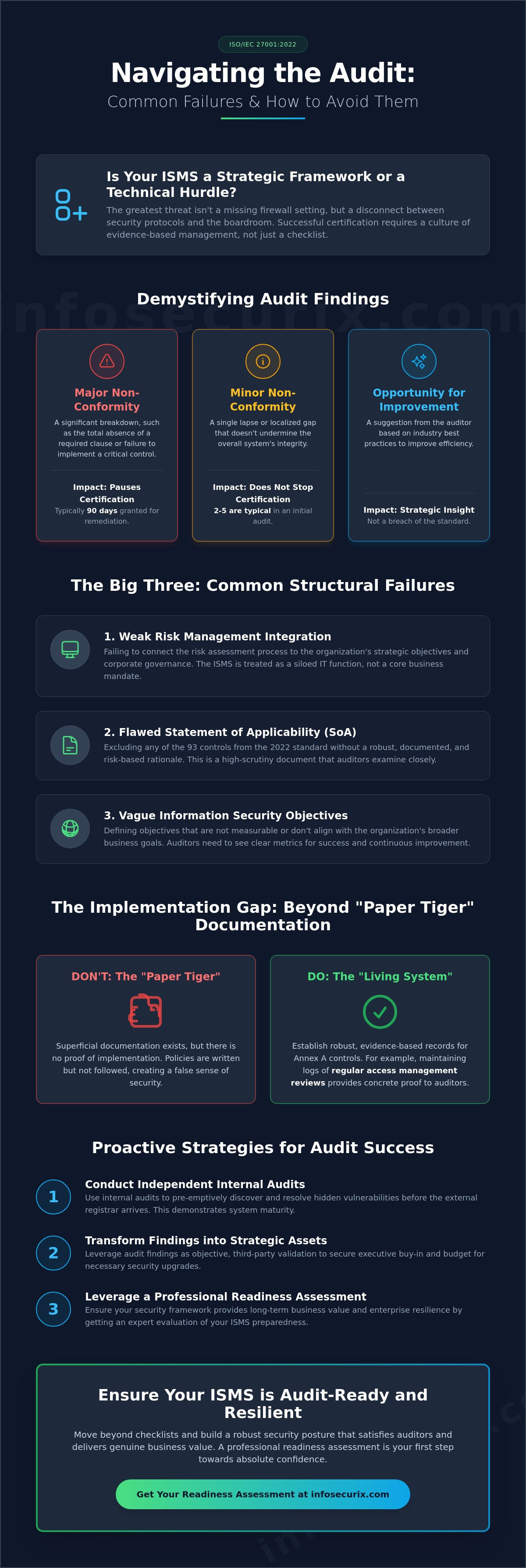
- Distinguish between Major and Minor non-conformities to navigate the certification process with absolute confidence and clarity.
- Identify the common iso 27001 audit failures that often stem from superficial risk assessment methodologies or a lack of executive mandate.
- Move beyond “paper tiger” documentation by establishing robust, evidence-based records for Annex A controls: specifically regular access management reviews.
- Utilize independent internal audits to pre-emptively discover and resolve hidden vulnerabilities before the external registrar arrives.
- Leverage a professional readiness assessment to ensure your security framework provides long-term business value and enterprise resilience.
Demystifying the ISO 27001 Non-Conformity: Myth vs. Reality
Achieving certification against the ISO/IEC 27001 standard is often perceived as a binary pass-fail event; however, the reality of the audit process is far more nuanced. Viewing a non-conformity as a catastrophic failure is a common misconception that can paralyze an organization’s progress. In truth, auditors aren’t searching for a flawless system. They’re evaluating the resilience and maturity of your Information Security Management System (ISMS). Understanding the distinction between the three tiers of audit findings is the first step in avoiding common iso 27001 audit failures that stem from misunderstanding the standard’s intent.
Audit findings generally fall into three categories: Major Non-Conformities (NCs), Minor Non-Conformities, and Opportunities for Improvement (OFIs). A Major NC represents a significant breakdown, such as the total absence of a required clause or the failure to implement a critical control. A Minor NC is a single lapse or a localized gap that doesn’t undermine the system’s overall integrity. Finally, an OFI is a suggestion from the auditor based on industry best practices, offering a path toward greater efficiency without indicating a breach of the standard. Auditors look for a “living” system that identifies and corrects its own errors rather than a static, “perfect” set of documents.
Major vs. Minor Non-Conformities: What Is at Stake?
Identifying a Major NC during your Stage 2 audit will pause the certification process, but it doesn’t end it. You’re typically granted a specific window, often 90 days, to submit a corrective action plan and provide evidence of remediation. Minor NCs are more frequent; research indicates it’s typical for an organization to receive 2-5 minor non-conformities during an initial certification audit. While these findings won’t stop certification, they must be addressed within a planned timeframe. Be aware that a cluster of Minor NCs within a single department or process can aggregate into a Major finding. This pattern suggests a systemic failure in risk ownership rather than an isolated administrative error.
The Strategic Value of an Audit Finding
Transforming an audit finding into a strategic asset requires a shift in perspective. These findings provide an objective, third-party validation of where your resources are most needed. Use these insights to secure executive budget for security upgrades that were previously dismissed as IT requests. A transparent approach to findings demonstrates the honesty and maturity of your internal reporting, which builds immense trust with the auditor. In 2026, treat every non-conformity as a rigorous stress-test. It’s an opportunity to future-proof your business against evolving threats by reinforcing the structural foundations of your security framework and remediating common iso 27001 audit failures before they impact your operational continuity.
The Big Three: Structural Failures in Risk and Leadership
Technical vulnerabilities often capture the headlines, yet the most persistent common iso 27001 audit failures originate in the structural foundations of the Information Security Management System (ISMS). These failures occur when the framework is disconnected from the organization’s strategic core. As we navigate the requirements of the 2022 version, auditors are increasingly focused on how risk management integrates with corporate governance. Understanding common ISO 27001 audit findings reveals that a lack of documented justification in the Statement of Applicability (SoA) or undefined security objectives can derail an entire certification effort. Organizations must move beyond treating the standard as a checklist and instead embrace it as a business mandate.
The Statement of Applicability remains a high-scrutiny document. With the transition to the 2022 version now complete, your SoA must reflect the 93 restructured controls across the four themes: Organizational, People, Physical, and Technological. A frequent failure point is the exclusion of controls without a robust, documented rationale. Similarly, failing to define measurable Information Security Objectives that align with your 2026 corporate strategy signals to an auditor that the ISMS is a stagnant document rather than a driver of continuous improvement. These structural gaps often lead to a disconnect between perceived security and actual operational resilience.
Surface-Level Risk Assessments: A Primary Failure Point
Generic templates offer a seductive efficiency; however, they rarely survive the scrutiny of a seasoned auditor. This “Paper Risk” trap occurs when an organization assesses risks it has no intention or capability of mitigating. Auditors look for asset-based or process-based granularity that proves you understand your specific threat landscape. The Risk Treatment Plan (RTP) serves as the primary evidence of active management. If your RTP lacks clear ownership, specific timelines, or a link to your financial resource allocation, it will be viewed as a theoretical exercise rather than a functional security tool. Precision in risk identification is the only way to transform a compliance obligation into a strategic advantage.
Leadership Commitment and Resource Allocation
The most significant catalyst for audit failure is the Leadership Gap. When the ISMS is relegated to a mid-level “IT project,” it lacks the authority to enforce compliance across the enterprise. Evidence of Management Review must move beyond rubber-stamping meeting minutes. Leadership must demonstrate they have reviewed the effectiveness of the ISMS and allocated the necessary resources to address findings. This is particularly critical for organizations managing dual compliance with SOC 2. Treating these standards as identical often leads to gaps in the Risk Treatment Plan because the executive team fails to provide the specific mandate required for ISO 27001’s rigorous management framework. A meticulous ISO 27001 Certification Readiness assessment can bridge this gap by aligning technical requirements with executive oversight, ensuring your leadership team is prepared for the depth of an auditor’s interview.
The Implementation Gap: Why Documentation Is Not Enough
Possessing a comprehensive set of policies is only the first step toward certification. The “Paper Tiger” syndrome is a pervasive issue where an organization maintains impeccable documentation that bears little resemblance to its actual operational habits. Auditors in 2026 are trained to look past the written word; they seek the digital footprints of your processes. This implementation gap is one of the most common iso 27001 audit failures, as it highlights a fundamental lack of discipline in maintaining the ISMS over time. It’s the difference between saying you protect data and proving that you do so every single day.
Control A.5.15, which governs access control reviews, remains the most frequent Annex A failure point. Many organizations establish a policy for quarterly reviews but fail to produce the records showing those reviews actually occurred. Similarly, supplier relationship management is often neglected. Your security perimeter now extends to every cloud provider and third-party vendor you employ. Failing to document the security requirements in your contracts or neglecting to audit your high-risk vendors creates a significant vulnerability that auditors will quickly identify. A mature ISMS also requires a transparent incident management process. If your logs only show major breaches and ignore near misses, an auditor will likely conclude that your reporting culture is either immature or intentionally opaque.
Evidence-Based Compliance in 2026
In a remote or hybrid audit environment, objective evidence is the only currency that matters. You must be prepared to provide more than just a verbal assurance. Auditors now expect to see system logs, timestamped screenshots of configuration settings, and clear version histories for all policy changes. Control A.8.10, which focuses on information deletion and data retention, is a high-scrutiny area. You must demonstrate that data is not just being stored, but is also being purged according to your stated retention schedule. Without these records, your ISMS exists only on paper, making it a prime candidate for a major non-conformity.
The Training and Awareness Deficiency
The “one-and-done” annual slide deck is no longer sufficient to pass the auditor’s staff interview test. Awareness is not measured by a completion certificate; it’s measured by the ability of your employees to describe their security responsibilities in their own words. During an audit walkthrough, an auditor may ask a random team member how they report a suspicious email or where they find the clean desk policy. These interviews are often where common iso 27001 audit failures are exposed. Fostering a security-first culture means moving beyond passive learning to active engagement, ensuring that every individual understands their role as a guardian of the organization’s resilience.
Strategic Internal Audits: Pre-empting External Failures
An internal audit shouldn’t be a cursory administrative check; it’s a rigorous simulation designed to identify structural weaknesses before an external registrar arrives. Many organizations treat this phase as a formality, yet a weak internal assessment is a leading indicator of common iso 27001 audit failures during Stage 2. To deliver real value, the internal audit must move beyond “checklist auditing,” where a simple yes or no suffices. Instead, it should embrace “process auditing,” which examines how information flows through the organization and whether the controls actually mitigate the risks they were designed to address. This proactive approach ensures that your ISMS is not just compliant on paper but resilient in practice.
Executing a successful “dress rehearsal” requires a high degree of precision. Utilizing a comprehensive ISO 27001 internal audit checklist allows your team to mirror the intensity of a formal certification audit. This process should always conclude with a formal Management Review. This meeting is your opportunity to present findings to executive leadership, ensuring they are aware of any gaps and have authorized the resources needed for remediation. This sequence proves to an external auditor that your leadership is actively engaged in the “Check” and “Act” phases of the PDCA cycle.
Ensuring Auditor Independence
The conflict of interest trap is the most frequent reason internal audits fail to provide meaningful insights. You simply cannot audit your own work and remain unbiased. Auditors look for clear evidence of independence; if the person who designed the access control policy is also the one auditing it, the finding will likely be invalidated. Many sophisticated enterprises avoid this pitfall by partnering with a cybersecurity internal audit firm to provide an objective, third-party perspective. Integrating professional internal audit services into your annual compliance calendar ensures that your security posture is evaluated by experts who have seen thousands of audit scenarios and remain unfazed by complexity.
Closing the Loop: Corrective Action Tracking
External auditors place immense value on your Non-Conformity Log. They don’t expect it to be empty; rather, they want to see a history of identified issues and their subsequent resolutions. A common mistake is providing a superficial response to a finding. If an internal audit reveals a missing training record, simply “fixing the file” is a poor response. A mature organization identifies the root cause: perhaps the onboarding process didn’t trigger the training notification. Proving that you have updated the underlying process demonstrates a commitment to continual improvement that effectively pre-empts common iso 27001 audit failures. If you’re ready to stress-test your ISMS with a high-level diagnostic, consider our professional Internal Audits to ensure your organization is truly certification-ready.
Achieving Resilience: The InfoSecurix Readiness Advantage
Navigating the complexities of a certification audit requires more than just technical proficiency; it demands a partner who has navigated this terrain thousands of times. Drawing upon over 25 years of industry-leading experience, InfoSecurix identifies structural weaknesses long before they reach the auditor’s desk. Our “Readiness Assessment” methodology provides an exhaustive deep dive into both technical and organizational controls, ensuring that common iso 27001 audit failures, such as fragmented risk management or incomplete evidence logs, are remediated with precision. We recognize that a successful audit is a narrative of organizational maturity, and we help you tell that story with absolute confidence.
Preparing your team for the auditor interview is perhaps the most critical yet overlooked phase of our engagement. While documentation provides the foundation, the testimony of your staff validates the “living” nature of your Information Security Management System (ISMS). We coach your subject matter experts to articulate their roles within the security framework, transforming potential anxiety into professional poise. This transition from a rigorous information security internal audit to a state of permanent readiness ensures that your certification remains a source of business value rather than an annual burden. By addressing common iso 27001 audit failures through behavioral training, we ensure your team is as resilient as your infrastructure.
Bespoke Compliance Strategies
Avoiding “templated” solutions is central to our philosophy. We focus on risk-aligned security that mirrors your specific operational reality, ensuring that every control serves a tangible purpose. For organizations managing multiple frameworks, we bridge the gap between ISO 27001 and SOC 2, creating a unified compliance roadmap that maximizes efficiency and eliminates redundant efforts. Securing executive buy-in is simplified through our strategic ISO 27001 certification readiness programs, which translate technical requirements into the language of corporate risk and strategic growth.
Your Partner in Sustainable Security
Our commitment to your resilience extends far beyond the initial issuance of your certificate. We provide continuous support to help you manage surveillance audits and the inevitable changes in the 2026 threat landscape. The InfoSecurix guarantee is built on meticulous preparation, ensuring a “no-surprises” external audit that reinforces your reputation as a trusted market leader. We don’t just help you pass; we help you build a culture of security that scales with your ambition. Partner with InfoSecurix for a Successful ISO 27001 Audit to transform your compliance obligations into a lasting competitive advantage.
Securing Your Enterprise Future with Strategic Compliance
Transitioning your security framework into a certified pillar of resilience requires a shift from reactive documentation to proactive, evidence-based management. By addressing the structural gaps in leadership and the implementation deficiencies in Annex A controls, you move beyond the risk of common iso 27001 audit failures. Success in 2026 is defined by a “living” ISMS that adapts to emerging threats while maintaining the rigorous transparency auditors demand. This strategic alignment ensures that your certification is not merely a badge; it’s a functional asset that drives corporate value.
InfoSecurix provides the seasoned guidance necessary to navigate this complexity with absolute confidence. Drawing on over 25 years of information security expertise and offering national coverage for enterprise-scale compliance, we provide specialized corrective action planning for rapid remediation. Our approach ensures your organization is prepared for every nuance of the audit process. Ensure Your Audit Success with a Comprehensive Readiness Assessment and transform your security standards into a lasting competitive advantage. We’re here to guide you toward excellence.
Frequently Asked Questions
Can you fail an ISO 27001 audit and still get certified?
You can still achieve certification if the audit findings are limited to Minor Non-Conformities. These findings require a documented corrective action plan rather than an immediate re-audit. However, a Major Non-Conformity will pause the process until you provide evidence of remediation. It’s a structured path toward improvement rather than a final rejection of your security efforts.
What is the most common major non-conformity in ISO 27001?
The most frequent Major Non-Conformity involves a fundamental breakdown in the risk assessment and treatment methodology. This often occurs when an organization fails to identify assets properly or neglects to link risks to specific Annex A controls. These common iso 27001 audit failures signal to the auditor that the ISMS isn’t grounded in the organization’s actual operational reality.
How much time do we have to fix an audit failure?
You generally have a 90-day window to remediate a Major Non-Conformity and provide evidence to the auditor. For Minor findings, you must usually submit a corrective action plan within 30 to 60 days. While the certification can proceed with Minor findings, the auditor will verify the effectiveness of your fix during the subsequent surveillance visit to ensure the loop is closed.
Is an internal audit required before the external ISO 27001 audit?
Conducting an internal audit is a mandatory requirement under Clause 9.2 of the standard. You must complete at least one full cycle of internal auditing and a subsequent management review before your external Stage 2 assessment. These records serve as critical evidence that your organization is capable of self-correcting and maintaining the integrity of the management system over time.
What happens if we disagree with an auditor’s finding?
You should first attempt to resolve the disagreement during the closing meeting by providing additional context or documentation. Auditors are open to technical clarifications if you can prove the standard’s requirements are met through an alternative method. If the dispute remains, you can escalate the matter through the certification body’s formal appeals process for an independent technical review.
How do we prove leadership commitment to an auditor?
Prove commitment by showing the auditor documented evidence of resource allocation and signed management review minutes. Leadership must demonstrate they have reviewed the performance of the ISMS and made informed decisions based on audit results. During interviews, executives should be prepared to discuss how information security objectives support the organization’s long-term commercial goals and risk appetite.
Can a lack of employee awareness cause an audit failure?
Systemic gaps in staff knowledge frequently lead to common iso 27001 audit failures during the interview phase. If multiple employees are unable to explain how to report an incident or find a policy, the auditor will likely issue a non-conformity. Awareness is a core requirement; you must prove that training is effective and that security responsibilities are understood at every level.
What is the difference between a Stage 1 and Stage 2 audit failure?
Stage 1 failures are typically structural gaps where your documentation doesn’t align with the standard’s clauses. Stage 2 failures are implementation gaps where your records don’t prove that you’re following your own documented procedures. Stage 1 ensures you’re ready to be audited; Stage 2 verifies that your security management system is actually functioning in a live environment.