
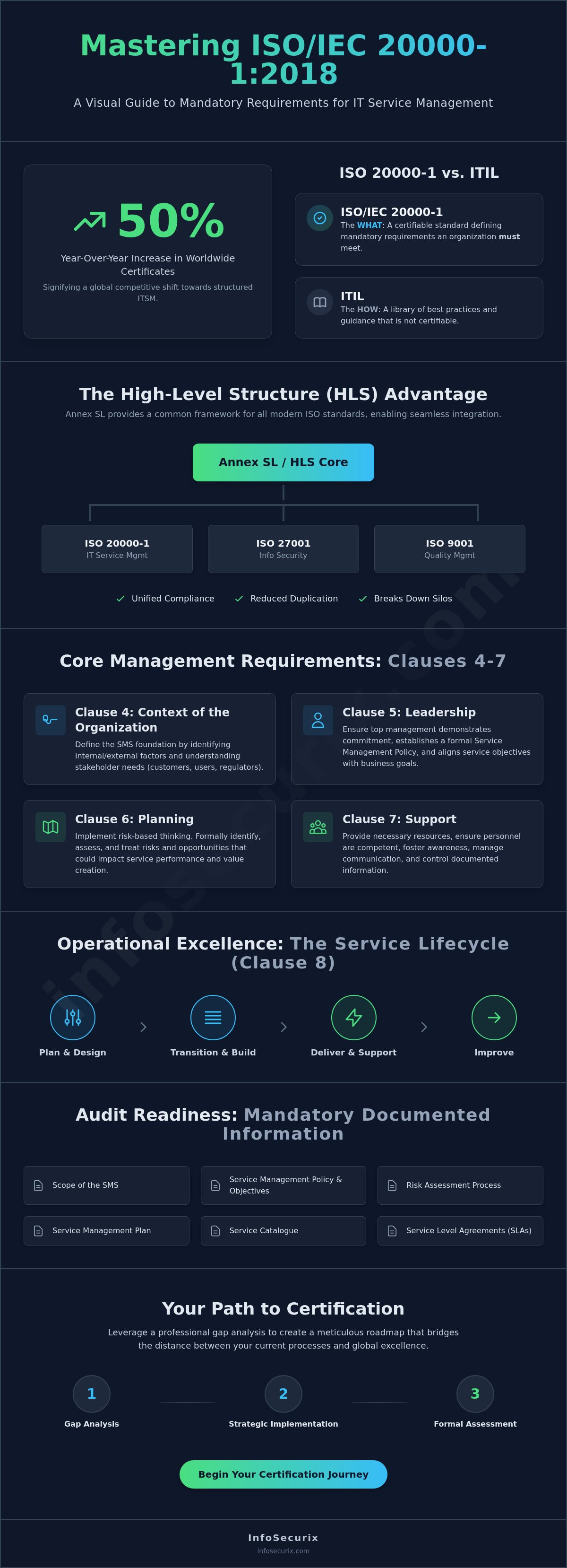
With a 50% year-over-year increase in worldwide certificates for ISO/IEC 20000-1, the global shift toward structured IT service management is no longer a trend; it’s a competitive necessity. You likely recognize that while ITIL provides a helpful library of best practices, achieving actual certification requires a more rigorous commitment to specific iso 20000 requirements. It’s common to feel a sense of hesitation when facing the High-Level Structure or the perceived mountain of documentation needed for audit readiness. Bridging the gap between existing processes and international standards requires both precision and a strategic perspective that many organizations struggle to find on their own.
This reference empowers you to master the mandatory clauses of ISO/IEC 20000-1:2018, transforming your IT operations from a reactive department into a resilient value driver. Expect a clear roadmap of operational controls that demonstrates how to integrate these standards with your existing ISO 27001 systems for a unified approach to governance. By following this guide, you’ll gain the confidence to align your current service management with global benchmarks and ensure your organization is fully prepared for its next formal assessment. We’ll explore the mandatory documentation, the depth of required controls, and the systematic path to achieving excellence in service delivery.
Key Takeaways
- Understand how the Annex SL High-Level Structure facilitates a seamless integration between IT service management and established security frameworks.
- Master the specific iso 20000 requirements within Clauses 4 and 5 to ensure your leadership and organizational context meet international benchmarks.
- Navigate the operational complexities of Clause 8 to transform the service lifecycle into a repeatable engine for corporate value.
- Identify the mandatory documented information required for certification to streamline your evidence collection and ensure audit readiness.
- Leverage a professional gap analysis to create a meticulous roadmap that bridges the distance between current processes and global excellence.
The Architecture of ISO/IEC 20000-1:2018
ISO/IEC 20000-1:2018 represents the definitive international standard for a Service Management System (SMS). It provides a rigorous framework for organizations to design, transition, and deliver services that create measurable value for customers. While many professionals utilize this ISO/IEC 20000 overview to understand its history, the 2018 revision marked a fundamental shift in how IT service excellence is measured. It moved the industry away from simple process adherence toward a holistic management system that prioritizes organizational agility and performance.
You shouldn’t confuse ISO 20000 with ITIL. ITIL provides the “how-to” guidance and best practices, but it’s not a certifiable standard. In contrast, ISO 20000-1:2018 sets the mandatory iso 20000 requirements that an organization must meet to achieve formal certification. This distinction is vital for leaders who want to move beyond “best effort” service to a validated, internationally recognized level of performance. The 2018 version specifically emphasizes risk-based thinking and value creation. It ensures that IT isn’t just a cost center but a strategic partner that supports the broader business mission.
The High-Level Structure (HLS) Advantage
The transition to Annex SL, often called the High-Level Structure (HLS), is perhaps the most significant update in the 2018 version. This common framework serves as the blueprint for all modern ISO standards. By adopting this structure, the standard ensures that service management doesn’t exist in a vacuum. It allows for the seamless integration of your SMS with other systems like ISO 27001 for information security or ISO 9001 for quality management. This alignment breaks down organizational silos; it creates a unified language for compliance, risk, and leadership. This makes it significantly easier for your team to manage multiple certifications simultaneously without duplicating effort.
The Scope of a Service Management System
Defining the scope is a critical first step in meeting iso 20000 requirements. You must determine exactly which services fall under the SMS umbrella, as this boundary dictates the reach of your certification. The “governing body” or top management plays a central role here. They’re responsible for setting the service objectives that align with your broader business goals. This scope isn’t limited to just the technical support desk; it covers the entire service lifecycle. This includes everything from the initial design and build phases to the final delivery and ongoing improvement of the service.
Mandatory Management System Requirements
Achieving certification requires a clear distinction between the “doing” of IT services and the “governing” of the system itself. While many organizations focus heavily on operational tickets, the core of the standard lies in Clauses 4 through 7. These sections establish the management framework that ensures consistency, accountability, and alignment with corporate goals. Meeting these specific iso 20000 requirements proves to an auditor that your service management isn’t accidental; it’s a deliberate, leadership-driven strategy designed for longevity.
Leadership and Governance (Clauses 4 & 5)
Clause 4 demands that you look both inward and outward. You must define the “Context of the Organization” by identifying internal and external factors that influence your service delivery. This includes recognizing the needs of stakeholders: from end-users and customers to regulatory bodies. Without this clarity, your Service Management System (SMS) lacks a foundation. Clause 5 then bridges this context with active leadership. It’s no longer enough for top management to simply approve a budget. They must demonstrate a hands-on commitment to the SMS by ensuring the Service Management Policy is not just a document on a shelf, but a living guide that informs every technical decision. This policy must be appropriate to the purpose of the organization, provide a framework for setting objectives, and include a formal commitment to satisfy applicable requirements and continually improve the system.
Risk Management and Resource Support (Clauses 6 & 7)
Planning and support represent the “Plan” and “Resources” stages of the management cycle. Clause 6 focuses on risk-based thinking. It requires a formal process to identify risks and opportunities that could affect service performance. This isn’t a one-time event; it’s a continuous assessment that ensures you’re prepared for service disruptions before they occur. For organizations looking to harmonize their efforts, this approach mirrors the strategic guide to ISO 27001 certification readiness, where risk management serves as the common denominator.
Clause 7 addresses the practicalities of execution. You must verify that your team possesses the necessary competence to deliver services effectively. This requires documented evidence of training, skills, and experience. It’s not enough to have talented people; you must prove their competence through a systematic verification process. Awareness is equally vital. Every member of the IT organization must understand how their specific role contributes to the achievement of service objectives. Establishing a meticulous ISO 20000 Implementation plan helps ensure these support requirements are integrated into your daily culture rather than treated as a checklist for an audit. By treating resources and risks as strategic assets, you move closer to a state of permanent audit readiness and operational excellence. Working with a qualified information security consulting firm can provide the specialized expertise needed to navigate these complex governance requirements with confidence.
Operational Requirements: The Service Lifecycle
Clause 8 represents the operational heart of the standard. It moves beyond the administrative framework discussed previously to address the actual delivery of services. This is where the Service Management System (SMS) manifests in daily activities: handling tickets, managing vendors, and deploying updates. Meeting these iso 20000 requirements isn’t just about technical proficiency. It’s about demonstrating a controlled environment where every action is recorded, measured, and aligned with the service portfolio.
Service portfolio management ensures your catalog of offerings remains relevant to the business. It works in tandem with service level management to define the precise expectations for performance. These aren’t just internal goals; they’re formal commitments. Relationship management requirements extend this discipline to both customers and suppliers. Meeting these external iso 20000 requirements ensures that third-party vendors don’t compromise your own service delivery. You must maintain professional, documented interactions with all partners to protect the integrity of the service chain.
Control is maintained through rigorous change and release management. Every modification to the service environment must be authorized, tested, and tracked. This prevents the unmanaged updates that often lead to service outages. By formalizing these processes, you ensure that the IT environment remains stable and predictable, even during periods of rapid growth or technological transition.
Service Design, Build, and Transition
Planning for new or changed services is a mandatory pillar of the standard. You can’t simply “go live” with a new feature without a structured assessment. The standard requires a systematic approach to design and transition: identifying the impact on existing services and ensuring the team is ready to support the change. Service Level Agreements (SLAs) act as the compliance anchor here. They provide the objective data needed to prove you’re meeting your promises. Capacity and availability management are equally critical. You must proactively monitor resources to ensure services remain accessible and performant during peak demand.
Resolution and Fulfillment Processes
Incident and service request management are the most visible parts of Clause 8. The standard requires a formal process to restore normal service operation as quickly as possible. However, the real maturity comes from Problem Management. This requirement forces your team to look beyond the immediate fix to identify root causes. It’s a proactive discipline that prevents recurring issues from draining resources. Monitoring these processes provides the evidence needed for continuous improvement. It turns operational data into strategic insights that prove your SMS is functioning as intended and delivering consistent value to the organization.
Documentation and Evidence Requirements
The transition from operational activity to formal certification depends entirely on the quality of your documented information. While previous versions of the standard focused heavily on voluminous manuals, the 2018 revision emphasizes evidence of effective operation. Meeting these iso 20000 requirements means you must prove your system works in practice, not just on paper. This shift requires a disciplined approach to record-keeping: capturing management review minutes, internal audit reports, and service level performance data as part of your daily workflow.
Auditors during a Stage 2 assessment aren’t looking for theoretical perfection. They’re looking for a consistent trail of activity that demonstrates the system is mature and self-correcting. This includes evidence that the governing body reviews the Service Management System (SMS) at planned intervals. These management review minutes must detail decisions regarding service improvements, resource changes, and the effectiveness of risk treatment plans. Without this “top-down” evidence, the system lacks the governance required for international recognition.
The Mandatory Documented Information List
To satisfy an auditor, your SMS must include several foundational documents that establish the baseline for your operations. These include:
- The clearly defined scope of the service management system.
- The Service Management Policy and measurable objectives.
- A robust Risk Management and Treatment Plan.
- A comprehensive Service Catalogue and associated Service Level Agreements (SLAs).
Beyond these high-level documents, you’re required to document specific service requirements for every offering in your scope. It’s vital to remember that auditors prioritize evidence of process execution over static manuals. They want to see that your incident logs, change requests, and capacity plans actually reflect the processes you’ve defined in your policy. This real-world data proves that the standard is integrated into your culture rather than existing as a separate administrative burden.
Preparing Evidence for Performance Evaluation
Clause 9 mandates a systematic approach to monitoring, measurement, and evaluation. You must maintain objective data that proves your services meet their defined targets. This performance evidence is often verified through a formal information security internal audit, which provides a strategic framework for validating your controls before the external registrar arrives. This internal assessment serves as a critical dress rehearsal for the formal certification audit.
When gaps are identified, Clause 10 requires you to track non-conformities and the resulting corrective actions. This creates a “paper trail” of continuous improvement that demonstrates organizational maturity. Auditors typically look for at least three months of operational data to confirm that processes like Problem Management and Change Management are functioning exactly as described. If you’re struggling to organize this evidence, our team can provide a comprehensive Internal Audit to ensure your documentation stands up to the highest level of scrutiny. By focusing on high-quality evidence, you transform the audit process from a stressful hurdle into a validation of your operational excellence.
Strategic Implementation: Navigating the Certification Path
Implementing a Service Management System (SMS) is a sophisticated journey that requires a balance of technical precision and organizational change. It’s not merely about checking boxes; it’s about embedding a culture of excellence into the fabric of your IT operations. Navigating the specific iso 20000 requirements demands a structured approach that begins with a clear understanding of your current maturity level. By treating the certification path as a strategic roadmap, you ensure that the resulting system is both resilient and scalable. Specialized consulting ensures these requirements are met with surgical accuracy, avoiding the common mistake of over-engineering processes that don’t contribute to your bottom line.
Preparing the organization for the two-stage certification audit requires a methodical mindset. Stage 1 focuses on your documentation and readiness: the auditor will verify that your policies, scope, and plans are firmly in place. Stage 2 is the “evidence” phase: where the auditor observes your processes in action to confirm they’re being followed exactly as written. Success in both stages depends on having a team that isn’t just aware of the rules but is fully invested in the outcomes. This transition from theory to practice is where most organizations find the greatest value, as it forces a level of operational discipline that directly improves service reliability. A well-structured ISO 20000 audit preparation checklist can be instrumental in ensuring your team is aligned and ready for both stages of the assessment.
Phase 1: Readiness and Gap Analysis
A formal Gap Analysis serves as the essential first step in identifying requirement shortfalls before they become audit liabilities. This professional readiness assessment provides a detailed look at your existing processes, highlighting “hidden” gaps that often go unnoticed: specifically in areas like service continuity and complex supplier management. InfoSecurix streamlines this transition by leveraging over 25 years of expertise to pinpoint exactly where your current framework deviates from the standard. This clarity prevents the wasted effort of building unnecessary documentation. We focus on creating a lean, effective SMS that meets all iso 20000 requirements while remaining aligned with your unique business objectives. Precision is paramount; we ensure your roadmap is both achievable and strategically sound.
Phase 2: Sustaining Compliance and Continual Improvement
Achieving initial certification is a significant milestone, but the true value of the standard lies in its ability to drive long-term improvement. Maintaining your status requires a commitment to the annual internal audit cycle. This cycle ensures that your SMS remains effective as your business evolves and new technologies emerge. It’s about moving beyond the audit to a permanent state of service excellence where risk is managed proactively. Partnering with a seasoned guide ensures that your organization remains vigilant and prepared for surveillance audits year after year. This ongoing partnership transforms compliance from a periodic hurdle into a foundational strength that supports your long-term growth.
Ready to elevate your service management? Partner with InfoSecurix for your ISO 20000 Implementation to ensure a smooth, expert-led journey toward international certification and operational excellence.
Elevating Your IT Service Governance
Mastery of the ISO/IEC 20000-1:2018 standard moves beyond simple technical adherence. It requires a fundamental alignment of leadership, risk management, and operational execution. By establishing a robust Service Management System, you transform IT from a reactive support function into a strategic asset that delivers consistent, measurable value. Navigating the complex landscape of iso 20000 requirements is a journey that demands precision and foresight to ensure long-term success.
Leveraging our 25+ years of information security and compliance expertise, we offer a proven methodology for developing integrated ISO 27001 and ISO 20000 systems. Our expert corrective action planning addresses audit vulnerabilities before they impact your certification status. This ensures your organization remains prepared for the scrutiny of external registrars while future-proofing your service delivery against an evolving technological landscape. We’re committed to your growth as a collaborative ally in the certification process.
Secure your ISO 20000 certification with an InfoSecurix Readiness Assessment
Your path to international service excellence starts with a single, strategic step toward a more resilient future. We’re ready to help you achieve the gold standard in IT service management.
Frequently Asked Questions
What are the most significant changes in the ISO 20000-1:2018 update?
The 2018 update introduced the Annex SL High-Level Structure, aligning it with other modern ISO standards like ISO 27001. It emphasizes risk-based thinking and value creation over simple process adherence. This version also removed some prescriptive requirements for specific procedures, giving organizations more flexibility in how they demonstrate evidence of effective operation through real-world data.
How does ISO 20000-1:2018 differ from ITIL 4?
ISO 20000-1:2018 is a formal international standard that specifies the mandatory requirements for an IT service management system. ITIL 4 is a comprehensive framework of best practices that provides guidance on how to deliver services. While you can’t be “ITIL certified” as an organization, you can use ITIL practices to meet the rigorous benchmarks set by the ISO standard.
Is ISO 20000-1 certification mandatory for IT service providers?
Certification isn’t legally mandatory for IT service providers, but it’s frequently a prerequisite for high-value contracts and public sector tenders. Many organizations adopt the framework voluntarily to improve service reliability and operational efficiency. Even without formal certification, implementing the standard provides a globally recognized benchmark for service excellence and competitive advantage.
Can we integrate ISO 20000 requirements with our existing ISO 27001 system?
You can absolutely integrate these systems because both standards share the Annex SL High-Level Structure. This common blueprint allows for a unified approach to risk management, internal audits, and leadership reviews. Integrating iso 20000 requirements with ISO 27001 reduces administrative duplication and creates a more cohesive governance framework for your entire IT organization.
What is the typical timeline for meeting all ISO 20000 requirements?
The timeline for full implementation typically ranges from six to twelve months depending on your organization’s current maturity and resource availability. This process involves conducting a gap analysis, developing necessary documentation, and generating at least three months of operational evidence. A well-structured roadmap ensures that you meet all benchmarks without disrupting your daily service delivery or business operations.
What are the mandatory documents required for ISO 20000-1:2018?
Mandatory documentation includes the SMS scope, service management policy, service objectives, and a formal risk treatment plan. You’re also required to maintain a service catalogue, service level agreements (SLAs), and evidence of performance evaluation like internal audit reports. The standard prioritizes evidence of effective operation, such as incident logs and change records, over simple static manuals.
Does ISO 20000 require a specific tool or software for implementation?
The standard is entirely tool-agnostic and doesn’t require any specific software for implementation. You can meet iso 20000 requirements using your existing ITSM platforms as long as they support the necessary controls for incident, change, and configuration management. The focus remains on the effectiveness of your processes rather than the specific technology used to manage them.
How often do we need to conduct internal audits to remain compliant?
You must conduct internal audits at planned intervals, which most organizations schedule at least once per year. These audits verify that your SMS continues to conform to the standard’s requirements and your own internal policies. Regular assessments identify vulnerabilities early, ensuring you remain in a state of permanent audit readiness for external surveillance visits and formal recertification.