

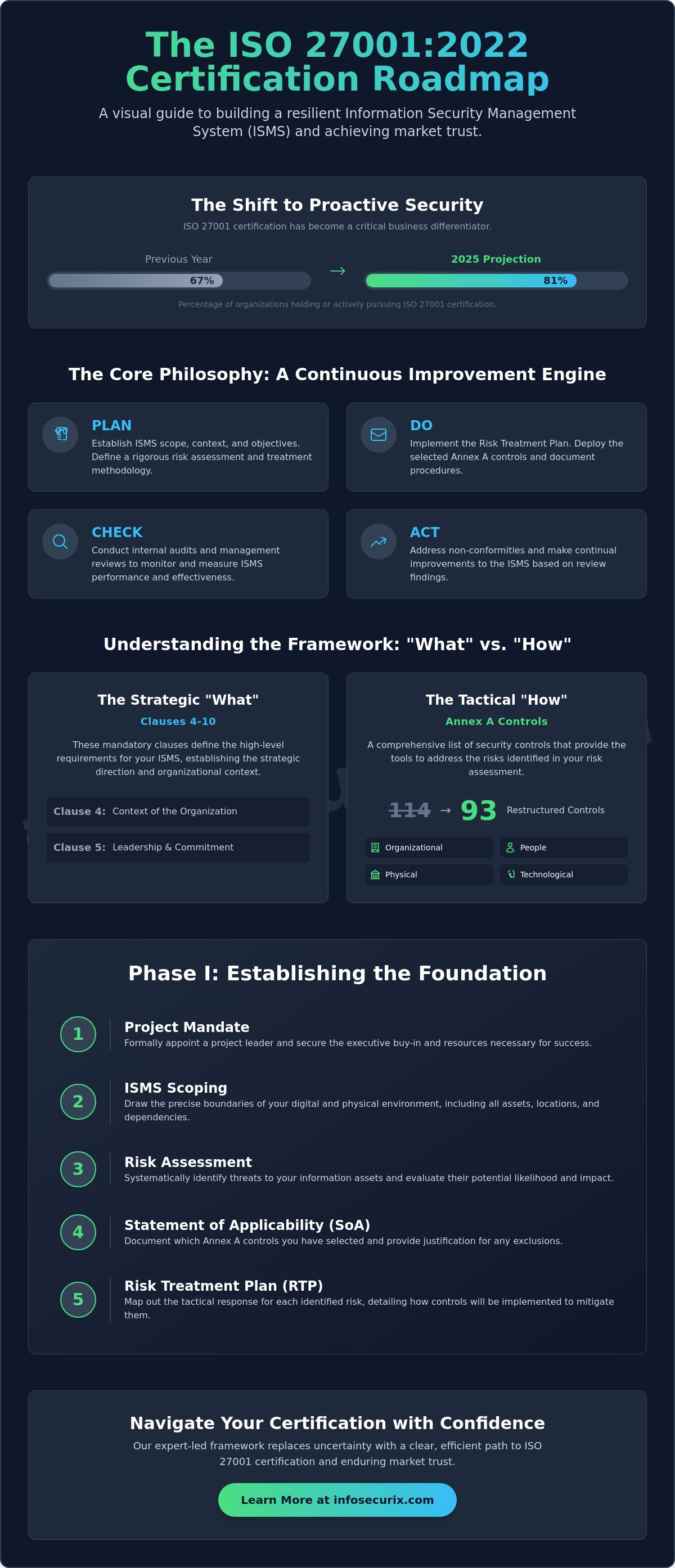
In 2025, 81% of organizations report holding or actively pursuing ISO 27001 certification, a notable increase from 67% the previous year. This shift proves that information security has moved from a technical requirement to a critical business differentiator. You likely understand the necessity of this standard, yet the iso 27001 certification process often presents a complex challenge. It’s common to feel apprehensive about the transition to the 93 restructured controls or the potential for operational friction during a certification audit.
We’ve developed this roadmap to replace that uncertainty with a clear, expert-led framework. You’ll learn how to navigate the systematic journey to certification with precision, ensuring your implementation is both efficient and robust. This article previews the chronological stages of the 2022 standard, including the recent climate action amendments, to help you build a resilient management system that earns lasting market trust.
Key Takeaways
- Internalize the “Plan-Do-Check-Act” philosophy to evolve your security management from a reactive posture into a proactive, strategic asset.
- Establish a rigorous project mandate and scope to refine the iso 27001 certification process, focusing efforts on your most critical information assets.
- Implement the restructured 2022 Annex A controls through a bespoke documentation toolkit that aligns technical precision with organizational excellence.
- Validate your readiness through mandatory internal audits and executive management reviews: these critical milestones ensure a seamless transition through the certification stages.
- Maintain your competitive advantage by mastering the surveillance and recertification cycles required for enduring compliance and market trust.
Understanding the ISO 27001 Certification Framework and ISMS Lifecycle
Approaching the ISO/IEC 27001 standard as a static checklist is a common pitfall that limits organizational growth. Instead, view the Information Security Management System (ISMS) as a living ecosystem: a set of interconnected processes that adapt to your business’s unique pulse. Achieving a successful iso 27001 certification process in 2026 requires moving beyond simple compliance. It demands a focus on dynamic risk, where your security posture evolves alongside emerging threats like AI-driven vulnerabilities and the recent 2024 climate action amendments. High-performing organizations don’t just “do” ISO 27001; they weave it into their operational DNA.
The philosophical backbone of this framework remains the Plan-Do-Check-Act (PDCA) cycle. This iterative methodology ensures that security isn’t a one-time event but a continuous loop of improvement. Planning involves setting clear security objectives that mirror your core business goals. Execution moves those plans into the real world. Checking involves rigorous internal monitoring. Finally, acting ensures you refine your defenses based on those findings. Aligning your security strategy with your corporate vision transforms a technical hurdle into a powerful engine for market trust.
The Core Requirements of Clauses 4 through 10
Success begins with Clause 4: understanding the internal and external drivers that shape your security context. You aren’t just protecting data; you’re safeguarding the specific value your organization provides to stakeholders. Leadership and commitment, outlined in Clause 5, serve as the non-negotiable foundation. Auditors look for active participation from the C-suite, not just a signature on a policy. Securing top-down support ensures that the human and financial capital required for Clauses 6 and 7 is readily available: it turns security into a shared cultural priority rather than a siloed IT burden.
Annex A Controls: The Tactical Toolkit
While the Clauses define “what” your organization must achieve, the Annex A controls provide the “how.” The 2022 update simplified the previous 114 controls into 93, organized into four intuitive themes: Organizational, People, Physical, and Technological. This restructuring mirrors modern digital environments, emphasizing cloud security and threat intelligence. Integrating these controls into the iso 27001 certification process allows your team to apply precise, bespoke solutions to identified risks. It’s a relationship of strategy and tactics: the Clauses set the direction, and Annex A provides the tools to reach the destination safely.
Phase I: Establishing the Foundation Through Scoping and Risk Assessment
The foundation of a resilient ISMS isn’t built on technical tools; it’s built on a clearly defined mandate. Appointing a project leader requires selecting an individual with the authority to drive cross-departmental change. This leader formalizes the project mandate, ensuring that leadership commitment translates into tangible resource allocation. Without this executive buy-in, the iso 27001 certification process often stalls at the first sign of organizational resistance. Establishing this groundwork early prevents the project from being viewed as a mere IT initiative.
Phase I focuses on five critical milestones that dictate the success of your entire implementation:
- Project Mandate: Formally appointing a leader and securing executive resources.
- Scoping: Drawing the precise boundaries of your digital and physical environment.
- Risk Assessment: Identifying threats and evaluating their potential impact on assets.
- Statement of Applicability (SoA): Justifying the selection of specific security controls.
- Risk Treatment Plan (RTP): Mapping the tactical response to every identified vulnerability.
Defining the ISMS scope is a high-stakes exercise in precision. You must identify exactly which assets, locations, and third-party dependencies fall under the protective umbrella. An overly broad scope leads to resource exhaustion, while a narrow one leaves critical vulnerabilities exposed. Ensuring your scope is accurate is essential for iso 27001 certification readiness, creating a manageable perimeter for the journey ahead. If you find the methodology selection overwhelming, our team provides expert-led risk assessments to ensure your foundation is unshakeable.
Conducting a comprehensive information security risk assessment is an integral part of the iso 27001 certification process. This stage involves evaluating the likelihood and impact of various threats to your information assets. To maintain credibility with auditors, you must document a repeatable methodology as part of the formal ISO certification process. This documentation serves as the evidence that your security choices are based on logic rather than guesswork.
Defining the Boundaries of Your ISMS
Precision is your greatest ally when mapping the ISMS perimeter. You must account for physical offices, remote work environments, and cloud service providers. Scope creep occurs when teams try to protect everything at once, diluting the effectiveness of their controls. Focus on the data flows that drive your primary value proposition. This ensures your certification is both achievable and strategically relevant to your long-term growth.
The Risk Assessment Methodology
Choosing between an asset-based or process-based framework depends on your organizational structure. Asset-based models focus on hardware and software; process-based models look at business workflows. Both require a clearly defined risk appetite: the level of risk leadership is prepared to tolerate. Documenting this appetite is essential for Stage 1 audit success, as it demonstrates a mature, risk-aware culture that remains unfazed by complexity.
Phase II: Implementing Controls and Developing Robust Documentation
Implementation is the stage where abstract risk treatment plans transform into operational reality. During this phase of the iso 27001 certification process, you’ll bridge the gap between high-level policy and daily practice by deploying the 93 Annex A controls. This isn’t merely a technical exercise; it’s a structural refinement of how your business functions. You’re building a documentation toolkit that spans from access control protocols to complex cryptography standards. Each document serves as a blueprint for your security posture, providing the clarity your team needs to operate with absolute confidence.
Auditors don’t just look for the existence of a policy; they require “Evidence of Operation.” This means your organization must demonstrate that the ISMS is active and effective through logs, meeting minutes, and incident reports. Maintaining these records is a meticulous task that proves your commitment to achieving and maintaining accreditation. It’s the difference between a theoretical framework and a battle-tested defense system. If your team requires assistance in aligning these controls with your specific business goals, our ISO 27001 Certification Readiness services provide the seasoned guidance necessary for success.
Writing Effective Policies and Procedures
Customization is the only way to avoid the “template trap” that often leads to audit non-conformities. While generic templates offer a starting point, your documentation must reflect your specific workflows and technical stack. Effective policies are actionable and measurable; they don’t just state a goal but define the exact steps to reach it. We recommend structuring your documentation for easy retrieval. Using a logical hierarchy ensures that when an auditor asks for your encryption standard, your team can produce it instantly. This level of organization signals a mature, well-governed ISMS.
The Human Element: Security Awareness Training
A robust ISMS is only as strong as the people who operate it. Moving beyond “check-the-box” annual slides is vital for fostering a security-first culture. Every employee needs to understand their specific role in the iso 27001 certification process, from basic password hygiene to reporting suspicious activity. Privileged users and management require even more specialized training to handle their elevated responsibilities. You can measure the effectiveness of these programs through simulated phishing and social engineering exercises. These real-world tests provide the data needed to refine your training and ensure your human firewall remains impenetrable.
Phase III: Navigating the Multi-Stage Certification Audit Journey
The transition from implementation to validation marks the most critical juncture in the iso 27001 certification process. This phase isn’t a singular event but a multi-stage engagement designed to verify that your ISMS is both theoretically sound and operationally effective. It begins with a rigorous Internal Audit, followed by an executive Management Review, and culminates in a two-stage external audit conducted by an accredited registrar. Approaching these milestones with a mindset of strategic improvement rather than anxiety ensures a smoother path to your final certification.
Step 6 requires a formal internal audit. This is your organization’s opportunity to identify remaining gaps before the external registrar arrives. To maintain the integrity of the process, this audit must be conducted by an independent party; someone who wasn’t involved in the daily development of the ISMS. Following this, Step 7 involves the Management Review. Here, leadership provides the final sign-off, confirming that the ISMS meets business objectives and possesses the necessary resources to persist. Only after these internal checks are complete do you move to the external registrar’s scrutiny.
The external iso 27001 certification process is split into two distinct parts:
- Stage 1 Audit: A high-level documentation review where the auditor ensures your ISMS is designed correctly on paper.
- Stage 2 Audit: An intensive effectiveness review where the auditor verifies that your team actually follows the documented policies in practice.
The Critical Role of the Internal Audit
The internal audit serves as a dress rehearsal for the main event. Using a formal information security internal audit allows you to stress-test your controls in a controlled environment. This process uncovers non-conformities that might otherwise lead to a failed certification. Once identified, you must implement corrective actions immediately. Documenting these corrections is vital; it shows the external auditor that your organization possesses a mature, self-correcting culture that values precision. If you’re unsure about your current audit readiness, our team provides comprehensive Internal Audits to ensure no detail is overlooked.
Surviving Stage 1 and Stage 2 Audits
Stage 1 focuses on the “what” and “why” of your ISMS. The registrar examines your Statement of Applicability and core policies to ensure they align with the 2022 standard. If Stage 1 is about the plan, Stage 2 is about the execution. The auditor will interview staff, observe physical security, and review technical logs to prove compliance. Handling auditor observations with professionalism is key. Minor non-conformities aren’t failures; they’re opportunities to demonstrate your team’s ability to resolve issues quickly. This transparency builds the trust necessary for a successful certification recommendation.
Ensuring Long-Term Compliance and Operational Resilience
Receiving your official certificate is a moment of significant organizational achievement, yet it represents the beginning of a more profound commitment. The iso 27001 certification process is designed as a three-year cycle: a structure that ensures security isn’t a fleeting priority but a permanent pillar of your corporate identity. This period involves annual surveillance audits followed by a full recertification in the third year. Maintaining this rhythm requires a shift from project-based implementation to a culture of continual improvement, where ISMS metrics drive business efficiency and long-term resilience.
Operational success in the post-certification phase depends on your ability to treat the ISMS as a living system. It’s not enough to simply hold the status; you must prove that the system is evolving. This involves regular reviews of your security objectives and an unwavering dedication to the Plan-Do-Check-Act cycle. By embracing this methodical approach, you transform compliance from a cost center into a strategic engine for growth and reliability.
The Surveillance Audit Process
Surveillance audits in years one and two act as annual “check-in” visits from your registrar. These are smaller in scope than the initial assessment, focusing on whether your ISMS is being maintained and improved. Avoiding the “post-audit slump” is essential for success here. You must continue to update your Risk Assessments to reflect the 2026 threat landscape, ensuring your controls remain relevant against emerging risks. This proactive stance prevents minor issues from snowballing into major non-conformities during your three-year renewal. Auditors specifically look for evidence that you’ve addressed previous observations and that your internal audit program remains active.
Strategic Benefits Beyond the Certificate
The value of ISO 27001 extends far beyond the physical certificate. It becomes a strategic asset in high-stakes enterprise RFPs, where proven security standards often serve as a prerequisite for engagement. You’ll find that having a recognized ISMS significantly streamlines the burden of vendor security questionnaires: a benefit that saves hundreds of hours for your technical and sales teams. By building a culture of resilience, you protect your brand reputation and instill absolute confidence in your global partners. This established trust enables faster market entry and more robust client relationships. Organizations of every size can benefit from this competitive edge, and ISO 27001 for small business is an increasingly viable path to attaining enterprise-level trust without the complexity of a large-scale rollout.
InfoSecurix stands ready to act as your long-term compliance partner and trusted advisor. We don’t just help you cross the finish line; we ensure your ISMS remains a visionary tool for future-proofing your business. Whether you require periodic Internal Audits to prepare for surveillance or need to integrate ISO 22301 Business Continuity into your framework, our seasoned guides provide the steady expertise needed to navigate every scenario. Maintaining the iso 27001 certification process is a journey of excellence, and we are invested in your enduring success.
Securing Your Strategic Advantage Through Certified Excellence
Transitioning from a state of vulnerability to one of certified resilience is a defining move for any modern enterprise. You’ve seen throughout this roadmap that success requires more than technical controls; it demands a philosophy of continuous improvement and executive-led strategy. By establishing a precise scope and a robust documentation toolkit, your organization builds a foundation that remains steady under the scrutiny of any registrar. This journey transforms compliance from a bureaucratic hurdle into a powerful engine for market trust and operational clarity.
Mastering the iso 27001 certification process is a sophisticated undertaking that benefits from the steady hand of a seasoned guide. With over 25 years of compliance expertise, InfoSecurix provides the bespoke, executive-level strategic guidance necessary to navigate this complexity with absolute confidence. Our readiness clients enjoy a 100% audit success rate, ensuring your path to accreditation is both predictable and efficient. Partner with InfoSecurix for a seamless ISO 27001 journey and empower your organization to grow with security. Your commitment to these rigorous standards today ensures a resilient and prosperous tomorrow.
Frequently Asked Questions
How long does the ISO 27001 certification process typically take for a mid-sized company?
For a mid-sized organization with 21 to 200 employees, the iso 27001 certification process typically spans five to eight months. This duration accounts for initial scoping, risk assessment, and the mandatory period of operating the ISMS to generate audit evidence. Larger enterprises may extend this timeline to 20 months, while smaller startups might achieve readiness in three months. Your specific timeline depends heavily on the maturity of your existing controls and the availability of internal resources.
What are the most common reasons organizations fail their Stage 2 audit?
Organizations most frequently fail their Stage 2 audit due to a lack of operational evidence or inconsistent application of policies. Auditors often identify systems where procedures exist on paper but aren’t followed by staff in daily workflows. Other common pitfalls include incomplete internal audits, failure to conduct management reviews, or a Statement of Applicability that doesn’t align with the actual risk environment. Precision in execution and a culture of accountability are essential to avoid these non-conformities.
Can we achieve ISO 27001 certification without hiring an external consultant?
Achieving certification independently is possible for organizations with deep in-house compliance expertise and significant internal bandwidth. However, many find the complexity of the 93 restructured controls and the 2024 climate action amendments difficult to navigate without a seasoned guide. External partners provide the objective perspective necessary for a successful internal audit and help you avoid the “template trap” that leads to audit failure. Engaging an expert ensures your resources are focused on high-impact security improvements rather than administrative guesswork.
How much does the total ISO 27001 certification process cost including registrar fees?
The total investment for the iso 27001 certification process in 2026 generally ranges from $6,000 to over $50,000 depending on organizational complexity. This figure includes registrar fees, audit time, and the internal resources required for implementation. While costs vary based on your chosen implementation path, understanding the total cost of iso 27001 certification across the full three-year cycle is essential for building a defensible budget roadmap. Most organizations find the long-term value far exceeds these initial operational expenses.
What is the difference between an ISO 27001 readiness assessment and an internal audit?
A readiness assessment is a preliminary gap analysis performed early in the journey to identify what needs to be built. It serves as a strategic roadmap for your implementation. In contrast, an internal audit is a mandatory requirement performed after the ISMS is operational to verify that your controls work as intended. While both are critical, the internal audit is a formal stress test that must be completed before you can proceed to the Stage 1 registrar audit.
Does ISO 27001 certification cover GDPR and other privacy regulations?
ISO 27001 provides a robust foundation for data security but doesn’t automatically guarantee GDPR or CCPA compliance. While many of the standard’s controls overlap with privacy requirements, specific legal obligations often require additional measures. Organizations focused on privacy often integrate ISO 27701, a dedicated privacy extension, into their management system. This approach ensures your ISMS addresses both the general security of information and the specific rights of data subjects under global privacy regulations.
How often do we need to perform a risk assessment to remain compliant?
Risk assessments must be performed at least annually or whenever significant changes occur within your business environment. This includes the introduction of new technologies, shifts in organizational structure, or changes in the external threat landscape, such as the 2024 climate action amendments. Regular assessments ensure your ISMS remains a dynamic ecosystem rather than a static document. Maintaining this frequency is essential for passing annual surveillance audits and demonstrating a proactive security posture to your accredited registrar.
What happens if the auditor identifies a major non-conformity during Stage 2?
If a major non-conformity is identified, the registrar cannot recommend your organization for certification until the issue is resolved. You’ll typically be given a specific timeframe, often 90 days, to implement corrective actions and provide evidence of their effectiveness. Once the auditor verifies the resolution through a follow-up review, the certification process can proceed. Minor non-conformities won’t prevent certification but must be addressed through a documented action plan before your next annual surveillance visit.