

Your internal audit is no longer a simple rehearsal; it’s a strategic mandate that validates your organization’s resilience in an era of heightened auditor expectations. It’s common to feel the weight of the 2022 updates, especially since the October 2025 transition deadline has passed and the 2024 Climate Action Amendment is now a core requirement. You’re likely struggling to balance these rigorous standards with operational efficiency while fearing a single missed non-conformity could derail your certification.
This guide provides a professional-grade iso 27001 internal audit checklist designed to ensure your ISMS is entirely certification-ready. By following this roadmap, you’ll master the complexities of Clause 9.2 and the 93 controls within Annex A. We’ll move beyond static screenshots to focus on the continuous evidence auditors now demand, such as logs, tickets, and documented reviews. You’ll gain the clarity needed to produce a flawless internal audit report and the confidence to face your Stage 2 certification audit with a future-proofed system that supports long-term growth.
Key Takeaways
- Understand why Clause 9.2 transforms the internal audit from a routine requirement into a strategic stress test for your security posture.
- Utilize a professional iso 27001 internal audit checklist to verify the core management system, ensuring that organizational context and leadership commitment are fully documented.
- Master the 93 controls of Annex A by focusing on the four essential themes: Organizational, People, Physical, and Technological.
- Learn advanced interviewing techniques to bridge the gap between your written policies and the actual operational practices of your Subject Matter Experts.
- Develop a risk-based remediation strategy that prioritizes non-conformities to guarantee your ISMS is prepared for a successful Stage 2 certification audit.
The Strategic Architecture of an ISO 27001 Internal Audit
The internal audit is the cornerstone of a resilient Information Security Management System (ISMS). While many organizations view it as a hurdle to clear before the certification body arrives, it actually functions as a sophisticated stress test designed to identify vulnerabilities before they manifest as breaches or non-conformities. Under the ISO/IEC 27001 standard, particularly the 2022 revision, this process is a mandatory requirement that demonstrates your organization’s commitment to continuous improvement. It’s the moment where theory meets practice, revealing whether your policies are truly integrated into your daily operations.
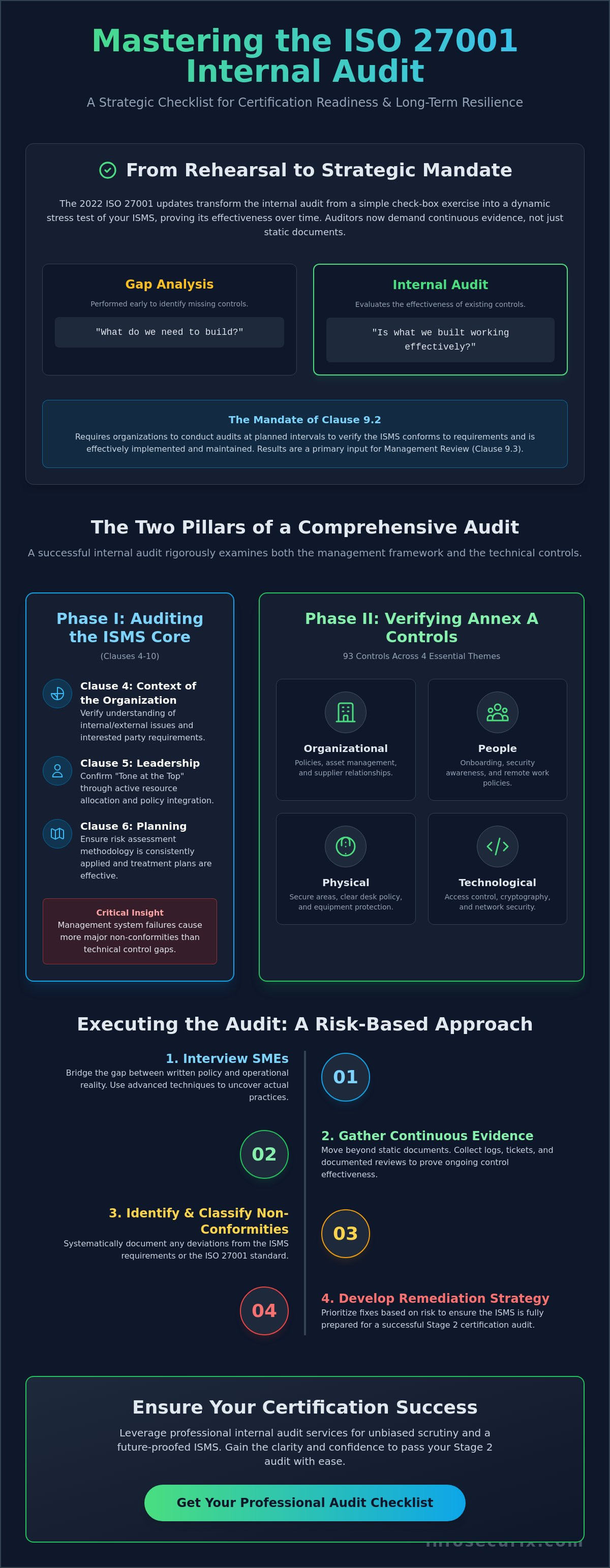
There’s a critical distinction to make between a gap analysis and a formal internal audit. A gap analysis is typically performed early in the implementation journey to identify what’s missing. In contrast, the internal audit evaluates the effectiveness of what’s already there. Using a robust iso 27001 internal audit checklist ensures that you’re not just looking for the presence of a control, but verifying its operational performance over time. This distinction is vital in 2026, as certification auditors now prioritize evidence of control effectiveness rather than just static documentation. Establishing the “Audit Universe” requires a clear definition of the audit’s scope and objectives, ensuring that every critical asset and process is under review with absolute independence.
The Mandate of Clause 9.2
Clause 9.2 requires organizations to conduct audits at planned intervals to provide information on whether the ISMS conforms to the organization’s own requirements and the international standard itself. This isn’t a passive exercise. It demands objective evidence that your system is effectively implemented and maintained. High-level leadership must remain involved; the audit results are a primary input for the Management Review (Clause 9.3), proving that Top Management is actively steering the security strategy. Documenting this program with precision is essential for satisfying external certification bodies that your oversight is rigorous and systematic.
Selecting an Independent Auditor
The “Independence Rule” is often the most challenging aspect for smaller teams to navigate. Simply put, you can’t audit your own work. Maintaining objectivity requires an auditor who isn’t involved in the daily management of the controls being tested. While some organizations attempt to cross-train staff, many find that leveraging professional internal audit services provides the necessary level of unbiased scrutiny. A seasoned auditor brings a wealth of experience, having seen how various industries interpret the 93 controls of Annex A. This external perspective is often the difference between a superficial check and a deep-dive evaluation that truly future-proofs your business.
Checklist Phase I: Auditing the ISMS Core (Clauses 4–10)
Technical controls often receive the most attention, yet the true foundation of a resilient ISMS lies within the management clauses. Auditors frequently refer to this as the “Invisible Audit” because these structural requirements provide the framework that allows technical controls to function. Management system failures cause more major non-conformities than technical gaps. A comprehensive iso 27001 internal audit checklist must prioritize these clauses to prevent systemic failures that could jeopardize your certification. By verifying the core first, you ensure the organization’s security posture is built on a stable, leadership-backed foundation.
Auditing Clause 4 requires verifying the Context of the Organization. It’s about more than just a document; it’s about proving you understand interested party expectations and the internal factors influencing your security. Clause 5 examines the “Tone at the Top.” You’ll need to demonstrate that leadership isn’t just signing off on policies but is actively allocating resources and integrating security into business processes. This is where the strategic values of an ISO 27001 internal audit become apparent, as it aligns security with corporate objectives. Finally, Clause 6 focuses on Planning and Risk Treatment. Your audit should confirm that the risk assessment methodology is applied consistently across the business. It isn’t enough to have a risk register; you must show that the criteria for risk acceptance are defined and followed.
Support and Operation (Clauses 7 & 8)
Auditing competence records is a vital step in this phase. You must prove that staff members have the necessary skills for their specific roles through training logs or certifications. Awareness training effectiveness is also under the microscope; it’s not enough to show a slide deck was sent. You need evidence that the message was understood. Verifying the “Control of Documented Information” is equally critical. Is your versioning airtight? Auditors will look for evidence that risk treatment plans are actually being executed as planned, rather than sitting idle on a digital shelf. If you find yourself struggling to maintain this level of oversight, our team can provide ISO 27001 Certification Readiness support to bridge the gap.
Performance Evaluation and Improvement (Clauses 9 & 10)
Reviewing monitoring and measurement metrics is essential for demonstrating maturity. Are you tracking the right KPIs, or are you collecting data for data’s sake? The Management Review Meeting serves as the ultimate proof of leadership engagement. You must verify that leadership is acting on audit findings and making informed decisions based on performance data. A robust process for non-conformity and corrective action demonstrates a “closed-loop” system for fixing errors. Every failure should be met with a documented root cause analysis and a verified fix to prevent recurrence, ensuring your iso 27001 internal audit checklist leads to genuine organizational growth.
Checklist Phase II: Verifying Annex A Information Security Controls
The 2022 revision of the standard refined the Annex A controls into 93 specific requirements categorized across four distinct themes: Organizational, People, Physical, and Technological. This consolidation reflects a more integrated approach to security, moving away from the siloed domains of the previous version. When executing your iso 27001 internal audit checklist, you must ensure each of these themes is scrutinized with equal rigor. Organizational controls (5.x) require a thorough review of your information security policies and asset management, especially how your organization governs cloud service usage. Beyond these requirements, people controls (6.x) have become increasingly vital; you’ll need to audit remote work security protocols and ensure confidentiality agreements remain legally robust.
Physical controls (7.x) go beyond locks and keys to include the secure disposal of media and the monitoring of entry points. Finally, technological controls (8.x) demand a deep-dive into encryption standards, logging mechanisms, and vulnerability management. Creating a comprehensive information security checklist allows you to bridge the gap between high-level policy and the granular technical configurations that protect your data. This phase of the audit is where the “paper trail” meets the “digital reality,” ensuring that your defenses are as effective as your documentation claims.
The Statement of Applicability (SoA) Review
Your Statement of Applicability is the definitive map of your security landscape. During the audit, you must cross-reference every Annex A control with the SoA to ensure that any exclusions are properly justified and documented. It isn’t enough to list a control as “implemented”; the auditor must verify that this status is backed by current evidence rather than just future intentions. Pay special attention to the controls introduced in the 2022 update, such as Threat Intelligence (5.7), ICT Readiness for Business Continuity (5.30), and Data Masking (8.11). These new requirements are often where organizations fail to provide sufficient evidence of operational maturity. Understanding the patterns behind these gaps is essential; reviewing common ISO 27001 audit failures can help you anticipate exactly where external auditors will focus their scrutiny.
Evidence-Based Verification Techniques
Successful auditing requires moving beyond simple “Yes/No” answers. The standard demands a tripartite approach: Observation, Inquiry, and Inspection. You shouldn’t just take a manager’s word for it. You need to see the process in action, interview the staff performing the tasks, and inspect the resulting records. When determining your sampling strategy, select a large enough subset of records to be statistically confident in your findings. A common pitfall is over-relying on automated GRC tools. While these platforms are helpful, they can’t replace the manual verification of a seasoned auditor who can spot the subtle inconsistencies that software might miss.
Executing the Audit: Methodology and Reporting
The execution of an audit is a methodical progression that transforms a theoretical plan into a strategic asset. It begins with a formal opening meeting to establish the audit’s scope and concludes with a definitive final report that serves as a roadmap for excellence. Central to this process is the art of interviewing Subject Matter Experts (SMEs). A seasoned auditor uses open-ended questions and active listening to uncover the “real” operational processes, often discovering where reality diverges from documented policy. This stage requires a high level of professional skepticism combined with a collaborative spirit, ensuring that the iso 27001 internal audit checklist is applied not as a weapon, but as a tool for refinement.
Classifying findings is perhaps the most critical task of the lead auditor. Distinguishing between a systemic failure and an isolated incident requires a deep understanding of the standard’s intent. A well-crafted Internal Audit Report provides executive-level value by translating technical gaps into business risks. It must be structured to satisfy external certification bodies while offering clear, actionable insights for the management team. This document becomes the primary evidence of your organization’s commitment to Clause 9.2, proving that your oversight is both rigorous and effective. It’s the bridge between current operations and future-proofed security.
The Three-Step Non-conformity Classification
A Major Non-conformity is a systemic failure to meet a requirement of the standard that compromises the integrity of the ISMS. It’s essential to differentiate between an isolated human error, which is typically a Minor Non-conformity, and a total lack of control, which warrants a Major classification. When a process meets the standard’s minimum requirements but could be optimized for better efficiency or security, auditors utilize an “Opportunity for Improvement” (OFI). These insights are invaluable for driving ISO 27001 certification readiness, as they allow you to address potential weaknesses before they escalate into formal findings.
Documentation and the Audit Trail
Precision in documentation is the hallmark of a professional audit. Every finding must be mapped back to a specific clause or Annex A control number to ensure the audit trail is unbreakable. Creating a “Finding Matrix” allows for streamlined remediation tracking; it provides a clear view of which gaps remain open and who is responsible for closing them. Once the evidence is gathered and the findings are finalized, the report must be signed off by the lead auditor and presented to management. This formal presentation ensures that the leadership team understands the strategic implications of the audit results. For organizations seeking to ensure their reporting meets the highest standards, engaging professional internal audit services can provide the objective scrutiny needed for success.
Beyond the Checklist: Ensuring Certification Success
Completing your iso 27001 internal audit checklist marks a significant milestone, yet the strategic value of the process lies in the remediation phase that follows. Simply identifying gaps isn’t enough; you must prioritize findings based on their potential impact on your certification and your organization’s risk profile. Major non-conformities require immediate attention since they represent systemic failures that will stop a certification in its tracks. Developing a structured remediation plan ensures that resources are allocated where they matter most. This methodical approach transforms a list of findings into a roadmap for organizational hardening, positioning your business as a leader in information security.
A “Second Look” or follow-up audit is often the hallmark of a mature ISMS. When major non-conformities are identified, a simple statement of resolution is rarely sufficient for an external auditor. You need to verify that the corrective actions are not only implemented but effective over time. This verification process builds immense trust with external certification bodies. When you present your internal audit results clearly, you demonstrate that your organization is self-aware and committed to the rigorous standards of the 2022 revision. Leveraging professional internal audit services can bridge the expertise gap, providing an objective perspective that internal teams might lack.
The Path to Final Certification
Your internal audit results feed directly into the Stage 1 Documentation Review performed by external auditors. This is where they evaluate if your system is ready for the deep-dive of Stage 2. Managing “Audit Fatigue” is a vital leadership task during this period. Clear communication about the benefits of these standards helps maintain momentum across the organization. Ultimately, the goal is to use these audit cycles to build a culture of security where compliance becomes a natural byproduct of excellence rather than a forced exercise. This cultural shift ensures your ISMS remains resilient long after the certificate is issued.
Partnering for Absolute Confidence
The most successful organizations often opt for a third-party “Mock Audit” conducted by an experienced cybersecurity internal audit firm. This exercise provides a safe environment to test your defenses before the official certification body arrives. InfoSecurix specializes in translating complex audit findings into strategic business advantages, ensuring your ISMS is both resilient and efficient. We don’t just find errors; we partner with you to build a future-proofed management system. If you’re ready to secure your certification with absolute confidence, we invite you to engage with our team for a professional ISO 27001 Certification Readiness assessment.
Securing Your Organizational Resilience
Mastering the ISO 27001:2022 standard requires more than a casual review; it demands a systematic evaluation of your entire security architecture. Moving beyond a simple iso 27001 internal audit checklist to focus on the strategic alignment of Clauses 4 through 10 transforms your ISMS into a formidable asset. You’ve learned that verifying the 93 controls of Annex A with objective evidence is the only way to satisfy the heightened expectations of 2026 auditors. It’s the definitive difference between a static document and a living, breathing defense system that grows with your business.
Achieving a flawless certification report is a journey that benefits from seasoned guidance. InfoSecurix brings over 25 years of information security expertise to your organization, specializing in seamless ISO 27001:2022 transitions. We provide strategic corrective action plans that don’t just fix errors but ensure long-term certification success. Partner with InfoSecurix for a Professional ISO 27001 Internal Audit to validate your resilience and empower your organization’s growth. Ensuring your mission-critical data remains protected through every audit cycle is our primary objective. We’re here to help you lead with confidence.
Frequently Asked Questions
Is an internal audit mandatory for ISO 27001 certification?
Yes, conducting an internal audit is a mandatory requirement under Clause 9.2 of the ISO 27001:2022 standard. You must provide documented evidence of these audits to your certification body to prove your ISMS is being monitored and maintained effectively. Without a completed internal audit, your organization will not pass the Stage 1 documentation review, as it’s a primary indicator of management system maturity.
Can we perform the ISO 27001 internal audit ourselves?
You can perform the audit using internal staff as long as the auditors remain impartial and independent of the processes they are evaluating. This “Independence Rule” is vital; it ensures that individuals don’t audit their own work, which would compromise the integrity of the results. While internal teams can manage this, many organizations choose to partner with external experts to ensure absolute objectivity and a deeper level of technical scrutiny.
How often should an ISO 27001 internal audit be conducted?
The standard requires audits at “planned intervals,” which most organizations interpret as an annual cycle. However, the frequency should reflect the complexity and risk profile of your specific operations. High-risk areas or processes that have recently undergone significant changes might require more frequent reviews to ensure controls remain effective against evolving threats. A risk-based approach to your audit schedule is highly regarded by external auditors.
What is the difference between a major and minor non-conformity?
A major non-conformity represents a systemic failure to meet a requirement of the standard, such as the total absence of a mandatory process like risk treatment. A minor non-conformity is typically an isolated incident or human error that doesn’t jeopardize the overall integrity of the management system. Both require documented corrective actions, but major non-conformities must be resolved before a certification body will issue your certificate.
What documents are required for an ISO 27001 internal audit?
You’ll need a formal audit program, a specific audit plan, and a comprehensive iso 27001 internal audit checklist to guide the process. Additionally, you must produce a final audit report that details your findings, any identified non-conformities, and opportunities for improvement. These documents serve as the primary evidence for external auditors during your certification assessments, proving your oversight is both rigorous and systematic.
How long does a typical ISO 27001 internal audit take to complete?
A typical audit usually takes between two and five days to complete, though this varies based on the size and complexity of your organization. Smaller entities with a focused scope may finish sooner; larger enterprises with multiple locations or complex technical environments will naturally require more time. This timeline includes the opening meeting, evidence gathering through interviews, and the final reporting phase.
What happens if we fail our internal audit?
Finding non-conformities during an internal audit isn’t a failure; it’s a successful identification of areas that need improvement. The goal is to detect these issues yourself so you can implement corrective actions before the formal certification audit begins. This proactive approach demonstrates to external auditors that your management system is functioning as intended by successfully identifying and fixing weaknesses within your own framework.
Does the internal auditor need to be ISO 27001 certified?
The standard doesn’t strictly require the auditor to hold a specific certification, but they must be able to demonstrate competency and deep technical knowledge of the standard. Utilizing an iso 27001 internal audit checklist helps maintain consistency, but the auditor’s ability to interpret complex findings is what adds strategic value. Most organizations prefer auditors with significant experience in the 2022 revision to ensure a thorough and reliable evaluation.