
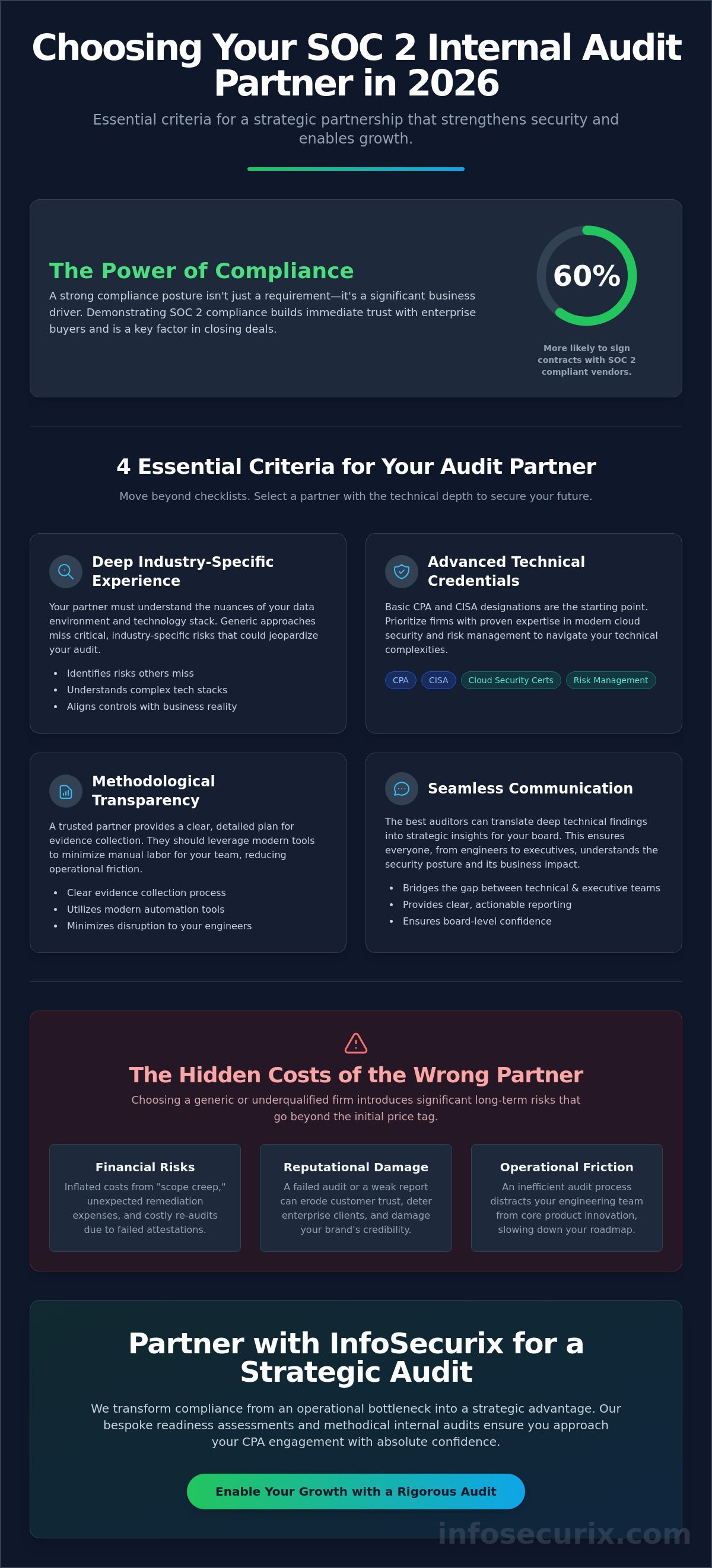
Sixty percent of organizations are more likely to sign contracts with vendors that demonstrate SOC 2 compliance; however, the journey toward that achievement often feels like an operational bottleneck rather than a strategic milestone. You likely recognize the inherent tension of balancing rigorous soc 2 internal audit requirements with the need to keep your engineering team focused on core innovation. It’s a delicate equilibrium where generic templates and rigid checklists frequently fail to address the specific complexities of your digital architecture or the sophisticated expectations of modern enterprise buyers.
We believe that compliance should never come at the cost of your team’s productivity or result in a report that merely ticks boxes without strengthening your actual security posture. Discover the essential criteria for selecting a cybersecurity internal audit firm that acts as a seasoned partner through the 2026 landscape. By focusing on bespoke readiness assessments and methodical internal audits, you can minimize operational friction and approach your formal CPA engagement with absolute confidence in your organization’s resilience.
Key Takeaways
- Understand why maintaining strict independence during the internal audit phase is the essential foundation for a seamless and successful external CPA attestation.
- Identify the specialized credentials and industry-specific experience necessary to satisfy rigorous soc 2 internal audit requirements while simultaneously enhancing your overall security posture.
- Discover how a methodical approach to boundary scoping and control testing transforms compliance from a simple checklist exercise into a robust, security-first strategic advantage.
- Evaluate the long-term financial and reputational risks associated with selecting a compliance partner that lacks the technical proficiency to navigate complex data environments.
- Learn how a sophisticated partnership with a seasoned guide ensures your compliance efforts enable enterprise growth rather than creating unnecessary operational friction.
The Strategic Necessity of a Specialized Cybersecurity Internal Audit Firm
Achieving a pristine SOC 2 report in 2026 requires more than a simple desire for excellence; it demands a rigorous, independent validation of your control environment. A specialized internal audit firm serves as a critical intermediary, ensuring that your organization doesn’t just meet the baseline What is SOC 2? standards but actually masters them. While internal teams possess deep knowledge of their own systems, they often suffer from the proximity bias that obscures systemic weaknesses. An external partner brings the objectivity needed to satisfy the most demanding soc 2 internal audit requirements, providing a level of scrutiny that internal resources simply cannot replicate.
Independence is the cornerstone of a successful CPA attestation. When an external auditor arrives to perform the formal examination, their confidence is significantly bolstered by the presence of a professional internal audit conducted by a specialized third party. This separation of duties ensures that the individuals designing the controls are not the same ones validating their effectiveness. It eliminates the “echo chamber” effect, where internal engineering teams might inadvertently overlook misconfigurations or documentation gaps because “that’s just how we’ve always done it.” By identifying these vulnerabilities early, a specialized firm transforms the audit from a stressful hurdle into a predictable, streamlined process.
Bridging the Gap Between Readiness and Attestation
There is a fundamental distinction between a readiness assessment and a formal internal audit. A readiness assessment is a diagnostic tool used to establish a baseline through meticulous gap analysis. It identifies what’s missing. In contrast, the internal audit is the active testing of those controls to ensure they operate effectively over time. By coordinating closely with your eventual external CPA, a specialized firm ensures that the Trust Services Criteria (TSC) are not just theoretical concepts but are mapped directly to your operational reality. This alignment prevents the “scope creep” that often inflates audit costs and timelines.
The Value of 25 Years of Security Expertise
Longevity in the cybersecurity space translates to more than just a list of past clients; it represents a deep repository of reliable audit outcomes and seasoned insights. Navigating complex regulatory landscapes requires a partner who has witnessed the evolution of threats and the corresponding shifts in auditor expectations. Leveraging this experience allows you to position compliance as a catalyst for market expansion. When you can demonstrate a history of rigorous standards, you move beyond mere “checkbox” security and build a foundation of trust that resonates with enterprise-level prospects and venture capital partners alike.
Essential Criteria for Evaluating a SOC 2 Internal Audit Partner
Selecting a premier cybersecurity internal audit firm is a decision that extends far beyond a simple procurement exercise: it is an investment in your organization’s future scalability and market reputation. Rather than settling for a generic service provider, look for a firm that demonstrates deep industry-specific experience. A partner who understands the nuances of your unique data environment will be far more effective at identifying risks that others might miss. They should possess a sophisticated understanding of how your specific technology stack interacts with the evolving soc 2 internal audit requirements that define the 2026 landscape.
Verify that their credentials go beyond the basics. While CPA and CISA designations are essential, you should prioritize firms whose professionals hold advanced certifications in cloud security and risk management. This ensures they can navigate technical complexities with precision. Methodological transparency is also the bedrock of trust. You should expect a firm to provide a detailed explanation of their evidence collection process: one that utilizes modern tools to reduce manual labor for your staff. This transparency must extend to their communication style. A high-level consultant should be able to move seamlessly from technical mechanics to executive-level reporting, ensuring that your board understands the strategic impact of your security investments.
National reach and scalability are vital for organizations with an eye on the horizon. If your enterprise plans to expand, you need an internal audit partner that can maintain a consistent standard across diverse geographic regions. This scalability ensures that your compliance framework doesn’t become fragmented as you grow. It provides a steady, protective force that enables your business to scale without the fear of outgrowing your security controls. Partnering with a firm that offers professional internal audit services tailored to your specific compliance objectives can provide the clarity needed to begin this journey with total confidence. A comprehensive SOC2 Readiness Assessment can also provide the clarity needed to begin this journey with total confidence.
Technical Proficiency vs. Strategic Guidance
The most effective partners don’t just identify gaps: they offer a curated roadmap for improvement. This involves delivering bespoke corrective action plans that align with your business objectives rather than just providing a list of findings. Assessing a firm’s legacy in mastering information security internal audits provides insight into their ability to handle complex, high-stakes environments with the steady hand of a seasoned veteran. They should act as a visionary guide, helping you future-proof your business through meticulous standards.
Cultural Alignment and Partnership
Audit fatigue is a real risk for internal engineering teams. You can mitigate this by choosing a partner who adopts a “Trusted Advisor” persona. This collaborative approach means the auditor works with you, not against you, to find solutions that satisfy compliance without hindering innovation. It’s about finding a rhythm that respects your internal operational pace while maintaining absolute rigorousness. A true partner is invested in your long-term success, ensuring that the audit process feels like a shared achievement rather than a distant, punitive inspection.
The Internal Audit Methodology: Moving Beyond Simple Checklists
A sophisticated methodology distinguishes a premier firm from a mere service provider. It replaces the anxiety of the unknown with a structured, logical path toward compliance. This process ensures your organization satisfies all soc 2 internal audit requirements while building a more resilient security architecture. A professional methodology follows five distinct phases:
- Phase 1: Comprehensive Scoping and Boundary Definition. The auditor identifies exactly which systems, data sets, and third-party relationships fall under the audit umbrella. This prevents scope creep and ensures every critical asset is accounted for.
- Phase 2: Meticulous Control Design and Effectiveness Testing. It isn’t enough to have a policy in place; the auditor verifies that each control functions as intended to mitigate specific risks.
- Phase 3: Deep-Dive Evidence Gathering and Documentation Review. Every security claim is backed by verifiable, high-quality data. This phase moves beyond surface-level reviews to ensure your documentation is audit-ready.
- Phase 4: Identifying Vulnerabilities and Strategic Remediation Planning. Instead of just pointing out flaws, your guide provides a curated roadmap for resolution. This identifies systemic issues that might otherwise remain hidden.
- Phase 5: Final Internal Audit Reporting and Readiness Confirmation. This provides the definitive green light to proceed to the formal external attestation with total confidence.
Rigorous Evidence Collection Strategies
A seasoned guide understands that evidence collection is often the most disruptive part of the audit lifecycle. To maintain momentum, the firm employs a systematic approach: connecting broad control requirements with specific evidence points to eliminate ambiguity. This clarity reduces audit fatigue for your engineering team. It allows them to stay focused on core innovation while the audit firm manages the technical heavy lifting. Robust evidence is essential; it must be strong enough to withstand the intense scrutiny of an external CPA, leaving no room for doubt regarding your security posture.
Strategic Corrective Actions
Remediation shouldn’t be a frantic race to patch holes. It requires a visionary approach that improves security without halting your organization’s productivity. A premier firm oversees the implementation of new controls: acting as a collaborative ally rather than a distant observer. By focusing on meticulous current-day standards, you future-proof your business against evolving threats. This strategic oversight ensures that every corrective action adds long-term value to your operational framework and enhances your market reputation. It transforms a technical necessity into a competitive advantage that resonates with enterprise-level partners.
The Hidden Costs of Choosing the Wrong Compliance Partner
The initial price of a compliance engagement is often a deceptive metric: the true cost reveals itself during the execution phase. Selecting a partner based solely on the lowest bid frequently results in a cascade of hidden expenses that far outweigh the upfront savings. A failed external CPA audit necessitates a second round of testing and documentation: a financial drain that includes both additional auditor fees and the massive opportunity cost of diverted internal focus. Beyond the balance sheet, the reputational fallout of a qualified report or a delayed attestation can be catastrophic. Enterprise buyers in 2026 have zero tolerance for security ambiguity; a single failure to meet soc 2 internal audit requirements can result in the immediate termination of high-value contract negotiations.
Operational friction is perhaps the most insidious cost. Low-cost firms often rely on rigid, automated templates that don’t account for your specific cloud architecture. This forces your most expensive engineering resources to spend weeks “translating” your environment for an auditor who lacks technical depth. It creates a state of “compliance theater” where your team is busy checking boxes but your actual security posture remains stagnant. This approach leaves you vulnerable to the very risks the framework was designed to mitigate, potentially leading to third-party data breaches that now cost an average of over $5.08 million.
Avoiding the Pitfalls of Generic Audit Firms
Generic firms often prioritize volume over technical precision: a strategy that inevitably leads to significant security gaps. These providers typically lack the deep-rooted knowledge required for complex frameworks like ISO 27001 certification readiness. Without this comprehensive perspective, an internal audit becomes a surface-level exercise. You need a partner who understands the interconnectedness of modern standards, including how a structured ISO 27001 internal audit checklist can serve as a strategic foundation for validating your ISMS controls across overlapping compliance frameworks. Choosing a firm that treats your audit as a commodity increases the likelihood of “nonconforming” engagements: a risk that has prompted the AICPA to implement more structured monitoring as of June 1, 2026.
Quantifying the Value of a Premium Audit
Investing in a rigorous internal audit is a strategic move that pays dividends in both efficiency and security. By identifying and resolving control deficiencies early, you save thousands in potential remediation costs that would otherwise surface during the formal attestation. Executive leadership gains a “peace of mind” dividend: the absolute confidence that their organization is resilient and future-proofed. Most importantly, a bulletproof SOC 2 report accelerates the sales cycle. It allows your team to close enterprise deals faster by removing security objections early in the procurement process. If you are ready to move beyond basic checklists, consider a professional Internal Audit to secure your competitive advantage.
InfoSecurix: Your National Partner for Rigorous Security Audits
For twenty-five years, InfoSecurix has served as a steadfast guardian for organizations navigating the complexities of the digital regulatory landscape. Our legacy is built on a foundation of trust: a quarter-century of guiding national enterprises through the most demanding shifts in security standards. We understand that your security posture is a living reflection of your commitment to excellence. By choosing a partner with this level of longevity, you gain access to a deep repository of institutional knowledge that remains unfazed by the increasing complexity of modern data environments. Our seasoned guides have seen every possible scenario, allowing them to remain calm under pressure while delivering the precision your stakeholders expect.
The InfoSecurix approach represents a sophisticated balance of authoritative expertise and reassuring partnership. We don’t view an audit as a distant, punitive inspection; instead, we act as a collaborative ally invested in your long-term growth. Navigating soc 2 internal audit requirements demands more than technical knowledge; it requires a partner who understands the strategic weight of every control. We deliver bespoke internal audits that are meticulously curated to reflect your unique architecture. This personalized attention ensures that your compliance framework is not a generic shell but a robust, functional asset that protects your competitive advantage.
National enterprises trust our team because we provide a visionary perspective that looks beyond the immediate audit cycle. We focus on future-proofing your business through meticulous standards that resonate with high-level decision-makers. Our professional internal audit services are designed to be steady and measured: reflecting our commitment to accuracy in every finding. This methodical flow ensures that your path to compliance is logical and transparent, providing a narrative of achievement that you can proudly share with venture capital partners and enterprise-level clients alike.
Our Commitment to Professional Excellence
We provide absolute confidence through meticulous documentation that stands up to the most rigorous external scrutiny. Every technical process we implement is designed to have a strategic impact on your business growth: transforming security from a cost center into a powerful market differentiator. We move beyond the granular mechanics of control testing to focus on visionary security leadership. This high-level register ensures that our reporting remains accessible to executive leadership while maintaining the technical proficiency required for a flawless attestation. Our goal is to empower your organization to scale with the security of a seasoned veteran at your side.
Begin Your Journey to Absolute Compliance
The 2026 landscape leaves no room for security ambiguity. Now is the time to engage a partner that can transform your compliance journey from a hurdle into a strategic milestone. We invite you to elevate your security standards and secure the trust of your most valuable partners. Whether you require a comprehensive SOC2 Readiness Assessment or a rigorous Internal Audit, our team is ready to guide you. Take the next step in future-proofing your enterprise by choosing a partner that values precision as much as you do. Contact us today to begin a collaboration that prioritizes your growth and resilience.
Elevating Your Security Posture for 2026 and Beyond
Selecting a partner who views compliance as a strategic asset rather than a technical burden is the definitive step toward long-term enterprise success. A methodical approach to scoping and evidence collection eliminates operational friction and protects your most valuable engineering resources. By prioritizing technical precision and cultural alignment, you ensure that your organization doesn’t just meet soc 2 internal audit requirements but actually strengthens its foundational security. This is particularly vital given that 70% of venture capitalists prefer to invest in SOC 2-compliant companies.
InfoSecurix brings over 25 years of information security expertise to every engagement; we provide a sophisticated balance of authoritative guidance and collaborative partnership. We specialize in delivering bespoke remediation plans for complex enterprise environments, ensuring that your unique architecture is reflected in every control. Our national reach is paired with a boutique, high-touch consultative approach that focuses on your specific growth objectives.
Approaching your audit with a seasoned guide at your side transforms a complex process into a predictable, empowering achievement. We look forward to helping you build a future rooted in absolute security and trust.
Frequently Asked Questions
What is the primary role of a cybersecurity internal audit firm in SOC 2 preparation?
The primary role of a cybersecurity internal audit firm is to provide an objective, third-party validation of your control environment before the formal CPA examination begins. This process ensures that your organization satisfies all soc 2 internal audit requirements by identifying design flaws or operational weaknesses early. It serves as a rigorous dress rehearsal that builds absolute confidence in your eventual audit outcome.
How long does a typical SOC 2 internal audit engagement last?
A typical internal audit engagement generally lasts between four and eight weeks. This timeline depends on the complexity of your digital architecture and the number of Trust Services Criteria included in your scope. Meticulous planning and efficient evidence collection can streamline this process; it allows your team to maintain its operational momentum while achieving a high standard of readiness.
Can an internal audit firm also perform the final SOC 2 attestation?
An internal audit firm cannot perform the final SOC 2 attestation due to strict independence standards established by the AICPA. The firm that prepares you must remain separate from the CPA firm that issues the formal report. This separation of duties is the cornerstone of a credible audit process, as it ensures that the external auditor provides a truly impartial evaluation of your security posture.
What are the specific Trust Services Criteria that an internal audit covers?
A SOC 2 internal audit covers the five Trust Services Criteria (TSC) defined by the AICPA: Security, Availability, Confidentiality, Processing Integrity, and Privacy. While the Security criterion is mandatory for every engagement, the others are selected based on your specific service offerings and the soc 2 internal audit requirements of your clients. A seasoned guide helps you determine which criteria are essential to satisfy enterprise expectations.
How much does it cost to hire a specialized cybersecurity internal audit firm?
The cost of hiring a specialized internal audit firm varies based on the size of your organization and the breadth of your audit scope. Factors such as the number of employees, the complexity of your cloud environment, and the specific Trust Services Criteria involved will influence the final investment. It’s best to request a bespoke proposal that reflects your unique operational requirements and strategic goals.
What happens if the internal audit identifies significant security gaps?
If significant security gaps are identified, the internal audit firm provides a curated remediation roadmap to address these vulnerabilities before the formal audit begins. This strategic intervention allows your team to implement corrective actions without the pressure of a live external examination. It transforms potential failures into opportunities for strengthening your overall security posture and operational resilience.
How does an internal audit differ from a standard IT risk assessment?
An internal audit focuses on testing the operating effectiveness of existing controls, while an IT risk assessment identifies and prioritizes potential threats to your environment. The internal audit is a backward-looking verification of whether your security promises are being kept. In contrast, a risk assessment is a forward-looking exercise that informs the design of your control framework and future security investments.
Is a SOC 2 internal audit required for both Type 1 and Type 2 reports?
While not strictly mandatory by AICPA standards, a SOC 2 internal audit is highly recommended for both Type 1 and Type 2 reports to ensure a successful outcome. For a Type 1 report, the audit validates control design at a point in time. For a Type 2 report, it tests the effectiveness of those controls over a duration, making the internal audit even more critical for identifying operational inconsistencies before the CPA arrives.