

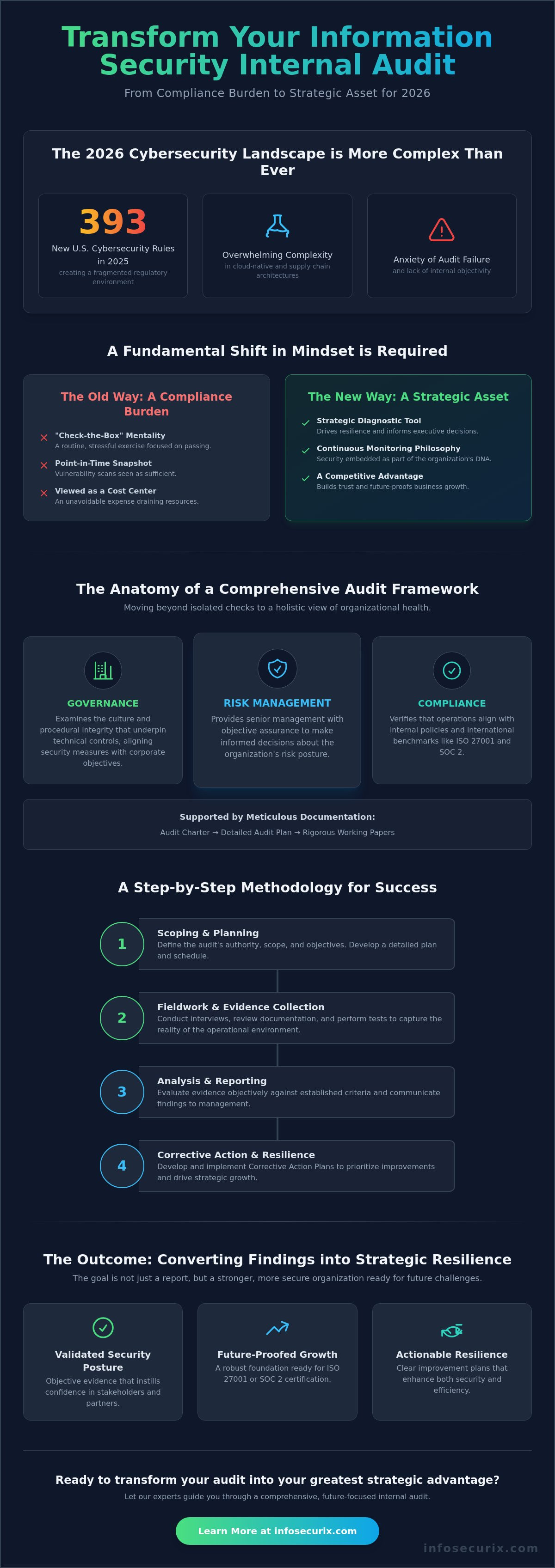
What if your next information security internal audit wasn’t a stressful checklist, but the most valuable strategic diagnostic tool in your executive toolkit? It’s a common sentiment among leaders that the overwhelming complexity of modern regulatory standards feels like a weight rather than a shield. You likely feel the anxiety of potential audit failures or worry that your internal team lacks the necessary objectivity to truly scrutinize their own systems. We agree that the mounting pressure of 393 new cybersecurity rules passed in the U.S. in 2025 makes this process feel more daunting than ever.
This article promises to help you transform your information security internal audit from a compliance burden into a powerful driver of organizational resilience and strategic growth. By moving beyond a “check-the-box” mentality, you can future-proof your business: you’ll demonstrate meticulous standards to your partners while securing your long-term trajectory. We’ll provide a clear, curated framework for 2026 that covers the mandatory transition to ISO/IEC 27001:2022 and the integration of the NIST CSF 2.0 “Govern” function into your broader risk management strategy.
Strategic Audit Insights
- Elevate your information security internal audit from a routine exercise to a strategic asset: providing the objective evidence required to validate your security posture and instill stakeholder confidence.
- Integrate governance and risk management into a bespoke framework: ensuring your security domains are thoroughly aligned with 2026 regulatory expectations and corporate objectives.
- Understand the symbiotic relationship between internal reviews and external certification: building a robust foundation that ensures readiness for ISO 27001 or SOC2 assessments.
- Adopt a methodical execution strategy: moving from precise scoping to comprehensive fieldwork that captures the reality of your operational environment through rigorous evidence collection.
- Transform audit findings into actionable resilience: utilizing Corrective Action Plans to prioritize improvements that drive both security integrity and strategic growth.
Defining the Strategic Value of Information Security Internal Audits
An information security audit is far more than a technical exercise; it’s a systematic, independent, and documented process designed to obtain evidence and evaluate it objectively. While many organizations rely on vulnerability scans or penetration tests to identify technical weaknesses, these are merely snapshots of a specific moment. An information security internal audit goes deeper: it examines the governance, the culture, and the procedural integrity that underpin those technical controls. It’s the difference between checking the locks on a door and evaluating the entire security strategy of the building.
In 2026, the paradigm has shifted from “point-in-time” assessments toward a philosophy of continuous monitoring. This evolution ensures that security isn’t just a hurdle to clear once a year but a living part of the organization’s DNA. By positioning the audit as the “Check” phase within the Plan-Do-Check-Act (PDCA) cycle, leaders ensure their security management systems remain agile and responsive to a volatile threat environment. It’s a proactive diagnostic that identifies where the system is thriving and where it requires refinement before an external auditor ever steps through the door.
The Core Objectives of a Professional Audit
The primary goal is to verify that your operations align with both internal policies and international benchmarks, such as ISO 27001. It’s about finding the gaps between what’s written in a policy and what’s actually happening on the ground. Beyond simple compliance, a professional information security internal audit identifies operational inefficiencies that might be draining resources without adding security value. Most importantly, it provides senior management with the objective assurance they need to make informed decisions about the organization’s risk management posture. It transforms technical data into executive-level insight.
Why Internal Audits are Non-Negotiable in 2026
The current environment is defined by the staggering complexity of cloud-native architectures and interconnected supply chains. With 393 new cybersecurity rules passed across 37 U.S. states in 2025, the regulatory environment is more fragmented than ever. Conducting a regular internal audit is now a mandatory prerequisite for maintaining SOC 2 or ISO certifications. It’s the mechanism that proves to your partners that you’re a reliable link in their chain. This transparency builds a legacy of trust, protecting your brand reputation and positioning security as a competitive advantage rather than a cost center. It’s about future-proofing your growth through meticulous current-day standards.
The Anatomy of a Comprehensive Internal Audit Framework
A high-performing framework acts as the architectural blueprint for your security posture. It must encompass the essential domains of governance, risk management, and compliance (GRC) to ensure that technical defenses aren’t operating in a vacuum. By examining the relationship between internal audit and information security, organizations can align their defensive measures with broader corporate goals. This integration is vital for a modern information security internal audit, as it moves the focus from isolated IT checks to a holistic view of organizational health.
Establishing this framework requires meticulous documentation. Every engagement begins with an audit charter that defines authority and scope, followed by a detailed audit plan and rigorous working papers. These documents serve as the permanent record of the auditor’s work, providing the traceability required by executive boards and external regulators alike. Without this paper trail, even the most thorough investigation lacks the evidentiary weight needed to drive real change.
Mapping to International Standards: ISO 27001 and SOC 2
Precision in auditing is often defined by how well a program maps to global benchmarks. For those pursuing ISO 27001 certification readiness, the internal audit is a specific requirement under Clause 9.2. This clause mandates that the organization conduct audits at planned intervals to provide information on whether the ISMS conforms to the standard’s requirements. To ensure your program addresses every control and clause requirement, a professional-grade ISO 27001 internal audit checklist can serve as an indispensable roadmap for achieving full certification readiness. Similarly, for SOC 2 compliance, the framework must align with the Trust Services Criteria, specifically focusing on Security, Availability, and Confidentiality. Understanding the full scope of SOC 2 internal audit requirements ensures that your internal efforts are directly contributing to the successful outcome of future external assessments.
Technical vs. Administrative Control Auditing
A balanced information security internal audit scrutinizes both the digital locks and the people who hold the keys. Technical control auditing focuses on safeguards like encryption protocols, granular access controls, and network security configurations. In contrast, administrative auditing assesses human-centric processes: employee security awareness training, the maturity of incident response plans, and the rigor of vendor management. Control effectiveness is the measure of a control achieving its intended security objective. Assessing both domains ensures that a sophisticated firewall isn’t undermined by a lack of procedural discipline. If you’re looking to validate your current framework, our professional Internal Audits bridge the gap between technical rigor and strategic oversight.
Internal vs. External Audits: Navigating the Compliance Lifecycle
Navigating the compliance lifecycle requires a clear understanding of the distinction between internal and external oversight. While an external audit provides a formal validation for stakeholders and regulators, the information security internal audit serves as the organization’s private engine for continuous improvement. These two functions don’t compete; they form a symbiotic relationship that ensures long-term resilience. External certification bodies, such as those issuing ISO 27001:2022 credentials, explicitly require proof of a robust internal program before they’ll grant or renew a certification. This requirement exists because a one-time external review cannot capture the nuances of year-round operational integrity.
The evolution of internal audit has shifted the focus from mere compliance to strategic partnership. It’s a common misconception that passing an external audit means your internal processes are flawless. Conversely, a strong internal program doesn’t remove the need for external validation. The reporting structures are also distinct: internal auditors typically report to the Board of Directors or an Audit Committee. This ensures that findings reach the highest levels of governance without being filtered by operational management, maintaining the integrity of the results.
The Synergy of the ‘Three Lines of Defense’ Model
Modern governance relies on the Three Lines of Defense model to prevent conflicts of interest and ensure comprehensive coverage. The first line consists of operational management who own and manage risks daily. The second line includes compliance and risk functions that provide oversight and frameworks. The third line, independent internal audit, provides high-level assurance that the first two lines are functioning as intended. InfoSecurix acts as a force multiplier for this third line, bringing specialized expertise that complements your existing team’s efforts and strengthens your overall defense posture.
Choosing Between In-House and Outsourced Internal Audits
Deciding whether to perform audits in-house or through a partner is a critical strategic choice. In-house teams possess deep tribal knowledge of the company’s systems, but they often suffer from the “blind spot” risk of auditing their own department’s work. Objectivity is the currency of a successful information security internal audit. Partnering with cybersecurity internal audit firms provides an unbiased, expert-level perspective that internal staff may lack. This co-sourcing approach ensures that your assessments are rigorous, independent, and capable of identifying risks that might otherwise go unnoticed.
Executing the Audit: A Step-by-Step Methodology for Success
Executing a rigorous information security internal audit requires a disciplined transition from high-level strategy to granular, evidence-based investigation. This phase is where the theoretical framework meets the operational reality of the organization. A successful execution doesn’t merely look for errors; it seeks to validate the integrity of the entire Information Security Management System (ISMS). By adhering to a methodical three-phase approach, auditors ensure that their conclusions are defensible, objective, and capable of withstandng the scrutiny of external certification bodies.
Phase 1: Strategic Planning and Scoping
Developing a precise scope is the most critical precursor to a meaningful audit. Rather than attempting to boil the ocean, auditors must identify critical assets and high-risk processes that demand prioritization based on their impact on business continuity. This risk-based audit plan should align perfectly with the organization’s strategic goals: ensuring that security investments are protecting what matters most. Securing senior management buy-in during this stage is vital; it guarantees the auditor has the necessary access to personnel, systems, and sensitive documentation without administrative friction.
Phase 2: Fieldwork and Evidence Gathering
Fieldwork represents the heart of the audit process, involving a deep dive into the daily life of the organization’s security controls. Auditors conduct structured interviews with process owners to verify that actual practices align with written policies. These conversations are often supplemented by “walkthroughs,” where the auditor observes controls functioning in a live environment: such as witnessing the offboarding process for a departing employee or reviewing real-time firewall logs. Audit evidence must be sufficient, reliable, and relevant to support the auditor’s findings. This empirical approach eliminates guesswork and ensures that every observation is rooted in verifiable fact.
Phase 3: Reporting and Strategic Synthesis
Concluding the fieldwork leads to the reporting phase, where raw data is synthesized into actionable intelligence. The resulting audit report should clearly distinguish between minor non-conformities, major system failures, and “opportunities for improvement” that suggest ways to enhance existing controls. It’s essential to present these findings not as a list of failures, but as a roadmap for growth. Drafting a clear narrative helps stakeholders understand the “why” behind each finding, facilitating a smoother transition into the remediation phase. If your organization requires a professional, unbiased perspective to lead this process, our Internal Audits provide the expert-level oversight needed to secure your 2026 compliance goals.
Maintaining a commitment to evidence-based conclusions over subjective opinions is what separates a professional audit from a casual review. This rigor is especially important when preparing for information security risk assessments or formal certifications, where the quality of your internal evidence will be the primary measure of your organization’s maturity. By treating the audit as a systematic diagnostic, you turn a mandatory requirement into a powerful tool for long-term strategic resilience.
Beyond the Report: Converting Audit Findings into Strategic Resilience
The true value of an information security internal audit isn’t realized when the final report is signed; it’s found in the subsequent transformation of your security posture. The Corrective Action Plan (CAP) serves as the most critical output of this entire process, providing a structured roadmap for remediation. By prioritizing findings based on their risk impact and the relative ease of implementation, leadership can allocate resources with surgical precision. This approach ensures that high-risk vulnerabilities are addressed first, maximizing the return on security investment while building a legacy of trust with stakeholders.
Utilizing root cause analysis is essential during this phase: it prevents organizations from merely treating symptoms. Instead of fixing a single misconfigured server, a thorough investigation uncovers the underlying procedural failure that allowed the misconfiguration to occur. This depth of analysis turns the audit into a catalyst for cultural change, fostering a sense of shared responsibility and heightened security awareness across the enterprise. With lawmakers across 37 U.S. states passing 99 cybersecurity-related bills in 2025 alone, this proactive shift in culture is no longer optional; it’s a fundamental requirement for staying ahead of a rapidly tightening regulatory net.
Managing Non-Conformities and Corrective Actions
Remediation requires a clear classification system to guide the urgency of response. A ‘Major Non-Conformity’ represents a significant failure in the management system that compromises security objectives, while a ‘Minor Non-Conformity’ is typically a localized or isolated failure that doesn’t jeopardize the overall system integrity. An ‘Observation’ identifies an opportunity for improvement where the current control is compliant but could be optimized for better efficiency. Developing a systematic process for tracking remediation progress is vital to ensure that every fix is durable and verified for effectiveness.
Organizations must be vigilant against “paper fixes”: the practice of creating policies that exist only on a hard drive without any operational reality. Such superficial compliance is the leading cause of external audit failures, as seasoned auditors quickly identify the gap between stated intent and actual practice. Real resilience is built through evidence-based remediation that stands up to the most rigorous scrutiny. A comprehensive information security risk assessment methodology ensures that your remediation efforts are grounded in a thorough understanding of your organization’s actual threat landscape.
The InfoSecurix Advantage: From Audit to Excellence
InfoSecurix brings over 25 years of experience to every engagement, helping organizations streamline the complex journey from an information security internal audit to full certification. We move beyond generic checklists to provide bespoke audit engagements that reflect your unique operational environment and strategic goals. Our seasoned advisors remain unfazed by complexity, providing the steady guidance needed to future-proof your business through meticulous current-day standards. Partner with InfoSecurix to elevate your security standards today and transform your compliance obligations into a powerful engine for growth.
Elevating Your Audit Strategy for 2026
Implementing a rigorous information security internal audit is the definitive step toward operational excellence. By shifting from a reactive “check-the-box” mentality to a proactive strategic framework, you ensure your organization doesn’t just meet standards but thrives within them. We’ve explored how a methodical execution, rooted in evidence and followed by meaningful corrective actions, transforms technical findings into institutional resilience. This disciplined approach provides the objective assurance senior leadership requires to navigate the fragmented regulatory environment of 2026 with absolute confidence.
InfoSecurix stands ready to guide you through this journey with 25+ years of industry-leading expertise. Our proven track record in ISO 27001 and SOC 2 readiness ensures that your path to compliance is both efficient and thorough. We utilize bespoke, risk-based audit methodologies designed to address your specific operational nuances rather than relying on generic templates.
Secure your organization’s future with a professional internal audit engagement. Together, we can build a secure foundation that enables your sustained growth and protects your professional legacy.
Frequently Asked Questions
What is the primary difference between a security audit and a risk assessment?
An audit verifies that your existing controls are functioning as intended against a specific standard; a risk assessment identifies and evaluates potential threats to your assets. While a information security risk assessment determines what controls you need, the audit confirms you actually have them in place. This distinction is vital for maintaining a robust and compliant Information Security Management System (ISMS).
How often should an organization conduct an information security internal audit?
Organizations should conduct an information security internal audit at least once per year to maintain compliance with international standards like ISO 27001. More frequent reviews are necessary when significant changes occur in your infrastructure, such as migrating to a new cloud provider or undergoing a merger. Continuous monitoring ensures your security posture remains resilient as your business objectives evolve.
Can our IT department perform their own internal audit for ISO 27001?
Your IT department can’t audit their own work because ISO 27001 requires auditors to be objective and impartial throughout the process. Internal teams often possess “blind spots” that prevent them from identifying their own procedural errors or control gaps. Utilizing a specialized partner ensures the independence required to satisfy external certification bodies and identify genuine vulnerabilities before they become risks.
What are the most common findings in a cybersecurity internal audit?
Common findings often include weak access management, such as failure to revoke credentials for terminated employees, and insufficient security awareness training. Auditors also frequently identify “paper fixes” where policies exist but aren’t followed in daily practice. Addressing these gaps early prevents major non-conformities during formal external assessments and strengthens your overall defense posture.
How long does a typical information security internal audit take to complete?
A typical information security internal audit generally takes between two and four weeks to complete, depending on the complexity of your environment. This timeframe includes the initial planning phase, active fieldwork, and the final synthesis of the report. Larger organizations with multiple locations or complex cloud architectures may require a more extended period for thorough evidence collection and interviews.
What documentation is required to prove an internal audit took place?
You must maintain a complete audit trail including the audit charter, the specific audit plan, and documented evidence like system logs or interview notes. The final report and the subsequent Corrective Action Plan (CAP) serve as the primary proof for external regulators. These documents demonstrate that your internal oversight is systematic, rigorous, and capable of driving genuine organizational improvement.
Is an internal audit mandatory for SOC 2 Type II compliance?
An internal audit isn’t strictly mandatory for SOC 2 Type II in the same way it is for ISO 27001, but it’s considered a best practice for demonstrating effective governance. Many organizations include internal reviews as a specific control within their SOC 2 framework to provide objective assurance. This proactive step verifies that your controls operate consistently over the entire audit period, reducing the risk of a qualified report.
How do we choose the right information security internal audit firm?
Select a firm with a proven track record in your specific industry and recognized certifications such as CISA or ISO Lead Auditor. You should prioritize partners who offer bespoke, risk-based methodologies rather than generic checklists, as outlined in our guide to selecting a cybersecurity internal audit firm for SOC 2 compliance in 2026. A truly seasoned guide will act as a collaborative ally, focusing on your long-term strategic resilience rather than just technical compliance.