

For 90% of mid-to-large enterprises, the cost of operational downtime now exceeds $300,000 per hour, making a definitive ISO 22301 implementation guide an essential strategic asset rather than a mere compliance checklist. You likely recognize the mounting pressure from stakeholders to demonstrate absolute operational resilience, yet the technical nuances of Business Impact Analysis (BIA) and Maximum Tolerated Period of Disruption (MTPD) often remain significant obstacles to progress. It’s difficult to feel secure when disaster recovery plans feel fragmented or disconnected from the actual pulse of your daily operations.
This guide provides the systematic clarity required to transform business continuity from a reactive necessity into a strategic competitive advantage. We’ll outline a clear roadmap to certification that prioritizes both rigorous compliance and genuine organizational protection. By following this methodical approach, you’ll move from a high-level vision to a robust framework: starting with readiness assessments and concluding with the internal audits that ensure your organization remains unfazed by complexity. This journey ensures your business doesn’t just survive a crisis, but thrives through it with improved market trust and a superior competitive position.
Key Takeaways
- Transform business continuity from a reactive necessity into a strategic competitive advantage by aligning with the elevated resilience standards of the 2026 landscape.
- Establish a sophisticated governance foundation through secured executive commitment and a meticulously defined scope for your management system.
- Master the intricate phases of Business Impact Analysis to precisely quantify critical dependencies and determine your Maximum Tolerable Period of Disruption.
- Utilize this ISO 22301 implementation guide to develop actionable response strategies: ensuring your organization remains steady and operational during unforeseen crises.
- Secure certification readiness by conducting rigorous internal audits and management reviews to identify and rectify non-conformities with absolute confidence.
The Strategic Value of ISO 22301 Implementation in 2026
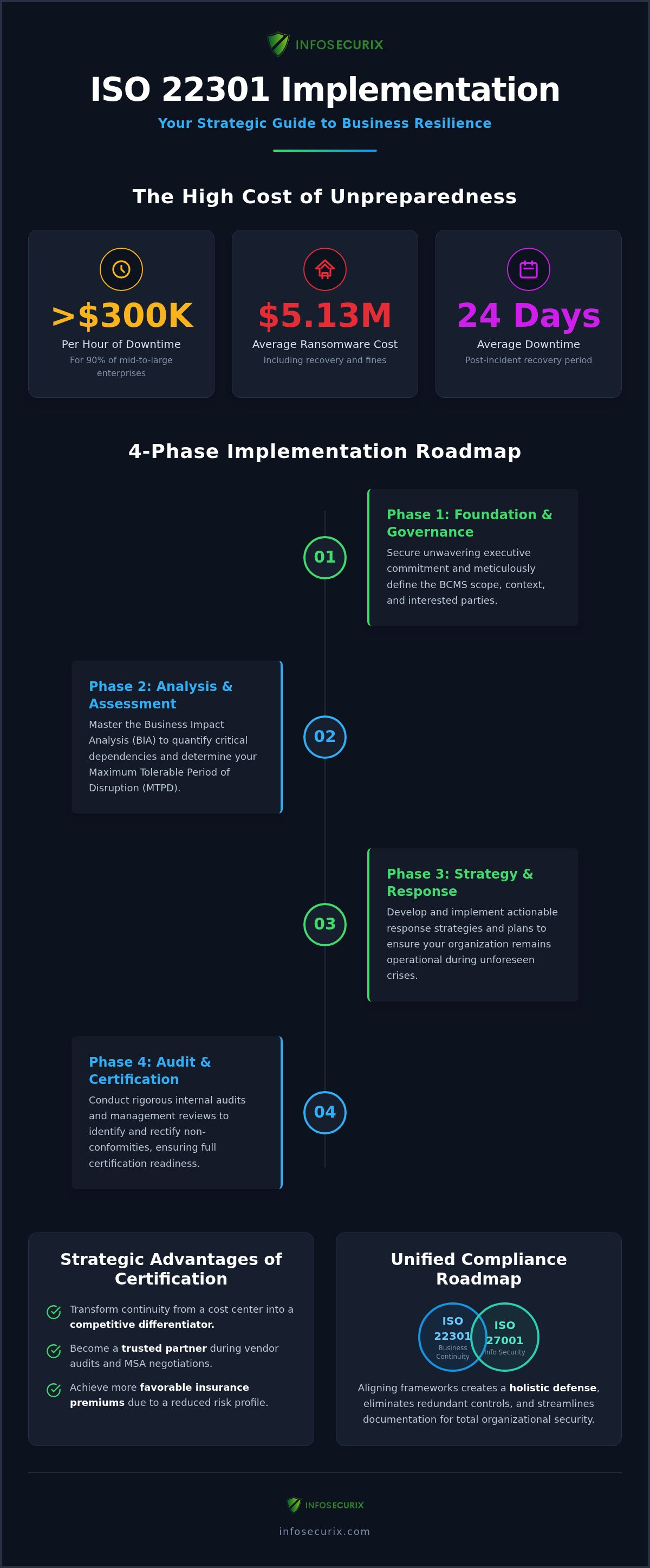
The ISO 22301 standard represents the international pinnacle of Business Continuity Management Systems (BCMS). In 2026, resilience has transitioned from a back-office IT concern into a definitive cornerstone of enterprise value. The shift is palpable: leading organizations are prioritizing proactive operational endurance over traditional, reactive disaster recovery models. This evolution is driven by a stark reality where the average cost of a ransomware attack has reached $5.13 million, and the resulting downtime often stretches to 24 days. Investing in a professional readiness assessment ensures that your journey follows a proven ISO 22301 implementation guide, preventing the costly audit failures that plague less prepared organizations. When you contrast the controlled investment of implementation against the catastrophic expense of unplanned downtime, which exceeds $300,000 per hour for 90% of mid-to-large enterprises, the strategic choice becomes clear.
Resilience as a Competitive Differentiator
Certification serves as a powerful signal to the global market. It transforms your organization into a trusted partner during rigorous vendor audits and Master Service Agreement (MSA) negotiations. When stakeholders see a certified BCMS, they recognize a business that is built to last, regardless of external volatility. This level of transparency often leads to more favorable insurance premiums, as underwriters reward the reduced risk profile of a resilient enterprise. The aspirational goal is no longer just “getting back to normal.” Instead, it is about becoming an organization that possesses the structural integrity to thrive amidst chaos, capturing market share while competitors struggle to recover.
Alignment with ISO 27001 and SOC 2
There is a profound and beneficial overlap between information security and business continuity that many organizations fail to leverage. By aligning your BCMS with other frameworks, you create a unified compliance roadmap that significantly reduces administrative burdens. This integrated approach eliminates redundant controls and streamlines documentation: creating a more efficient path to total organizational security. You can effectively link your continuity efforts with ISO 27001 certification readiness to build a truly holistic defense. Utilizing a shared ISO 22301 implementation guide across departments ensures that your data is not only protected from theft but remains available and functional when your clients need it most. This synergy reinforces your market position as a seasoned veteran who remains calm and capable under pressure.
Phase 1: Establishing the BCMS Foundation and Governance
Success in business continuity is never accidental. It requires a deliberate, top-down mandate that begins with unwavering executive commitment. This stage serves as the bedrock for the entire ISO 22301 implementation guide, ensuring that the Business Continuity Management System (BCMS) is viewed as a vital strategic investment rather than a peripheral IT project. Without a clear signal from leadership, even the most meticulous plans will lack the authority needed to drive organizational change. Establishing this foundation ensures that the organization remains steady and prepared, reflecting the organized nature of a truly resilient enterprise.
Defining the Scope and Context
Defining the scope requires a sophisticated understanding of your organization’s internal and external environment. You must identify the “interested parties,” ranging from regulatory bodies to global supply chain partners, and document their specific continuity requirements. For multi-site or national operations, this involves distinguishing between critical core functions and non-essential peripheral services to ensure resources are focused where they matter most. A concise scope statement should explicitly cover all vital products and services while excluding low-risk areas that don’t impact your primary mission.
This foundational work prepares the ground for the more technical Business Impact Analysis (BIA) and Risk Assessment that will follow. Establishing this context early prevents the common pitfall of over-extending the BCMS, which often leads to administrative bloat and diluted focus. If you’re unsure how to draw these boundaries, engaging with a partner for ISO 22301 business continuity consulting can provide the seasoned perspective needed to navigate complex multi-site requirements.
Leadership and Resource Allocation
Appointing a dedicated Business Continuity Manager and a representative Steering Committee is an indispensable step. The Steering Committee provides the high-level oversight and strategic direction necessary to resolve cross-departmental conflicts. They ensure that resource allocation is consistent and sufficient, moving beyond “part-time” assignments that often fail under pressure. This committee must empower the Business Continuity Manager with the authority to implement the ISO 22301 implementation guide across the corporate culture.
Resilience is built when continuity becomes a shared responsibility. By embedding these standards into the organizational DNA, you create a protective force that enables growth even during periods of extreme volatility. This phase concludes with the formalization of your Business Continuity Policy. This high-level document articulates your organization’s commitment to operational endurance and serves as a guiding light for all subsequent implementation efforts. It’s the moment when the organization’s vision is translated into a tangible, structured commitment to longevity.
Phase 2: Mastering the Business Impact Analysis (BIA) and Risk Assessment
Once the governance framework is established, the focus shifts to the analytical engine of your resilience strategy. This stage of the ISO 22301 implementation guide requires a deep dive into the operational realities of your business to identify what truly matters. You must first identify critical business activities and their intricate dependencies: both internal systems and external partners. Quantifying the impact of disruption over time allows you to determine the Maximum Tolerable Period of Disruption (MTPD), which is the absolute deadline before an outage causes irreparable harm. The official ISO 22301 standard mandates this rigorous approach to ensure that recovery efforts are prioritized based on objective necessity rather than departmental guesswork.
Establishing Recovery Time Objectives (RTO) and Recovery Point Objectives (RPO) is the next vital step. These metrics aren’t just technical targets; they’re business survival thresholds. Given that 58% of backups fail during actual recovery attempts, according to 2024 industry data, these objectives must be grounded in realistic capability. Finally, you’ll conduct a threat-based Risk Assessment to identify vulnerabilities in your critical processes. This proactive stance allows you to address weaknesses before they’re exploited, moving your organization from a state of vulnerability to one of prepared endurance.
The BIA: Quantifying the Unthinkable
A sophisticated BIA distinguishes between financial loss, operational paralysis, and long-term reputational damage. It’s a strategic decision tool that allows you to prioritize activities based on the sheer urgency of recovery. During this phase, you must look beyond your own walls to identify “Single Points of Failure” within your supply chain. Identifying these bottlenecks early ensures that your continuity plan isn’t derailed by a third-party failure. By mapping these dependencies with precision, you create a transparent view of your enterprise’s true resilience profile, allowing leadership to make informed investments in redundancy.
Risk Assessment vs. BIA
It’s vital to clarify the distinct roles of these two processes: the BIA focuses on the effect of a disruption, while the Risk Assessment focuses on the cause. The Risk Assessment evaluates the likelihood and potential impact of specific threats, such as cyberattacks, natural disasters, or equipment failure. This methodology ensures that your response strategies are tailored to the most probable scenarios. The synergy between these processes is explored in depth in our guide to information security risk assessment, which illustrates how business continuity and data protection work in tandem. This holistic view ensures that your BCMS remains robust, integrated, and capable of protecting the organization’s most valuable assets.
Phase 3: Developing and Exercising Response Strategies
Translating the analytical insights from your BIA into actionable results is where the ISO 22301 implementation guide proves its practical worth. You must select continuity strategies that align precisely with your established survival thresholds. These strategies, which might include site mirroring, remote work protocols, or third-party redundancy, are the structural pillars of your enterprise resilience. Documenting these Business Continuity Plans (BCP) with clear, actionable procedures ensures that your team remains steady when a crisis hits. By developing robust Incident Response and Emergency Management protocols, you provide your staff with the authoritative guidance needed to manage complex disruptions with absolute confidence.
Strategic Response Options
Evaluating the cost-benefit of “Active-Active” versus “Cold Site” recovery strategies is a high-level decision that defines your operational endurance. Active-Active configurations provide near-instantaneous failover for critical services, while Cold Sites offer a more budget-conscious, albeit slower, recovery path. You must also prioritize the human element: ensuring staff safety and maintaining clear communication channels during a disruption. Integrating IT Disaster Recovery (ITDR) within the broader BCP ensures that your technical infrastructure supports your critical business functions without any friction or misalignment. This holistic approach reflects the organized nature of a truly mature management system.
The Power of the Exercise
A plan only becomes a genuine organizational capability through rigorous, methodical testing. You should implement a tiered exercise program: starting with Tabletop Exercises to identify logic gaps and moving toward full-scale simulations that test real-world response under pressure. These exercises allow you to document “Lessons Learned” to drive the “Act” phase of the Plan-Do-Check-Act (PDCA) cycle. An unexercised plan is merely a liability in disguise. Regular testing ensures that your response protocols are deeply embedded in the organization’s muscle memory, allowing you to thrive amidst chaos while others struggle to find their footing.
Validation is the final step in transforming a document into a protective force. If your current plans haven’t been rigorously validated through a professional simulation, it’s time to partner with a seasoned guide for ISO 22301 business continuity to ensure your organizational readiness is absolute and audit-ready.
Navigating the Certification Audit with InfoSecurix
Achieving formal recognition for your resilience efforts marks the transition from a well-prepared organization to a market-leading enterprise. While the previous phases of this ISO 22301 implementation guide focused on construction, the certification audit is about validation and absolute transparency. Conducting a comprehensive Internal Audit is the indispensable first step in this final journey; it serves as a high-stakes dress rehearsal before the external Registrar arrives. This process identifies potential non-conformities and ensures that your Business Continuity Management System (BCMS) is not just a collection of documents, but a living, breathing protective force. Performing a final Management Review ensures the system remains suitable and effective, aligning your continuity goals with the evolving strategic vision of the boardroom.
The Internal Audit: A Strategic Readiness Check
An independent review of your BCMS controls is more than a compliance requirement: it’s a strategic readiness check that protects your investment. InfoSecurix leverages 25+ years of boutique consultancy experience to identify hidden vulnerabilities in your BIA and BCP documentation that internal teams might overlook. We scrutinize every dependency and recovery objective to ensure they stand up to the most rigorous external examination. For those seeking a deep-dive into our rigorous methodology, our guide on information security internal audit provides a comprehensive framework for multi-standard alignment. This meticulous approach ensures your documentation package, including the Statement of Applicability and BIA reports, is polished and beyond reproach.
The Road to Certification and Beyond
The certification process typically unfolds in two distinct stages. Stage 1 focuses on a thorough documentation review where the auditor confirms your framework meets the structural requirements of the standard. Stage 2 is the implementation audit: a deeper dive where the auditor seeks evidence that your plans are actually practiced and understood by the staff. Partnering with InfoSecurix bridges the critical gap between simple implementation and true certification mastery. We help you navigate these stages with absolute confidence, utilizing our fixed-fee engagement models to provide cost certainty throughout the process.
Certification isn’t a one-time destination; it’s a commitment to a journey of continuous improvement. By maintaining these rigorous standards, you’re future-proofing your business against the sophisticated threats of the 2026 landscape. It’s time to move beyond reactive planning and embrace a bespoke approach to operational endurance. Partner with InfoSecurix for your ISO 22301 Readiness Assessment and transform your ISO 22301 implementation guide into a lasting strategic advantage that secures your organization’s legacy.
Cultivating Absolute Operational Endurance in 2026
Transforming your organization into a disruption-proof enterprise requires more than documentation; it demands a fundamental shift toward proactive endurance. By establishing a robust governance framework and mastering the analytical rigor of the Business Impact Analysis, you’ve laid the groundwork for a system that protects your most critical assets. This ISO 22301 implementation guide has outlined the systematic phases necessary to move from fragmented recovery plans to a unified strategic advantage. Integrating these continuity standards with your existing security frameworks ensures a streamlined, efficient path to compliance that reduces administrative friction.
Navigating the path to certification is a complex undertaking that benefits from the steady hand of a seasoned veteran. Leveraging 25+ years of expert compliance guidance, InfoSecurix provides specialized ISO 22301 readiness assessments designed to ensure your organization remains unfazed by sophisticated threats. Our comprehensive multi-standard integration strategies bridge the gap between readiness and true operational mastery. Secure Your Operational Future with InfoSecurix Compliance Consulting and take the definitive step toward a resilient future. Your commitment to these rigorous standards today ensures your business remains a protective force for your stakeholders for years to come.
Frequently Asked Questions
How long does a typical ISO 22301 implementation take?
Most organizations require three to six months to fully implement the standard. While the certification process itself can take as little as two months for smaller firms, the internal development of policies and procedures requires a more deliberate pace to ensure they’re deeply embedded in the corporate culture.
What is the difference between Business Continuity and Disaster Recovery?
Business Continuity is a holistic strategy that ensures the entire organization remains functional during a crisis. Disaster Recovery is a technical subset of this strategy that focuses specifically on restoring IT systems and data after a failure. A mature management system ensures these two disciplines work in perfect harmony.
Is ISO 22301 certification mandatory for my industry?
It depends on your sector and geography. For example, the EU Digital Operational Resilience Act (DORA) has mandated robust continuity for financial entities since January 2025. Even when not legally required, many organizations find it’s a prerequisite for securing high-value contracts and favorable insurance premiums.
How often should we update our Business Impact Analysis (BIA)?
You should update your BIA at least once per year. It’s also vital to trigger a review after any major change: such as a merger, the adoption of new cloud infrastructure, or a shift in critical supply chain partners. Regular reviews ensure your recovery priorities remain aligned with your current operational reality.
Can ISO 22301 be integrated with ISO 27001?
Integration is highly encouraged and efficient. Because both standards follow the same high-level structure, you can share many core components: including leadership roles, internal audit processes, and document control systems. This unified approach reduces administrative overhead and strengthens your overall security posture.
What are the most common reasons for failing an ISO 22301 audit?
Auditors frequently find non-conformities when plans haven’t been tested or when the BIA lacks depth. Following a professional ISO 22301 implementation guide helps you avoid these pitfalls by ensuring every control is validated and supported by objective evidence before the final assessment begins.
How much does ISO 22301 certification cost?
External certification fees generally fall between $4,000 and $12,000 for the registrar’s services. These costs vary based on the number of sites and the total headcount within the scope of your management system. This figure does not include the internal resources or professional consulting required for implementation readiness.
What is the “Maximum Tolerable Period of Disruption” (MTPD)?
MTPD represents the absolute time limit that a business activity can be disrupted before irreparable damage occurs to the organization’s viability. It’s a strategic survival threshold that dictates the urgency of your response strategies within any ISO 22301 implementation guide. Identifying this period is the most critical step in your BIA.