

Could the perception of your IT department as a mere cost center be the primary obstacle preventing your organization from securing its next major enterprise contract? Many leadership teams find themselves trapped in a cycle of inconsistent service delivery and misaligned priorities: a friction that often results in missed opportunities within the public and private sectors. We recognize that achieving true operational excellence requires more than just technical proficiency; it demands a structured, verifiable commitment to quality that instills absolute confidence in your partners. By understanding the strategic benefits of ISO 20000 certification, you can transform your IT service management into a powerful engine for competitive advantage.
This guide explores how the ISO/IEC 20000-1:2018 standard fosters predictable service levels and builds a reputation for reliability that resonates with global stakeholders. We’ll examine the systematic ways this framework bridges the gap between technical execution and business growth, ensuring your infrastructure is ready for the demands of 2026. Discover how elevating your management system from a set of internal guidelines to a certifiable standard can future-proof your organization through meticulous, world-class excellence.
Key Takeaways
- Understand the transition from reactive troubleshooting to a proactive service model using the global ISO/IEC 20000-1:2018 benchmark.
- Recognize how certification serves as a critical differentiator for winning federal and enterprise contracts in a competitive 2026 landscape.
- Examine the internal benefits of ISO 20000 certification, focusing on streamlined processes and the elimination of operational bottlenecks through precise metrics.
- Learn the strategic importance of conducting a readiness assessment to identify control weaknesses and ensure a successful audit path.
Understanding ISO 20000 in the 2026 IT Landscape
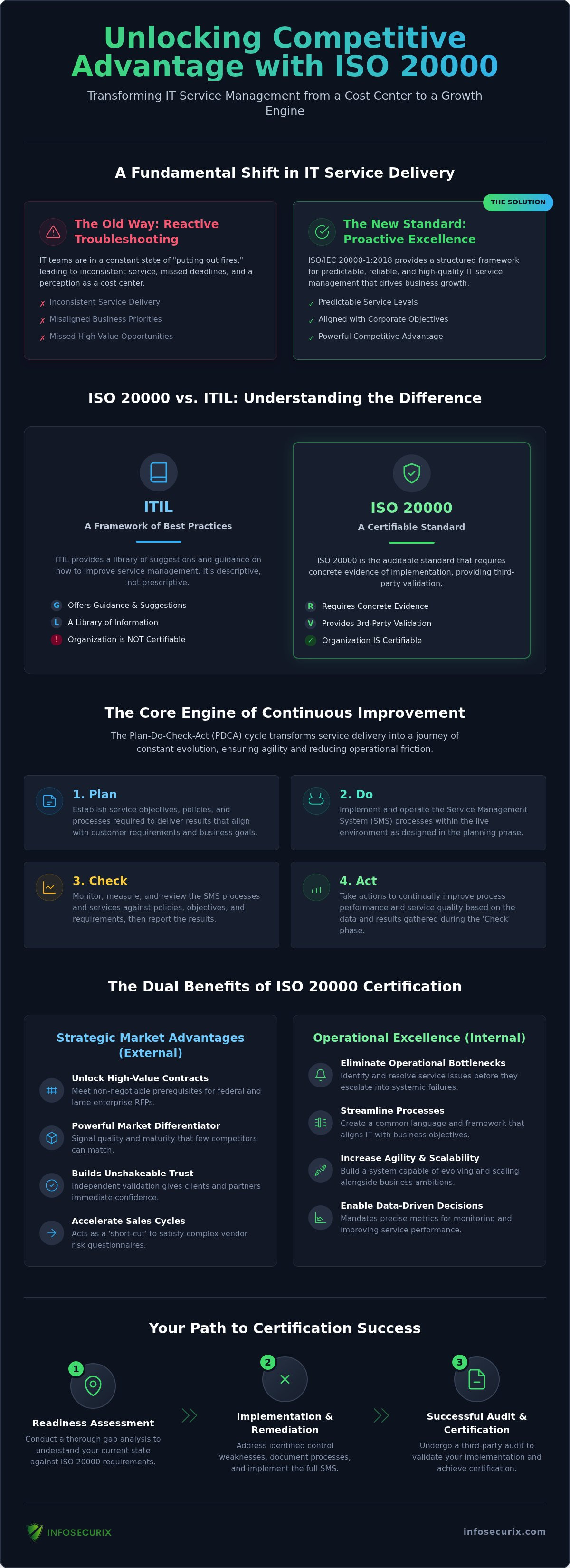
The global benchmark for IT Service Management Systems (SMS) is defined by ISO/IEC 20000-1:2018. This standard represents a fundamental shift in how organizations perceive their digital infrastructure. It moves the needle from reactive troubleshooting: a state where teams are constantly “putting out fires,” to a model of proactive service delivery excellence. In 2026, this distinction is more critical than ever. As organizations grapple with complex AI-driven workflows and sprawling cloud-native service catalogs, the need for a structured management framework becomes undeniable. Adopting this standard provides a common language for IT and business stakeholders; it ensures that performance metrics are aligned with actual corporate objectives.
ISO 20000 vs. ITIL: What is the Difference?
It’s common to hear ITIL and ISO 20000 mentioned in the same breath, yet they serve distinct roles in the pursuit of excellence. ITIL is a comprehensive framework of best practices; it offers a library of suggestions on how to improve service management. However, it isn’t something an organization can be “certified” in. ISO 20000 is the certifiable standard that requires concrete evidence of implementation. One of the major benefits of ISO 20000 certification is that it mandates a level of rigor that ITIL alone does not. It provides third-party validation, giving your partners and clients absolute confidence that your processes aren’t just documented, but are actively followed and measured by independent experts.
The Core Components of an ISO 20000 SMS
A successful Service Management System is built on a foundation of leadership commitment and organizational context. The 2018 revision of the standard places a heavy emphasis on these elements, ensuring that service management is integrated into the very fabric of the business. The engine that drives this system is the “Plan-Do-Check-Act” (PDCA) cycle. This cycle transforms service delivery into a journey of continuous evolution:
- Plan: Establish service objectives and processes necessary to deliver results.
- Do: Implement the processes as designed within the live environment.
- Check: Monitor and measure processes against policies and objectives.
- Act: Take actions to continually improve process performance.
By embedding this cycle into daily operations, the benefits of ISO 20000 certification manifest as increased agility and reduced operational friction. It empowers teams to identify service bottlenecks through data-driven metrics before they escalate into systemic failures. This methodical approach ensures that your IT services are not only reliable but are also capable of scaling alongside your business ambitions.
Strategic Market Advantages and External Benefits
The managed services marketplace is increasingly saturated. Standing out requires more than just technical aptitude. One of the most significant benefits of ISO 20000 certification is its ability to act as a powerful market differentiator. For organizations aiming to elevate their status, this credential serves as a visible hallmark of quality: a signal to the market that your service management processes meet the most rigorous global standards. It effectively shifts the conversation from price to value; it positions your firm as a premium partner capable of handling the most demanding requirements. By securing this standard, you demonstrate a level of maturity that few competitors can match.
Unlocking High-Value Contracts and RFPs
In the United States, the competitive landscape for IT service providers is intense. Many federal agencies and large-scale corporate procurement offices now mandate ISO 20000 compliance as a non-negotiable prerequisite. Without this certification, your organization might be excluded from high-value RFPs before the evaluation even begins. Achieving this standard creates a ‘short-cut’ effect during the vendor onboarding process. It often satisfies the majority of complex vendor risk management questionnaires, allowing your team to bypass months of back-and-forth documentation. This efficiency speeds up the sales cycle and reduces the administrative burden on your legal and compliance departments, allowing them to focus on higher-value strategic initiatives.
Building Trust Through Independent Validation
Trust is the currency of the digital age. The psychological impact of the ISO logo on prospective clients and investors cannot be overstated. It provides an immediate sense of security, suggesting that your organization is a seasoned veteran that remains calm under pressure. This independent validation is particularly crucial for providers operating in high-uptime environments or managing critical infrastructure. Obtaining ISO 20000 Certification proves that your reliability isn’t just a marketing claim; it’s a verified reality. Such transparency is one of the key benefits of ISO 20000 certification, as it fosters long-term loyalty with high-profile stakeholders.
Demonstrating a commitment to world-class service levels enhances your brand reputation and makes it easier to expand existing accounts. This foundation of trust is essential for those looking to secure referrals and build a legacy of excellence. For those ready to begin this transition, reviewing the strategic guide to ISO 20000 implementation can provide a clear roadmap for success. If you’re looking for expert guidance to navigate these complexities, our team can help you develop a bespoke ISO 20000 implementation strategy tailored to your unique business goals.
Operational Excellence: Internal Benefits of ISO 20000
The true power of a Service Management System lies in its ability to refine the internal engine of an organization. Beyond the external prestige, the primary benefits of ISO 20000 certification involve a comprehensive streamlining of internal processes that reduces redundant tasks and eliminates operational friction. By implementing a standardized framework, leadership can identify service bottlenecks through data-driven metrics; this clarity allows for more precise resource allocation. It ensures that your most valuable assets, your people and your technology, are focused on high-impact activities rather than administrative overhead. It’s a fundamental shift from reactive fire-fighting to a state of controlled, predictable delivery.
Standardization also serves as a critical defense against the “knowledge silo” risk. When procedures are documented and standardized according to global requirements, the organization’s intellectual property is no longer held by a handful of key individuals. It creates a resilient environment where services remain consistent regardless of staff turnover or internal shifts. This transition fosters a culture of continual improvement, ensuring that IT services don’t just stay stagnant but evolve in lockstep with shifting business needs. By making service delivery measurable, you make it manageable.
Synergy with ISO 27001 and Security Compliance
Operational excellence and security are two sides of the same coin. A robust service management framework directly supports ISO 27001 certification readiness by establishing disciplined controls for incident management and change control. These areas represent significant overlap between the two standards. By adopting an integrated management system (IMS), organizations can harmonize their security and service objectives, which significantly reduces audit fatigue and administrative complexity. It transforms compliance from a fragmented burden into a unified strategic asset that protects and enables the business simultaneously.
Measurable ROI: Efficiency and Cost Reduction
In the context of modern IT, Return on Investment is most clearly measured by the significant and sustained reduction in service downtime. Standardized problem management protocols lower the “cost of failure” by enabling teams to resolve underlying issues faster and prevent their recurrence. This efficiency doesn’t just impact the bottom line; it also improves employee morale. When roles and responsibilities are clearly defined, teams spend less time in chaotic crisis mode and more time delivering the value they were hired to provide. This organizational clarity is one of the most enduring benefits of ISO 20000 certification for any forward-thinking enterprise looking to scale without losing control.
The Path to Certification: Readiness and Implementation
Achieving a certifiable standard is a significant milestone that requires a deliberate, methodical approach. The journey begins with a comprehensive gap analysis: a rigorous diagnostic exercise designed to identify existing control weaknesses before they become audit failures. Securing executive buy-in is the next essential step. Without a clear commitment from leadership to allocate the necessary human and financial resources, even the most technically sound implementation will struggle to maintain momentum. This phase is about more than just checking boxes; it’s about refining processes and generating the audit evidence required to prove that your Service Management System (SMS) is functional and mature. One of the long-term benefits of ISO 20000 certification is the creation of this disciplined operational culture.
Implementation involves a collaborative effort across the entire IT organization. Teams must work together to standardize service catalogs, refine incident management workflows, and ensure that change control processes are both agile and rigorous. This isn’t a transition that happens overnight. It requires a steady hand and a clear vision of the desired end state. By focusing on milestone-based progress, organizations can avoid the overwhelm that often accompanies large-scale compliance projects. A successful internal audit must always precede the formal certification body’s review; it serves as the final rehearsal to ensure every control is performing as intended.
The Crucial Role of a Readiness Assessment
Skipping a formal readiness assessment often leads to costly audit failures that could’ve been avoided with early intervention. These assessments act as a stress test for your SMS. By leveraging information security internal audits, organizations can validate the health of their management system against the 2018 revision requirements. A professional assessment delivers more than just a list of problems. It provides a roadmap of specific findings, prioritized risks, and strategic corrective actions. This proactive approach is what allows organizations to reap the full benefits of ISO 20000 certification while avoiding the stress of a failed audit.
Preparing for the Certification Audit
Final preparation involves organizing your documentation into a clear, accessible Service Management System (SMS) manual. This document serves as the single source of truth for your service management practices. You must also train ‘process owners’ to speak confidently to external auditors about their specific domains. Auditors look for evidence of process maturity, which typically requires having three to six months of operational data available for review. This data proves that your processes aren’t just theoretical; they’re actively guiding your daily service delivery. If you’re ready to begin this transformation, you can book an ISO 20000 implementation consultation to ensure your team is prepared for every stage of the audit process.
Partnering for Success: The InfoSecurix Approach
Navigating the intricacies of global standards requires more than a simple checklist; it demands a partner who understands the strategic nuances of your specific business environment. InfoSecurix provides elite consultancy focused on strategic readiness and audit success. We leverage 25+ years of industry experience to guide organizations through the complexities of ISO 20000 requirements. Our milestone-based engagements ensure absolute transparency: providing a clear view of measurable progress at every stage of the implementation. We don’t just prepare your team for a single audit event. We work to build a resilient service culture that sustains excellence long after the certificate is issued.
Choosing the right advisor is a critical decision for any leadership team. Our seasoned consultants remain unfazed by complexity, drawing on a legacy of success across diverse industries. We position ourselves as a collaborative ally invested in your long-term achievement. This partnership ensures that the benefits of ISO 20000 certification extend beyond the technical department, creating a ripple effect of quality throughout the entire organization. By focusing on the strategic impact of technical processes, we help executive decision-makers realize the full potential of their IT investments.
Bespoke Corrective Action Planning
Identifying gaps is only the first step in the journey toward excellence. The true value lies in how those findings are addressed and integrated into your daily operations. We transform information security risk assessment findings into actionable, prioritized tasks that align with your broader corporate goals. Having a guide who has seen every possible audit scenario is invaluable: it prevents the common pitfalls that often derail certification efforts. Our approach focuses on future-proofing your organization against evolving regulatory requirements, ensuring that your management system remains a robust asset as the digital landscape shifts.
Securing Your Competitive Future
As we look toward the remainder of 2026, the benefits of ISO 20000 certification become even more pronounced. It is the bridge that connects technical proficiency with market-leading reliability. By choosing a partner dedicated to your growth, you ensure that your IT service management remains a strategic competitive advantage rather than a secondary function. We invite you to engage with our experts to discuss how these standards can be tailored to your unique organizational objectives. Take the first step toward elevating your IT excellence: Schedule an ISO 20000 Readiness Consultation with InfoSecurix today.
Securing a Legacy of Operational Excellence
Transitioning your IT infrastructure into a strategic asset requires more than technical updates; it demands a cultural shift toward verifiable quality. By embracing the 2018 revision, your organization can unlock the full benefits of ISO 20000 certification: including enhanced brand reputation and a streamlined path to high-value enterprise contracts. This journey transforms reactive departments into proactive engines of growth. It’s the most effective way to ensure that your service management remains resilient in the face of 2026’s evolving digital demands.
Navigating this path successfully requires a seasoned guide who understands the delicate interplay between service excellence and information security. With over 25 years of strategic compliance experience, InfoSecurix specializes in integrated systems and specialized readiness assessments that prevent audit failure. We’ve seen how meticulous standards drive long-term prosperity. We invite you to Partner with InfoSecurix for ISO 20000 Implementation and future-proof your organization today. Your commitment to these rigorous standards today will define your competitive standing tomorrow.
Frequently Asked Questions
Is ISO 20000 certification worth it for small IT departments?
ISO 20000 is highly valuable for small departments because it establishes a mature foundation early in the organization’s lifecycle. Implementing these standards prevents the technical debt and operational chaos that typically accompany rapid scaling. One of the primary benefits of ISO 20000 certification for smaller teams is the ability to compete for enterprise contracts that were previously out of reach due to perceived service delivery risks.
How long does the ISO 20000 certification process typically take?
The timeline for certification typically spans six to twelve months, depending on the current maturity of your service management system. This duration accounts for the initial gap analysis, the refinement of internal processes, and the collection of at least three months of operational data. Rushing this methodical process often leads to oversight. A steady, milestone-based approach ensures that the management system is deeply embedded before the final audit.
Can we achieve ISO 20000 certification if we don’t use ITIL?
You can absolutely achieve certification without strictly following the ITIL framework. While ITIL provides a popular set of best practices, ISO 20000 is a standard that focuses on outcomes and requirements rather than specific methodologies. As long as your organization meets the requirements defined in the 2018 revision, you can utilize any internal or industry-standard framework that aligns with your specific business goals and service delivery needs.
What are the most common reasons for failing an ISO 20000 audit?
Audit failures most frequently stem from a lack of documented evidence or inconsistent leadership commitment. External auditors look for proof that processes are followed consistently across the entire organization, not just during the audit week. Other common pitfalls include insufficient training for process owners and a failure to address findings from the mandatory internal audit. Conducting a thorough readiness assessment is the most effective way to identify and mitigate these risks.
How much does ISO 20000 certification cost for a national organization?
The total investment for a national organization varies based on the scope of services and the number of operational sites involved. Costs generally include internal resource allocation, consultancy fees for implementation, and the official fees charged by the chosen certification body. It’s essential to view these expenses as a strategic investment in long-term efficiency. Organizations should prioritize a bespoke approach to ensure the management system provides genuine value rather than just a badge.
What is the difference between ISO 20000-1 and ISO 20000-2?
ISO 20000-1 defines the mandatory requirements for an IT Service Management System, while ISO 20000-2 provides non-mandatory guidance for its application. Organizations are audited and certified against Part 1 only. Part 2 serves as a trusted advisor’s manual; it offers explanatory text and practical examples to help leadership teams interpret the requirements. Utilizing both parts ensures a more comprehensive understanding of the standard’s strategic intent and operational impact.
How often does an organization need to renew its ISO 20000 certificate?
ISO 20000 certificates are valid for three years, provided the organization successfully completes annual surveillance audits. These yearly check-ins verify that the management system remains effective and continues to evolve. At the end of the three-year cycle, a more comprehensive recertification audit is required to renew the certificate. This regular cycle ensures that the benefits of ISO 20000 certification are maintained through a culture of continuous improvement and disciplined operational management.
Can ISO 20000 be integrated with SOC 2 compliance?
Integration with SOC 2 compliance is highly recommended for organizations seeking a holistic approach to risk management. Both frameworks share core requirements regarding incident management, change control, and service availability. By aligning these standards into an integrated management system, you can reduce audit fatigue and ensure that your security and service delivery objectives are mutually reinforcing. This synergy creates a protective force that enables sustained corporate growth and absolute client confidence.