
An identified exception in your SOC 2 report isn’t a sign of organizational failure; it’s a strategic opportunity to fortify your operational resilience before a prospective enterprise partner ever sees the final document. We understand the quiet anxiety that accompanies an audit window, especially the concern that a qualified opinion might undermine months of technical preparation. The role of internal audit in SOC 2 is to act as your seasoned guide, providing a protective layer that uncovers design deficiencies and operational gaps long before the formal external auditor arrives on the scene.
By embracing a meticulous internal review, you can transform a high-pressure compliance exercise into a repeatable framework for corporate excellence. You’ll learn how a rigorous internal audit function identifies and remediates SOC 2 exceptions before they compromise your enterprise trust or your final audit opinion. This article previews the essential steps to differentiate between design and operational failures, helping you secure an unqualified report and enhance your credibility with the world’s most demanding procurement teams.
Key Takeaways
- Reframe SOC 2 exceptions as essential maturity milestones that reveal exactly where your control environment requires precision tuning.
- Identify the most frequent 2026 audit pitfalls, specifically regarding expedited access revocation and documented peer reviews for code deployments.
- Recognize the critical role of internal audit in SOC 2 as a diagnostic tool that prevents qualified reports and ensures a clean attestation.
- Implement a structured remediation framework: use Root Cause Analysis to distinguish between technical glitches and systemic process failures.
- Establish a repeatable path toward an unqualified audit opinion to enhance your standing with sophisticated enterprise partners.
Understanding SOC 2 Audit Exceptions as Maturity Milestones
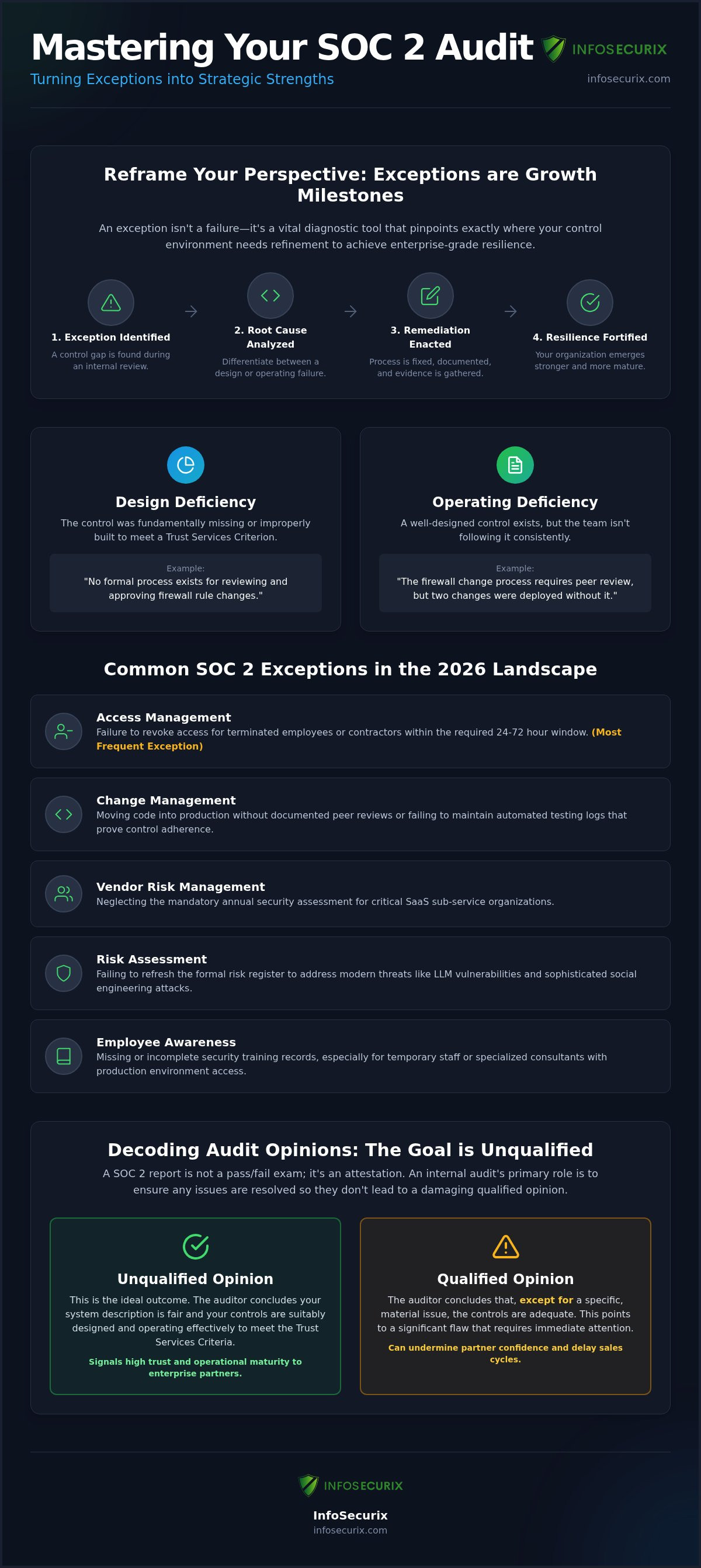
A SOC 2 exception occurs when a control fails to operate as intended or lacks the structural integrity to meet its specific objective. While the term often carries a negative connotation, it’s actually a vital diagnostic tool for growing enterprises. In the context of System and Organization Controls (SOC) reporting, these findings act as early warning systems that prevent minor operational gaps from becoming systemic failures.
The primary role of internal audit in SOC 2 is to act as a rigorous filter, identifying these “red flags” before the formal external attestation begins. This proactive approach is especially critical for Type II reports. Because Type II audits examine a testing window of 6 to 12 months, the likelihood of a human or technical slip-up increases compared to a point-in-time Type I assessment. A single missed access review in July shouldn’t be allowed to compromise your reputation in December. By catching these instances early, the internal audit function allows for remediation and documentation that demonstrates a commitment to continuous improvement.
Shifting your perspective is essential for long-term success. View these findings as signals of operational maturity rather than marks of failure. They show you exactly where your processes need refinement to handle enterprise-scale demands. This mindset transforms the audit from a stressful hurdle into a strategic exercise in resilience.
Design vs. Operating Deficiencies
Distinguishing between the root causes of an exception is the first step toward meaningful remediation. A design deficiency means the control was fundamentally missing or improperly built to address a specific Trust Services Criteria. Conversely, an operating deficiency occurs when a perfectly designed process simply isn’t followed consistently by the team. A professional information security internal audit provides the clarity needed to differentiate these two categories. This ensures you don’t waste resources redesigning a process that only requires better employee training or automated enforcement.
Misconception: Pass/Fail vs. Attestation
Many executives mistakenly view SOC 2 as a pass or fail exam. It’s actually an attestation of system reliability where the auditor provides an opinion on your control environment. Auditors evaluate whether exceptions are “material,” meaning they’re significant enough to cast doubt on the overall system description. The role of internal audit in SOC 2 is to ensure that any identified issues are addressed or contextualized so they don’t reach that level of significance. An unqualified opinion can still contain minor, non-material exceptions as long as the overall control objectives are met and the auditor remains confident in the system’s integrity.
Common SOC 2 Exceptions in the 2026 Landscape
While the 2017 Trust Services Criteria remain the foundational benchmark, the interpretation of these standards has evolved to match an increasingly automated corporate environment. Understanding where peers frequently stumble allows you to fortify your own environment before the formal audit begins. A high level SOC 2 certification guide can provide the broad strokes, but the most damaging exceptions often hide in the granular details of daily operations. In the current landscape, auditors are seeing a rise in several specific areas of non-compliance:
- Access Management: A failure to revoke access for terminated employees or contractors within the required 24 to 72 hour window.
- Change Management: Moving code into production without documented peer reviews or failing to maintain automated testing logs that prove control adherence.
- Vendor Risk Management: Neglecting the mandatory annual security assessment for critical SaaS sub-service organizations.
- Risk Assessment: Failing to refresh the formal risk register to address 2026 specific threats, including LLM vulnerabilities and sophisticated social engineering.
- Employee Awareness: Missing security training records for temporary staff or specialized consultants who have access to the production environment.
The Access Control Pitfall
Timely revocation of credentials is the most frequent exception cited in modern reports. This failure typically isn’t a result of negligence, but rather a disconnect between HR triggers and IT execution. The role of internal audit in SOC 2 is to expose these communication silos by performing “look-back” testing on recent departures. By identifying where the deprovisioning workflow breaks down, an internal review ensures your team can implement automated triggers to maintain 100% compliance. If your current onboarding and offboarding processes feel fragmented, a SOC 2 Readiness Assessment can offer the seasoned guidance needed to harmonize these departments.
Emerging AI and Automation Exceptions
The 2026 audit cycle has introduced new complexities regarding “shadow AI” and unmonitored agents. Exceptions occur when autonomous tools are integrated into workflows without being vetted against the organization’s Trust Services Criteria. Furthermore, we see frequent failures in continuous monitoring tools where critical security alerts are either ignored or improperly triaged. The role of internal audit in SOC 2 is to verify that your AI governance is documented and that your automated monitoring actually results in verifiable remediation. Ensuring these advanced technologies are governed with the same rigor as traditional systems is vital for a clean audit opinion.
Decoding Audit Opinions: Why Internal Audits Prevent Qualified Reports
The final opinion in your SOC 2 report is the ultimate verdict on your organization’s commitment to security. It’s the first thing an enterprise procurement team looks at during due diligence, and its clarity can either accelerate a contract or halt negotiations entirely. Understanding the nuances between these opinions is vital for any leadership team. An unqualified opinion is the gold standard: it’s a “clean” report indicating that your controls are designed and operating effectively to meet the Trust Services Criteria. Conversely, a qualified opinion signifies that while most controls are functional, specific exceptions were significant enough to impact a particular criteria, such as Security or Confidentiality.
In more severe cases, an auditor might issue an adverse opinion or a disclaimer of opinion. An adverse opinion indicates systemic control failures that render the system unreliable. A disclaimer occurs when the auditor cannot gather enough evidence to form an opinion at all. The role of internal audit in SOC 2 is to act as a definitive safeguard against these outcomes. By identifying gaps months in advance, your internal team ensures that evidence is organized and controls are battle-tested before the external CPA arrives.
Compensating Controls: The Internal Auditor’s Secret Weapon
Sometimes, a primary control fails due to a technical glitch or a human oversight. This is where compensating controls become essential. These are alternative measures that mitigate the risk associated with a primary control’s failure. For example, if an automated log review fails for a week, a manual secondary review performed by a supervisor can act as a compensating control. Identifying these safety nets early is a core function of the internal review process, and a comprehensive soc 2 readiness checklist helps you map these alternatives long before they’re needed. When the role of internal audit in SOC 2 includes mapping these redundancies, a minor exception is far less likely to result in a qualified opinion.
The Power of the Management Response
If an exception does make it into the final report, Section IV provides a unique opportunity to provide context. This is the Management Response section. It’s your platform to explain the “why” behind an exception and, more importantly, the “how” of your remediation efforts. Drafting a professional, transparent response demonstrates accountability and a proactive security posture. Sophisticated enterprise partners often value a transparent response that shows a problem was identified and fixed over a suspiciously perfect record that lacks detail. It proves your organization is resilient and capable of self-correction, which is the hallmark of a truly mature service provider.
A Strategic Framework for Exception Remediation
Remediation is the bridge between identifying a vulnerability and securing your enterprise’s reputation. The role of internal audit in SOC 2 extends beyond mere discovery; it serves as the catalyst for systemic improvement through a structured remediation framework. When an exception is uncovered, a methodical approach ensures the fix is not just a temporary patch but a permanent reinforcement of your security posture. This process typically follows five critical steps:
- Step 1: Perform a Root Cause Analysis (RCA). Determine if the failure was human, technical, or process-based. A developer forgetting a manual step is a human error; a script failing to trigger is technical; a lack of clear instructions for a new hire is a process failure.
- Step 2: Implement immediate corrective actions. Close the gap immediately to secure the environment. This might involve revoking a forgotten credential or manually reviewing a week’s worth of logs.
- Step 3: Update policies and procedures. Formalize the fix. Documentation ensures the new control is sustainable and provides a clear trail for future auditors.
- Step 4: Conduct a follow-up “mini-audit.” Verify the control is now operating effectively over a short period. This confirms the remediation actually works in practice.
- Step 5: Gather and organize evidence. Prepare the documentation of the failure, the RCA, and the fix. Presenting this proactively to an external auditor demonstrates high operational maturity.
The Role of SOC 2 Readiness Assessments
A proactive SOC 2 Readiness Assessment acts as a vital pre-audit phase to flush out design deficiencies. It allows you to identify “untestable” controls: processes that exist in practice but lack the necessary logs or timestamps to satisfy a CPA. Identifying these gaps early prevents the high-stress, high-cost scrambling that occurs when an external auditor arrives and finds an empty evidence folder. This strategic foresight is the hallmark of a seasoned security leader who values precision over speed.
Building a Sustainable Compliance Posture
True resilience requires moving from point-in-time audits to a culture of continuous compliance monitoring. Integrating security controls into daily DevOps and HR workflows reduces human error by making security a default state rather than an extra task. Quarterly internal reviews are essential to maintain this readiness year-round. They ensure that as your technical stack evolves, your compliance framework evolves with it. This methodical approach transforms compliance from a seasonal burden into a competitive advantage that instills absolute confidence in your enterprise partners.
InfoSecurix: Your Partner in Absolute Compliance Confidence
Navigating the modern regulatory landscape requires more than just a digital checklist; it demands a legacy of expertise and a deep understanding of auditor expectations. InfoSecurix leverages over 25 years of information security proficiency to guide organizations through the most complex compliance environments. Our approach isn’t merely about checking boxes. It’s about empowering your leadership team through education and strategic corrective actions that turn compliance into a genuine competitive advantage. By mirroring the rigor of a Big Four audit without the associated overhead, we provide the sophisticated oversight necessary to secure enterprise-level trust.
The role of internal audit in SOC 2 is most effective when it’s treated as a collaborative partnership rather than a distant inspection. We focus on identifying design deficiencies and operational gaps months before your formal audit begins, ensuring that your final report is a testament to your operational excellence. This proactive guidance transforms a high-pressure requirement into a repeatable framework for resilience, allowing you to approach your external attestation with absolute confidence.
Why a Boutique Consultancy Outperforms Generic Software
Automated compliance platforms have become popular for data collection, yet they often lack the contextual human insight required to navigate nuanced audit scenarios. Our “Trusted Advisor” approach provides the strategic depth that software-only solutions frequently miss. We specialize in tailoring controls to your specific business context and unique risk profile, ensuring that your security measures are both effective and sustainable. You gain direct access to seasoned experts who’ve seen every possible exception and remediation challenge, providing a level of bespoke problem-solving that automated tools simply can’t replicate.
Secure Your Enterprise Trust Today
Predictability is essential for any high-growth organization. Our fixed-fee engagement model provides absolute certainty in your compliance budget, eliminating the risk of unexpected costs during the remediation phase. We provide a clear, methodical roadmap from your initial gap analysis to a clean SOC 2 Type II report and beyond. This steady, measured pace reflects our commitment to accuracy and detail, ensuring your organization is future-proofed against evolving threats. Partner with InfoSecurix for your SOC 2 Readiness Assessment and experience the security of having a seasoned guide by your side.
Securing Your Competitive Edge Through Operational Excellence
Achieving a clean SOC 2 report is more than a compliance requirement; it’s a powerful statement of your organization’s integrity and readiness for enterprise-scale partnerships. You’ve seen how exceptions can be transformed from red flags into milestones of maturity when they are handled with the right diagnostic framework. By identifying gaps early and implementing systemic remediation, you ensure that your control environment remains resilient against both human error and emerging technical threats. The role of internal audit in SOC 2 is to provide this essential layer of protection, turning potential liabilities into proof points of reliability before the final attestation.
InfoSecurix offers the seasoned guidance necessary to navigate these complexities with absolute certainty. Leveraging 25+ years of industry-leading expertise, we provide bespoke readiness assessments and tailored corrective action plans that mirror the rigor of global standards. Our fixed-fee engagement model ensures your path to compliance is both predictable and transparent. Partner with InfoSecurix for your SOC 2 Readiness Assessment and move forward with the confidence that your enterprise trust is in expert hands. Your journey toward a pristine audit opinion starts with a single, strategic step today.
Frequently Asked Questions
Can you pass a SOC 2 audit with exceptions?
You can absolutely receive an unqualified (clean) opinion even if the auditor identifies minor exceptions. SOC 2 is an attestation of system reliability rather than a simple pass or fail exam. The auditor evaluates whether these findings are material to the overall control objectives. If the exceptions are isolated and don’t compromise the Trust Services Criteria, your report remains a positive reflection of your security posture.
What is the most common reason for a SOC 2 exception?
Access management failures remain the most frequent findings in modern audits. Specifically, failing to revoke credentials for terminated employees within the required 24 to 72 hour window is a recurring issue. These gaps often stem from a lack of synchronization between HR triggers and IT provisioning workflows. Consistent internal monitoring is vital to ensure these high-velocity processes don’t fall out of compliance between audit cycles.
How long do I have to remediate an exception found during an audit?
Remediation timelines depend on when the exception is discovered. If an issue is found during a Type II testing window, the exception will likely appear in the final report, though you can document the fix in the Management Response. It’s best to identify and resolve these issues during the readiness phase. This ensures the control operates effectively before the formal observation period begins, protecting your audit opinion.
Will a qualified SOC 2 opinion prevent me from closing enterprise deals?
A qualified opinion won’t automatically disqualify you, but it will certainly trigger deeper scrutiny from sophisticated procurement teams. Enterprise partners look for transparency and a clear plan for improvement. The role of internal audit in SOC 2 is to prevent this friction by ensuring material weaknesses are addressed long before the final report is shared with prospects. A clean report accelerates trust and shortens sales cycles.
What is the difference between an exception and a material weakness?
An exception is a single instance where a control failed to operate as designed. A material weakness is a more severe classification, indicating that there is a significant deficiency or a combination of deficiencies that could result in a failure to meet the Trust Services Criteria. While an exception is a diagnostic signal for improvement, a material weakness often leads to a qualified or adverse opinion from the auditor.
How do I document remediation for the auditor in the next cycle?
Effective documentation requires a clear trail showing the identification, root cause analysis, and corrective action taken. You should provide the auditor with updated policies, training logs, or technical screenshots that prove the new control has been operating consistently since the fix. Organizing this evidence in a structured repository demonstrates high operational maturity and proactive governance, which builds significant confidence with your external CPA firm.
Can automated compliance tools prevent all SOC 2 exceptions?
Automated tools are excellent for data collection, but they can’t replace human insight or prevent process-based failures. Many exceptions arise from “shadow AI” or manual workflows that software simply doesn’t track. The role of internal audit in SOC 2 is to provide the critical oversight that catches these nuanced gaps. This ensures your compliance posture is both comprehensive and context-aware, covering areas that automation often misses.
Does a SOC 2 Readiness Assessment guarantee a clean audit report?
While no assessment can offer an absolute guarantee, a rigorous readiness review significantly reduces the risk of a qualified opinion. It acts as a diagnostic pre-audit that flushes out design deficiencies and untestable controls. This allows your team to implement strategic fixes and gather necessary evidence before the external CPA begins their formal fieldwork. It provides a clear, documented path to a successful and unqualified audit outcome.