
An ISO 27001 readiness assessment isn’t a dress rehearsal for an audit. It’s a strategic diagnostic that determines whether your security framework can actually support your business velocity. We recognize that the pressure to align with 93 complex Annex A controls can feel like a significant resource drain. The fear of an expensive audit failure often overshadows the true purpose of the standard. You aren’t just looking for a certificate: you’re looking to protect your enterprise legacy and build a foundation of absolute reliability.
This guide shows you how a rigorous assessment transforms compliance from a regulatory hurdle into a strategic advantage for your long-term operational resilience. We’ll provide a clear roadmap to the ISO/IEC 27001:2022 standard that ensures you’re prepared for every contingency. You’ll discover how to secure confident management buy-in and establish a verified security posture that wins the trust of global enterprise partners. By the end of this article, you’ll have the clarity needed to turn security from a cost center into a powerful driver of sustainable growth.
Key Takeaways
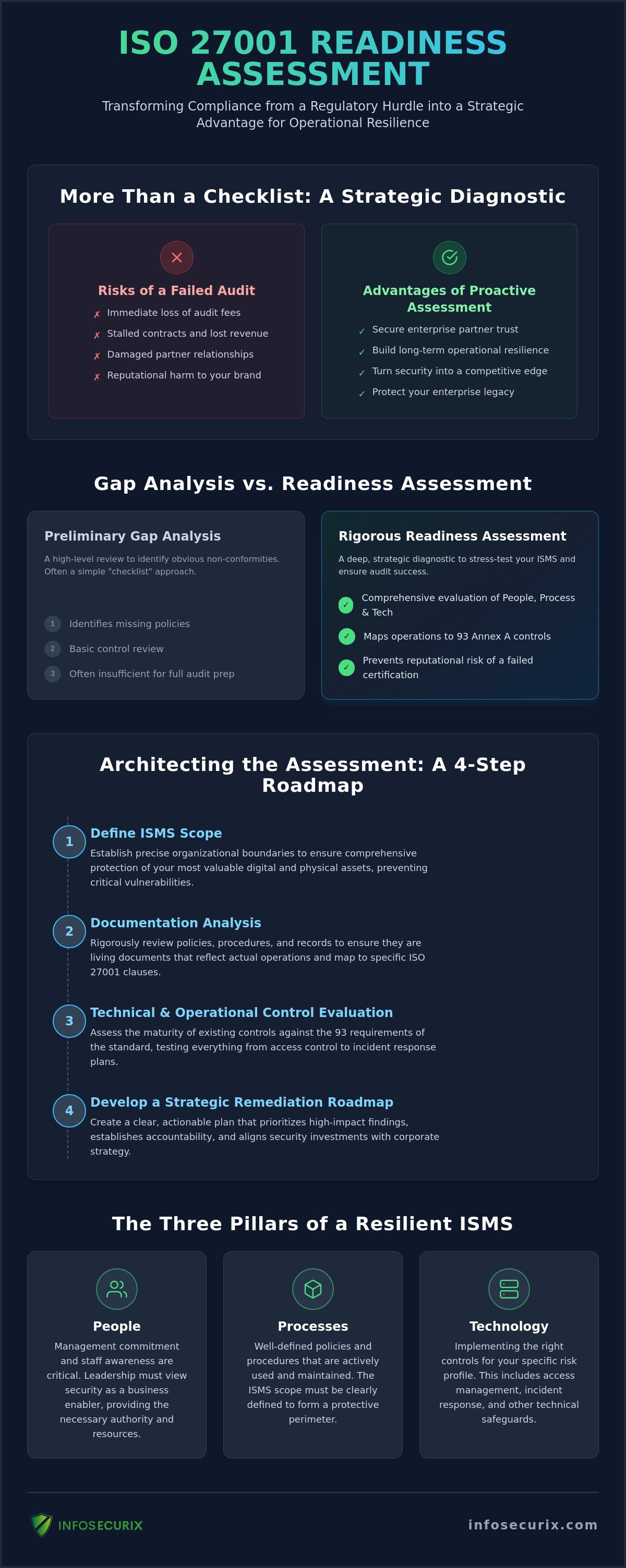
- Distinguish between a preliminary gap analysis and a rigorous ISO 27001 readiness assessment to prevent the reputational risks of a failed certification attempt.
- Define precise organizational boundaries for your ISMS to ensure comprehensive protection of your most valuable digital and physical assets.
- Develop a strategic remediation roadmap that prioritizes high-impact findings and establishes clear accountability for corrective actions.
- Align your security posture with enterprise-level expectations to win the trust of global partners and future-proof your operational legacy.
The Strategic Imperative of an ISO 27001 Readiness Assessment
An ISO 27001 readiness assessment is far more than a simple checklist; it’s a comprehensive diagnostic of your Information Security Management System (ISMS). Think of it as a strategic stress test for your organizational integrity. While many view certification as a finish line, the assessment process is where the real transformation occurs. It shifts the focus from simple compliance to long-term operational resilience, ensuring that your security framework can withstand the complexities of a modern threat landscape. By identifying vulnerabilities early, you turn a potential regulatory hurdle into a verified competitive advantage that secures your enterprise legacy.
The risks of receiving a “not recommended” status during an official audit are substantial and multi-faceted. Beyond the immediate loss of audit fees, a failure can result in stalled contracts and damaged relationships with enterprise partners who demand rigorous standards. It’s a public signal that your security posture might not be as robust as your marketing suggests. A proactive assessment mitigates these risks by ensuring your controls are battle-tested before the registrar arrives. This level of preparation doesn’t just save money; it preserves the professional reputation you’ve worked decades to build.
The Anatomy of Audit Preparedness
A resilient ISMS is built on three essential pillars: people, processes, and technology. Our assessment evaluates how these components align with the ISO/IEC 27001 framework to create a cohesive defense. Management commitment is the most critical factor in this equation. Leadership must view security as a business enabler rather than a technical burden to ensure the system has the necessary authority and resources. The ISMS scope serves as the definitive boundary for the readiness engagement, ensuring every critical asset remains within the protective perimeter.
Risk Mitigation Through Proactive Evaluation
The primary goal of this evaluation is to expose “blind spots” that often go unnoticed during daily operations. We rigorously analyze the maturity of your existing controls against the 93 requirements found in the 2022 version of the standard. This process ensures that your security roadmap supports business growth rather than creating friction. There’s also a significant psychological benefit for your internal teams. Verified preparedness replaces the anxiety of the unknown with the confidence of a proven posture, allowing your staff to focus on innovation rather than audit defense.
Ultimately, a successful ISO 27001 readiness assessment aligns your security investments with your broader corporate strategy. It isn’t about implementing every possible control; it’s about implementing the right controls for your specific risk profile. This bespoke approach ensures that your compliance journey is efficient, effective, and entirely sustainable. When security is integrated into the DNA of the organization, certification becomes a natural byproduct of excellence rather than a forced administrative exercise.
Architecting the Assessment: Core Components of Certification Preparedness
Architecting a successful ISO 27001 readiness assessment begins with a meticulous definition of the Information Security Management System (ISMS) scope. This foundational phase determines the organizational boundaries and identifies exactly which digital and physical assets require protection. Without a clearly defined scope, even the most sophisticated security measures may leave critical vulnerabilities exposed. Aligning this boundary with the official ISO 27001 standard ensures that your certification journey remains focused and efficient; it prevents the wasted effort of securing non-critical areas while leaving your enterprise legacy vulnerable.
The Depth of Documentation Analysis
Establishing a robust ISMS requires more than just a collection of templates. We analyze your policies, procedures, and records to ensure they’re living documents that reflect your actual operations. Every internal procedure must be mapped to specific ISO 27001:2022 clauses and Annex A controls. This rigorous documentation review ensures that your framework is not only compliant on paper but also functional in practice, providing the clear trail of accountability that auditors expect during a formal certification cycle.
Evaluating Technical and Operational Controls
Moving into the technical layer, the assessment evaluates access control mechanisms and identity management protocols. We test whether incident response plans are truly functional through simulated scenarios and review how business continuity is integrated into your daily workflows. Technical controls must be supported by verifiable human processes to remain effective over time. This approach ensures that your technology and your people are working in a cohesive defense to protect your most sensitive data assets.
Verifying the effectiveness of these controls is what separates a high-level diagnostic from a superficial check. We move beyond “paper compliance” to confirm that security measures are operational and effective in real-world scenarios. This involves observing staff behaviors, reviewing system logs, and testing the integrity of your encryption protocols. By identifying where controls are underperforming, we provide the clarity needed to strengthen your posture before the external auditor arrives, reducing the risk of unexpected findings.
Concluding the process with a formal management review ensures that assessment findings are integrated into the executive decision-making process. This step transforms technical data into strategic insight, allowing leadership to allocate resources where they’ll have the greatest impact on long-term resilience. Partnering with a seasoned guide for a bespoke ISO 27001 readiness assessment ensures this journey is tailored to your specific business velocity. It’s an investment in your organization’s future that turns a complex regulatory requirement into a foundation for sustainable growth and enterprise trust.
Gap Analysis vs. Readiness Assessment: Navigating the Nuances
Distinguishing between a gap analysis and a formal ISO 27001 readiness assessment is essential for any organization serious about its certification journey. While many stakeholders use these terms interchangeably, they represent two distinct levels of maturity evaluation. A gap analysis serves as a high-level survey: it identifies which components of the Information Security Management System (ISMS) are currently absent or incomplete. In contrast, a readiness assessment is a rigorous, audit-simulated evaluation of existing control maturity. It doesn’t just ask if a policy exists; it verifies whether that policy is consistently applied and effective in mitigating real-world risk.
This distinction matters because knowing what is missing is only half the battle. You don’t want to fall into the trap of having a complete set of policies that fail to function under pressure. While frameworks like the NIST Cybersecurity Framework provide excellent structural guidance for risk management, the ISO standard demands specific, verifiable operational evidence. Relying on a superficial “gap check” often leads to a false sense of security that crumbles under the scrutiny of an accredited certification body. A readiness assessment provides the “seasoned eye” required to ensure that what you have in place actually works as intended.
Expert-Led Insights vs. Automated Checklists
Algorithms and automated software solutions have their place in modern compliance, but they cannot judge the suitability of a control for your unique risk profile. They often miss the “soft” gaps in organizational culture or subtle process deviations that a human auditor catches instantly. Leveraging over 25 years of industry experience, a seasoned cybersecurity internal audit firm identifies these nuanced non-conformities before they become expensive audit failures. This consultative approach turns raw assessment findings into strategic business intelligence, allowing you to strengthen your posture with precision and confidence.
Identifying Common Readiness Pitfalls
Finding the “Goldilocks” zone for your certification boundary is one of the most common challenges in ISMS development. Over-scoping drains valuable resources on non-critical areas, while under-scoping leaves your enterprise legacy vulnerable to hidden threats. Another frequent pitfall is the “documentation only” fallacy. Having a signed policy is not the same as having an operational control. Auditors look for a consistent trail of evidence, not just a library of PDFs. Even the most talented internal security teams benefit from an external perspective; we offer an objective evaluation that stakeholders who are too close to the daily mechanics might naturally overlook.
From Assessment to Action: Executing Your Remediation Roadmap
Once the ISO 27001 readiness assessment concludes, the focus shifts from discovery to deliberate action. We advocate for a risk-based approach that prioritizes high-impact gaps first: addressing vulnerabilities that pose the greatest threat to your organizational integrity. This phase isn’t about rushing to close every minor finding; it’s about building a robust framework that supports your long-term business velocity. Developing strategic corrective action plans requires more than just a list of tasks. Each finding needs a clear timeline with assigned ownership and accountability to maintain momentum. This methodical approach ensures that remediation efforts are not just a temporary fix, but a permanent enhancement to your security posture.
Building the Remediation Framework
Success in this stage depends on integrating remediation tasks into your existing project management workflows. Assigning specific resource owners to identified gaps prevents the stagnation that often follows a high-level diagnostic. Remediation should focus on long-term sustainability rather than simply “fixing for the audit” to ensure your ISMS remains effective long after the certificate is on the wall. Systematically gathering the artifacts required for a Stage 2 certification audit is a critical component of this process. These evidence pieces: system logs, training records, and incident reports: serve as the objective proof that your controls are operational. Organized evidence collection reduces friction during the final audit and demonstrates a level of maturity that wins immediate auditor trust.
The Final Validation: Preparing for the Auditor
Performing an internal audit that mimics the final ISO 27001 readiness assessment criteria serves as your last validation step before engaging an external certification body. This process includes conducting mock interviews with key staff to ensure awareness and confidence in their security roles. Reviewing a comprehensive ISO 27001 certification readiness checklist helps identify any remaining outliers that could jeopardize your success. Finalizing the Statement of Applicability (SoA) based on your assessment results is the concluding act of preparation. This document serves as the definitive map of your security controls, justifying why specific Annex A requirements were chosen or excluded. If you’re ready to move from diagnostic insights to a battle-tested security posture, our experts can help you execute your bespoke remediation roadmap with precision and authority.
Partnering for Resilience: The InfoSecurix Approach to ISO 27001 Excellence
At InfoSecurix, we view compliance as a bespoke journey rather than a standardized product. Our philosophy is rooted in the belief that a robust Information Security Management System (ISMS) should be a catalyst for growth, not a bureaucratic anchor. Leveraging a 25-year legacy of industry leadership, our consultants provide the clarity and precision required to transform complex requirements into actionable strategic advantages. While many providers offer generic templates, we focus on the nuances of your specific operational environment to ensure your security posture is both resilient and sustainable.
Our comprehensive service portfolio is designed to support your organization through every phase of the certification lifecycle. This begins with a high-level information security risk assessment to identify your unique threat profile and extends through to the final stages of audit preparation. We prioritize the strategic impact of technical processes, ensuring that your ISO 27001 readiness assessment delivers genuine business intelligence. This methodical approach future-proofs your enterprise, allowing your ISMS to remain robust even as the global regulatory landscape continues to evolve.
A Collaborative Alliance for Compliance
We move beyond the traditional “distant auditor” model to become a collaborative ally in your long-term success. By tailoring our assessment methodology to your unique organizational culture and risk appetite, we ensure that security controls feel integrated rather than imposed. This partnership approach provides the peace of mind necessary to enter your certification audit with absolute confidence. Our seasoned guides have seen every possible audit scenario, allowing us to anticipate challenges and resolve them before they impact your certification goals.
Strategic Next Steps
Engaging with InfoSecurix for a national-scale readiness assessment provides the foundational trust required to win enterprise-level contracts. Many of our clients also find significant synergy between their ISO efforts and the requirements found in a SOC 2 readiness checklist, allowing for a more unified approach to global compliance. We invite you to transform your security posture through our expert guidance and secure the legacy of your enterprise. Whether you’re just beginning your journey or seeking a final validation of your controls, our team is ready to provide the professional support your organization deserves.
Securing Your Future Through Strategic Compliance
The journey toward certification represents a defining moment for your organization’s integrity. By choosing a rigorous ISO 27001 readiness assessment, you move beyond the limitations of basic checklists and embrace a framework built for longevity. You’ve learned that true preparedness requires a deep dive into control maturity and a risk-based remediation roadmap that prioritizes high-impact improvements. This strategic approach ensures that your security posture isn’t just a document on a shelf; it’s a living defense that supports your business velocity.
InfoSecurix brings 25 years of strategic compliance expertise to every partnership. We provide comprehensive readiness across ISO and SOC 2 standards using a bespoke methodology focused on your operational resilience. Our seasoned guides provide the clarity needed to navigate complex requirements with absolute confidence. It’s time to transform your compliance obligations into a powerful foundation for enterprise growth.
Your commitment to excellence ensures a secure and prosperous legacy for the years to come.
Frequently Asked Questions
What is the primary difference between an internal audit and an ISO 27001 readiness assessment?
An internal audit is a mandatory requirement specified in Clause 9.2 of the standard, whereas an ISO 27001 readiness assessment is a strategic diagnostic performed to ensure your ISMS is mature enough for certification. While the internal audit verifies that you’re following your own documented rules, the readiness assessment simulates the external auditor’s perspective to identify hidden vulnerabilities. This distinction ensures you aren’t just checking boxes but are truly prepared for the rigor of a formal external evaluation.
How long does a typical ISO 27001 readiness assessment take to complete?
A typical assessment generally takes between two to six weeks to complete depending on the complexity and size of your organization. This timeline includes the initial documentation review, personnel interviews, and the delivery of the final findings report. It’s important to allow additional time following the assessment for your team to execute the necessary remediation tasks before the official certification body arrives for the Stage 1 audit.
Can we perform a readiness assessment internally or should we hire a consultant?
You can perform a readiness assessment internally if your team possesses the required expertise and can maintain absolute objectivity. However, many organizations choose to hire a seasoned consultant to benefit from an unbiased perspective and a deeper understanding of auditor expectations. External experts bring a legacy of success from multiple industries—much like how Lin Inspects provides professional property inspection services for real estate—helping to identify subtle process gaps that internal teams might overlook due to their proximity to daily operations.
What documentation is essential for a successful readiness assessment?
Essential documentation includes your ISMS Scope statement, the Statement of Applicability (SoA), and the Risk Treatment Plan. You must also provide evidence of operational controls such as access control logs, incident response records, and management review minutes. Having these artifacts organized and ready for review is critical for a successful ISO 27001 readiness assessment and ensures that your remediation roadmap is based on accurate data.
How does the ISO 27001:2022 update affect our current readiness status?
The ISO 27001:2022 update requires organizations to align with the revised Annex A control framework, which consolidated 114 controls into 93 specific items. As of July 2026, all certified organizations must conform to this 2022 edition. Your assessment will focus on these updated themes: organizational, people, physical, and technological: to ensure your security posture meets the current global standards for information security management.
What happens if the readiness assessment identifies major non-conformities?
Identifying major non-conformities during a readiness assessment is a positive outcome because it allows you to address these gaps before the official audit begins. Once identified, these findings are integrated into a strategic corrective action plan with clear ownership and timelines. This proactive approach prevents the financial and reputational damage associated with a “not recommended” status from a certification body, turning potential failures into opportunities for operational improvement.
Is a readiness assessment mandatory before the official certification audit?
A readiness assessment is not a mandatory requirement of the standard, but it’s considered a best practice for organizations seeking first-time certification. It acts as a vital safety net that significantly reduces the risk of expensive audit failures. By verifying your posture in advance, you gain the confidence needed to engage a certification body, ensuring your investment in compliance leads to a successful and steady outcome.
How much does an ISO 27001 readiness assessment cost for a mid-sized organization?
The cost of an ISO 27001 readiness assessment for a mid-sized organization varies based on the scope of the ISMS and the number of physical locations involved. Factors such as the complexity of your technological stack and the maturity of your existing documentation will also influence the final investment. Rather than looking for a fixed price, organizations should focus on the value of a bespoke diagnostic that prevents the much higher costs associated with failed certification attempts.