
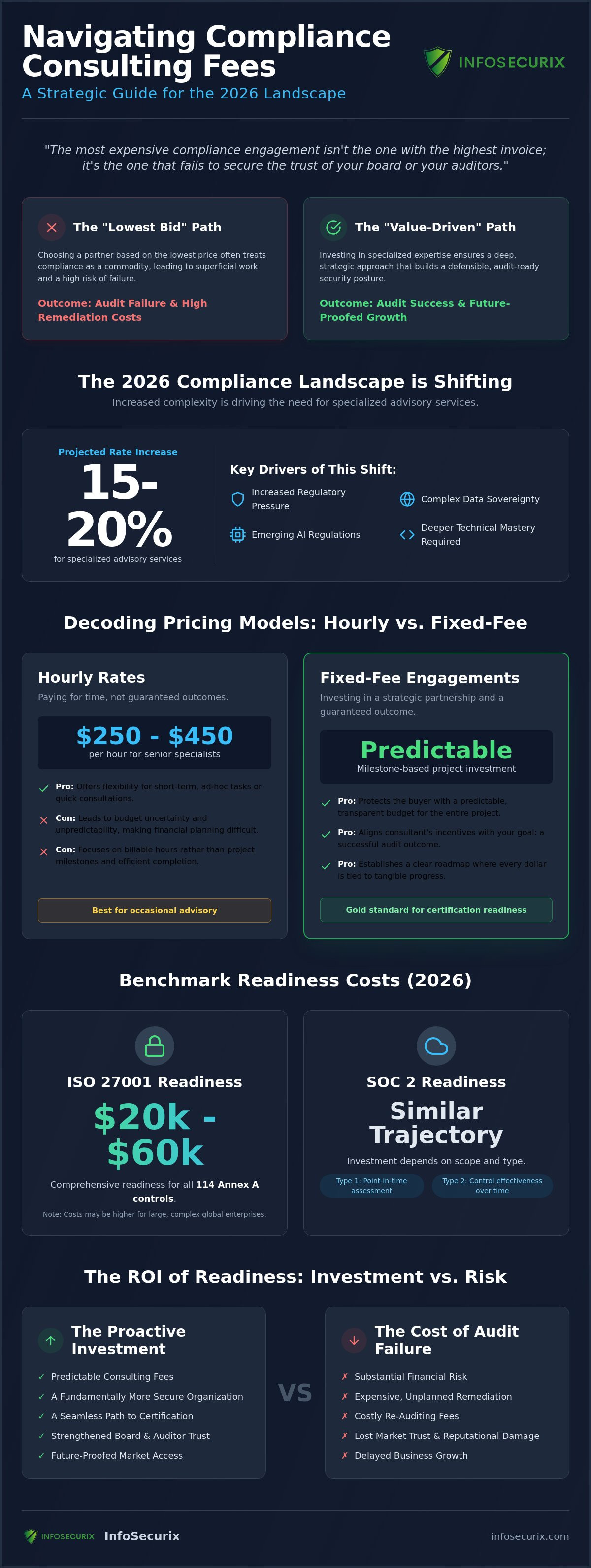
The most expensive compliance engagement isn’t the one with the highest invoice; it’s the one that fails to secure the trust of your board or your auditors. Evaluating various quotes for compliance consulting fees often leaves executives facing a sea of inconsistent numbers, ranging from flat project fees to opaque hourly rates. It’s frustrating to feel like you’re comparing apples to oranges while the pressure of an upcoming audit looms. We recognize that justifying a premium investment requires more than a leap of faith; it requires a clear connection to risk mitigation and market access.
This guide provides the clarity you need by offering expert benchmarks and a strategic framework to evaluate these investments as business enablers rather than just line-item expenses. Focusing on the 2026 market landscape, we break down the value of specialized expertise and show you how to select a partner that ensures a seamless path to certification. By the end, you’ll have the confidence to choose a guide who doesn’t just check boxes but future-proofs your organization’s growth.
Key Takeaways
- Recognize how shifting regulatory demands in 2026 are driving the need for specialized advisory services over generic technical solutions.
- Evaluate the strategic trade-offs between hourly and fixed-fee compliance consulting fees to ensure your budget aligns with specific organizational milestones.
- Identify the critical variables—such as audit scope and framework complexity—that dictate the total investment required for successful certification.
- Quantify the long-term return on investment by contrasting upfront consulting costs with the substantial financial risks of audit remediation and lost market trust.
- Implement a milestone-based budgeting framework to eliminate hidden costs and provide your board with a clear, predictable path toward audit success.
Understanding the Landscape of Compliance Consulting Fees in 2026
Viewing compliance consulting as a mere technical commodity is a mistake that often leads to budget overruns and audit friction. In the current market, these services represent a specialized professional advisory, similar to legal counsel or high-end management consulting. Organizations that treat their security posture as a line-item expense often find that the lowest bid results in the highest long-term cost. Compliance consulting fees in 2026 reflect the scarcity of high-level expertise in an era where check-the-box exercises no longer satisfy sophisticated auditors.
The 2026 market has seen a significant shift. Increased regulatory pressure and the emergence of complex data sovereignty requirements are driving a 15% to 20% increase in specialized advisory rates. This upward trend isn’t arbitrary. It’s the direct result of a more rigorous Regulatory compliance environment that demands deeper technical mastery and strategic foresight. Distinguishing between readiness consulting, which builds the foundation, and maintenance advisory, which preserves it, is essential for accurate budgeting. A transparent understanding of compliance consulting fees allows leadership to allocate resources with precision.
The Evolution of Compliance Advisory in a Complex Regulatory Era
Modern compliance now extends far beyond traditional boundaries. Emerging AI regulations and stringent data privacy laws have expanded the necessary consulting scope; this requires advisors to possess a blend of legal, technical, and operational knowledge. Firms are moving away from isolated compliance silos toward integrated risk management. Choosing the ‘cheap’ path often proves expensive. A lack of depth during the initial stages can lead to catastrophic failures during the final audit phase, necessitating costly remediation and re-auditing.
Benchmark Fee Ranges for 2026 Security Frameworks
Market benchmarks for ISO 27001 readiness typically range from $20,000 to $60,000, though larger enterprises with complex global footprints should expect higher quotes. SOC 2 readiness follows a similar trajectory. A Type 1 engagement focuses on a point-in-time assessment, while a Type 2 readiness project requires a more extensive evaluation of control effectiveness over several months. These investments ensure that the organization isn’t just prepared for an audit but is fundamentally more secure. The ‘compliance floor’ is the minimum investment required to maintain a defensible audit posture that protects the organization’s integrity and future growth.
Decoding Pricing Models: Hourly Rates vs. Fixed-Fee Engagements
Selecting the right pricing structure is just as critical as selecting the security framework itself. Understanding how consultant pay is determined helps executive leaders evaluate whether they’re paying for a consultant’s time or for a guaranteed outcome. In 2026, hourly rates for senior specialists typically fall between $250 and $450. While this model offers flexibility for occasional technical inquiries or brief advisory sessions, it often lacks the structural rigor required for a full-scale certification project. Relying on hourly billing for complex readiness can lead to budget uncertainty that makes board reporting difficult.
Fixed-fee engagements have emerged as the gold standard for organizations seeking certification readiness. This milestone-based approach ensures that the total compliance consulting fees remain predictable throughout the project lifecycle. It shifts the focus from billable hours to tangible progress. By aligning the consultant’s incentives with your ultimate success, this model encourages efficiency and high-quality delivery. It establishes a clear roadmap where every dollar spent is tied to a specific stage of the audit preparation process.
Why Fixed-Fee Engagements Protect the Buyer
Predictability is paramount when you’re aligning compliance costs with annual fiscal planning. A fixed-fee structure allows you to account for the entire scope of work, such as addressing all 114 controls of ISO 27001, without the anxiety of per-hour fluctuations. Boutique firms often use this model to prioritize comprehensive results over administrative tracking. It transforms the relationship from a simple transaction into a strategic partnership focused on a successful audit outcome. This clarity allows you to present a confident, stable budget to your stakeholders.
The Pitfalls of Low-Cost Hourly Consulting
Low hourly rates can be deceptive. Often, they mask the use of junior staff who require more time to navigate complex regulatory requirements. This lack of senior expertise frequently leads to poor initial scoping, which causes projects to stall. What began as a seemingly affordable engagement can easily balloon into a six-figure expense as hours pile up without reaching the finish line. Evaluating the total cost of ownership is vital. You aren’t just paying for hours; you’re paying for the security of your data and the long-term trust of your enterprise clients.
A comprehensive budget must also account for secondary expenses that aren’t always visible in the initial quote. Travel costs for on-site assessments, specialized software licenses, and additional fees for audit support can add significant weight to the final bill. Many organizations now utilize retainer models to manage ongoing support, such as internal audits and corrective actions, after the initial certification is achieved. This ensures a steady, professional presence that maintains your security posture year-round. For a clearer view of how these models apply to your unique environment, reviewing a tailored readiness assessment can provide the necessary strategic clarity.
Key Factors That Drive Compliance Consulting Costs
Budgeting for a security audit requires a nuanced understanding of your organization’s internal architecture. Pricing is rarely uniform; instead, it’s dictated by the specific variables that define your operational environment. Analyzing The Cost of Regulatory Compliance in the United States reveals that labor-intensive processes and administrative burdens scale significantly with firm size and industry rigor. When evaluating compliance consulting fees, leadership must look beyond the initial quote to understand the drivers of effort: the breadth of the audit boundary, the complexity of the chosen framework, and the current maturity of existing controls.
Framework selection plays a pivotal role in determining the final investment. For instance, implementing ISO 20000 focuses heavily on service management workflows and delivery excellence, while ISO 22301 demands a rigorous deep dive into business continuity and disaster recovery planning. The latter often requires more extensive impact analyses and testing phases, which naturally increases the consultant’s workload. Similarly, an organization with a high level of existing documentation will require less foundational work than one starting from scratch. Timeline urgency also introduces a “speed premium,” as expedited projects often necessitate dedicated senior resources to meet aggressive certification deadlines.
The Scope Factor: Defining the Audit Boundary
Complexity scales with the physical and logical footprint of your business. While a single-product startup operating entirely in the cloud presents a streamlined profile, a multi-divisional enterprise with legacy on-premise systems requires a far more exhaustive risk assessment. Hybrid infrastructures typically demand more sophisticated control mapping to bridge the gap between cloud-native tools and traditional hardware. Scope creep is the #1 reason for mid-project fee adjustments.
Technical vs. Strategic Requirements
There is a distinct cost difference between simply writing policies and actually implementing the technical controls required for a defensible posture. Policy generation is a foundational step, but the true value of a consultant lies in their ability to integrate these standards into your daily operations. Achieving ISO 27001 certification readiness requires a high level of strategic advisory to ensure that the Information Security Management System (ISMS) is both compliant and functional. Internal audits are also a critical component of the final fee structure: they serve as the final dress rehearsal that ensures your team is prepared for the official external assessment. By addressing these factors early, you ensure that your compliance consulting fees remain a predictable investment in your company’s future.
The ROI of Readiness: Consulting Fees vs. the Cost of Audit Failure
Viewing compliance consulting fees through the lens of a one-time expense ignores the significant financial impact of audit failure. A failed SOC 2 or ISO assessment triggers a cascade of hidden costs: immediate remediation, mandatory re-auditing, and the intangible but devastating loss of client trust. For the C-suite, a seasoned consultant acts as a strategic insurance policy. They protect leadership from regulatory scrutiny by ensuring every control is defensible and every document is audit-ready before the official assessor arrives. This partnership transforms compliance from a hurdle into a competitive advantage.
Market access remains the most compelling argument for a robust compliance budget. Enterprise-level contracts often require specific certifications as a prerequisite for even entering the RFP process. These multi-million dollar opportunities dwarf the initial investment in professional advisory. Implementing a rigorous information security internal audit framework allows your organization to identify vulnerabilities in a controlled, private environment. This proactive stance prevents data breaches and ensures that your path to market remains unobstructed by technical or administrative roadblocks.
Avoiding the Remediation Trap
Fixing a non-conformity after an official audit typically costs three times more than implementing the control correctly during the readiness phase. This remediation trap drains internal resources and delays revenue recognition by stalling sales cycles that depend on successful certification. Building a business case for the Board of Directors requires highlighting this disparity. It’s far more efficient to fund a “Readiness First” approach than to scramble for emergency budget when a critical audit fails. Proactive investment ensures a seamless, predictable path to certification.
Long-Term Value: Beyond the Certificate
The benefits of a structured compliance program extend well beyond the physical certificate. Conducting a thorough information security risk assessment often leads to lower annual insurance premiums; underwriters recognize the reduced risk profile of a certified organization. Systems built on ISO 20000 or ISO 22301 standards introduce operational efficiencies that streamline service delivery and business continuity. This methodical approach future-proofs the business against evolving national security standards, ensuring longevity in an increasingly regulated world.
To secure your next enterprise contract with absolute confidence, schedule a strategic scoping session with our senior advisors to align your budget with your growth objectives.
Partnering with InfoSecurix: Strategic Compliance for National Enterprises
InfoSecurix brings over 25 years of experience to the landscape of corporate excellence. We don’t just act as distant auditors; we serve as seasoned guides who have successfully navigated every possible regulatory scenario. Our approach ensures that compliance consulting fees are never a source of frustration or surprise. We prioritize a meticulous scoping process to ensure every engagement is built on a foundation of absolute transparency. This commitment to detail eliminates the budget uncertainty that often plagues large-scale security projects, allowing you to plan your fiscal year with total confidence.
Our “Trusted Advisor” methodology focuses on a collaborative partnership that is invested in your long-term success. Unlike firms that provide a checklist and disappear, we offer a steady, professional presence that remains unfazed by complexity. This proactive stance ensures that your compliance consulting fees represent a high-value investment in market access and operational resilience. We bridge the gap between technical requirements and strategic growth, positioning your organization as a leader in security standards.
A Legacy of Certification Success
National organizations require a level of precision that matches their stature and complexity. Our senior-level consultants specialize in high-stakes SOC 2 readiness, ensuring your data management practices meet the most stringent enterprise standards. Whether you are focused on ISO 20000 implementation to refine service delivery or ISO 22301 business continuity to protect against disruption, our methodology remains deeply rooted in professional services excellence. We stay by your side through the final audit and any necessary corrective action phases. This partnership provides a protective force that enables your organization to scale with absolute security.
Requesting Your Strategic Proposal
Securing an accurate, fixed-fee quote starts with a thorough discovery process. We examine your organizational scope, the maturity of your existing controls, and your specific timeline requirements to provide a bespoke proposal. This initial stage is critical for setting the stage for audit success. By understanding the strategic impact of your technical processes early, we can align our services with your specific business objectives. You’ll receive a roadmap that is visionary yet grounded in meticulous current-day standards. Contact InfoSecurix today for a confidential consultation on your compliance roadmap.
Secure Your Competitive Advantage through Strategic Investment
Budgeting for security standards in 2026 requires a fundamental shift in perspective. It’s time to move from viewing compliance as a technical hurdle to recognizing it as a critical business enabler. By understanding the nuances of compliance consulting fees, you empower your organization to select a pricing model that prioritizes tangible outcomes over billable hours. We’ve explored how a proactive readiness approach eliminates the high costs of audit failure while opening doors to lucrative enterprise contracts. To effectively navigate the complex bidding requirements of these contracts, organizations often partner with RightCostIQ for professional RFP management and negotiation assistance. Selecting a partner who provides budget certainty through fixed-fee engagements is the final step in future-proofing your growth. It’s about building a legacy of trust that resonates with your board and your clients alike.
InfoSecurix offers 25+ years of expert guidance to help you navigate this complex landscape with absolute confidence. Our national reach, combined with boutique precision, ensures that your security posture is both defensible and scalable. We remain committed to your long-term success, acting as a collaborative ally from the initial scoping phase through to final certification. Take the next step toward operational excellence and market leadership today.
Secure your organization’s future with a strategic compliance roadmap from InfoSecurix.
Frequently Asked Questions
How much should a small business budget for ISO 27001 consulting in 2026?
Budgeting for ISO 27001 readiness depends on organizational complexity; however, industry benchmarks suggest a range of $15,000 to $100,000 for the entire process. Small businesses typically find themselves at the lower end of this spectrum if their scope is limited to a single product or location. This investment covers the strategic advisory necessary to build a defensible Information Security Management System before the final audit begins. It’s a foundational step that ensures your security posture is both robust and scalable.
Is it cheaper to use compliance software instead of a consultant?
Compliance software often appears more affordable upfront but serves a different purpose than a professional consultant. While platforms automate evidence collection, they don’t provide the strategic oversight required to interpret complex controls or manage organizational change. Most enterprises find that a hybrid approach, incorporating the specialized expertise of M.I.S. Support, Inc., is most effective. Using software without expert guidance can lead to technical gaps that result in higher remediation costs during the final audit phase.
Do compliance consulting fees include the cost of the actual audit?
No, compliance consulting fees are separate from the fees charged by an external registrar or CPA firm for the actual audit. The consultant’s role is to ensure your organization is fully prepared to pass that assessment. Separating these functions is essential to maintain the independence and objectivity required by most certification bodies. You should budget for the audit itself as a distinct line item in your security roadmap to ensure total fiscal clarity.
What is the typical hourly rate for a senior information security consultant?
Senior information security consultants in 2026 typically command hourly rates between $250 and $450 for specialized advisory work. These rates reflect a high level of expertise in navigating complex regulatory environments and high-stakes certification requirements. While standard rates for general compliance support can be lower, organizations seeking senior-level guidance for frameworks like ISO 27001 or SOC 2 should expect to invest in this premium tier of professional expertise.
Why are SOC 2 readiness fees different from ISO 27001 fees?
Fees differ because each framework involves a unique scope and level of administrative rigor. SOC 2 focuses on the effectiveness of controls over a specific period; this requires a deep dive into operational history and technical evidence. ISO 27001 centers on the creation and maintenance of a comprehensive management system. The depth of documentation, the number of technical controls involved, and the specific reporting requirements of each standard dictate the total effort required from your consultant.
Can we pay for compliance consulting in milestones?
Yes, milestone-based payment structures are the industry standard for fixed-fee readiness engagements. This model aligns payments with tangible progress, such as the completion of a gap analysis, policy development, or the final internal audit. Paying in milestones provides budget certainty and ensures that your consultant is incentivized to reach key project goals efficiently. It’s a transparent way to manage your compliance consulting fees throughout the entire certification lifecycle.
What happens if our consultant’s work fails the audit?
A reputable consultant remains engaged through the corrective action phase to address any non-conformities identified by the auditor. While no consultant can guarantee a pass, their methodology should include a rigorous internal audit designed to catch vulnerabilities before the official assessment. Choosing a partner with a proven legacy of success minimizes this risk. They’ll work collaboratively with your team to remediate findings and ensure long-term certification success through meticulous standards.
How do I justify compliance consulting fees to my CFO?
Justifying these fees requires framing compliance as a strategic investment in market access and risk mitigation. Explain how certification enables enterprise contracts that significantly outweigh the initial cost of advisory. Contrast the consulting fee with the financial impact of a failed audit, which includes remediation costs and lost revenue opportunities. Position the consultant as a seasoned guide who protects the organization’s reputation and ensures a predictable, steady path to future growth.