
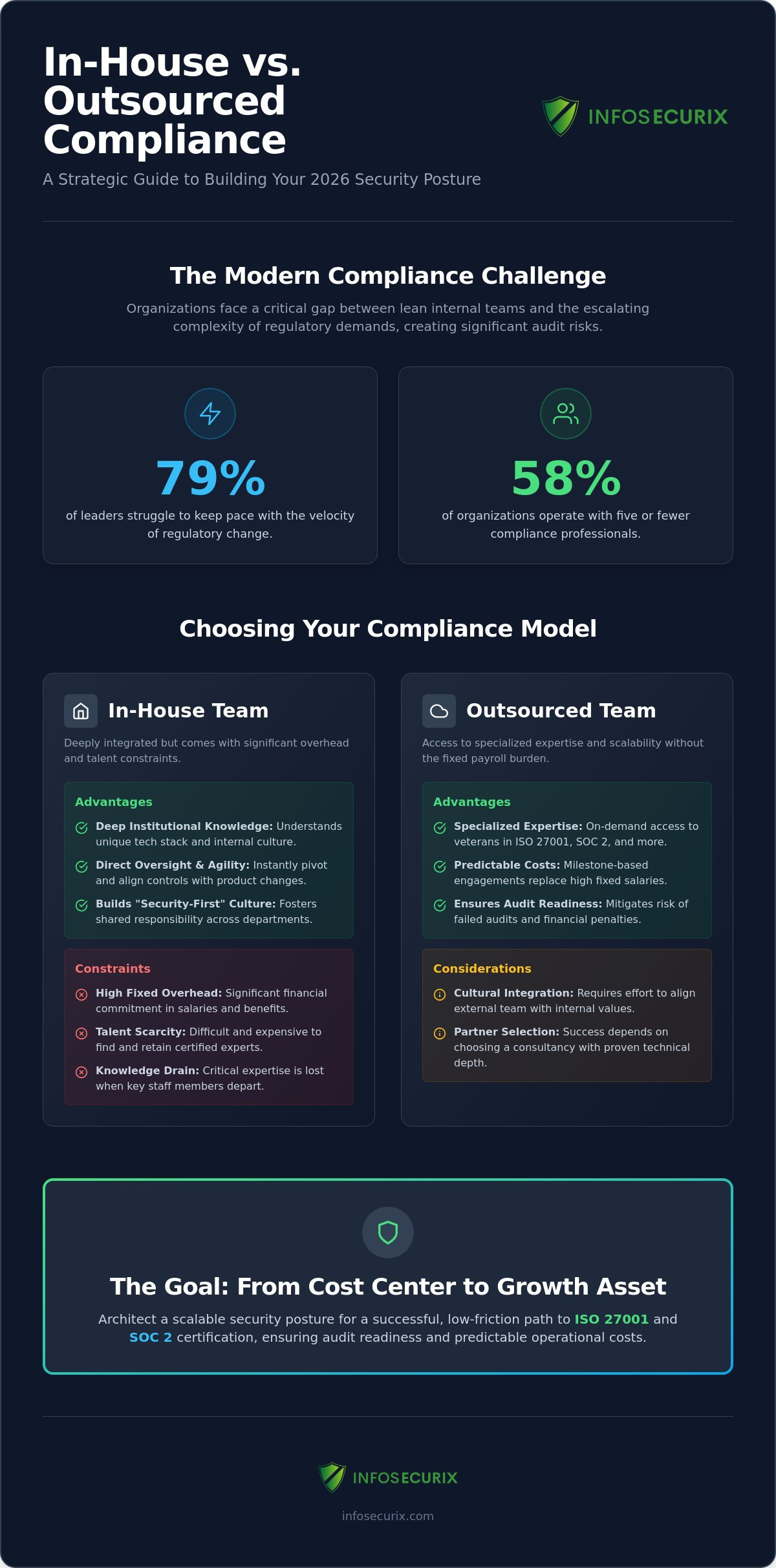
Recent data from Corsica Technologies reveals that 58% of organizations currently operate with five or fewer compliance professionals; a stark reality when 79% of leaders admit they’re struggling to keep up with the velocity of regulatory change. You’ve likely felt this tension within your own operations as the difficulty of finding and retaining specialized security talent collides with the rising fixed overhead of full-time staff. Deciding between an in-house vs outsourced compliance team isn’t merely a budgetary exercise. It’s a strategic choice that dictates your firm’s agility and its ability to withstand rigorous scrutiny.
We understand that your ultimate objective is a successful, low-friction path to ISO 27001 or SOC 2 certification without the burden of inconsistent documentation. This article provides a comprehensive framework to help you balance operational control with the specialized expertise required for modern standards. You’ll discover how to architect a scalable security posture that transforms compliance from a complex cost center into a predictable, growth-enabling asset for 2026 and beyond.
Key Takeaways
- Identify how to bridge the gap between internal institutional knowledge and the high-level specialized expertise required for modern security standards.
- Evaluate the cultural advantages of an internal presence against the agility and technical depth provided by a dedicated external consultancy.
- Analyze the financial impact of an in-house vs outsourced compliance team by comparing fixed payroll overhead with milestone-based engagement models.
- Apply a strategic decision matrix to select a compliance structure that aligns with your organization’s complexity and long-term growth objectives.
- Discover a collaborative approach to ISO 27001 and SOC 2 certification that ensures audit readiness while maintaining predictable operational costs.
The Compliance Talent Gap: Navigating the In-House vs. Outsourced Dilemma
The landscape of regulatory adherence has undergone a fundamental transformation. Organizations no longer view compliance as a peripheral administrative task; it has become a core pillar of operational integrity. As we move through 2026, the traditional struggle to maintain an effective in-house vs outsourced compliance team has intensified due to a widening talent gap. Recent industry data indicates that 58% of organizations are attempting to manage their entire regulatory burden with five or fewer professionals. This lean staffing model creates significant vulnerability, especially when 79% of organizations report they cannot keep pace with the current velocity of regulatory updates.
Finding and retaining certified experts who possess a nuanced understanding of ISO 27001 or SOC 2 is becoming increasingly difficult. These individuals are in high demand, leading to inflated compensation packages and frequent turnover that disrupts continuity. When a key compliance officer departs, the institutional knowledge often leaves with them. This leaves the organization exposed during critical audit windows. Such scarcity is driving many leaders to reconsider the foundational structure of their security departments, seeking a model that ensures longevity and precision.
What Defines a Compliance Team in 2026?
Modern compliance has evolved beyond simple “checkbox” activities to encompass strategic risk management. A high-functioning team must now operate at the intersection of legal requirements, technical controls, and operational resilience. This requires a sophisticated blend of roles, including the Compliance Officer who sets the vision, the Internal Auditor who ensures adherence, and the Risk Assessor who identifies emerging threats. These professionals don’t just manage documents; they protect the organization’s reputation and enable sustainable growth through meticulous standards.
The High Stakes of Certification Readiness
Relying on generalist IT staff for certification readiness often leads to friction. While these professionals are skilled in infrastructure, they frequently lack the specialized training needed for a rigorous ISO 27001 certification readiness engagement. A failed audit is more than a minor setback. It carries significant financial penalties and can lead to a loss of client trust that takes years to rebuild. To mitigate these risks, many enterprises are adopting the business practice of outsourcing to secure specialized expertise on demand. This approach ensures that the nuances of a SOC 2 readiness assessment are handled by veterans who understand the specific evidence requirements of modern auditors. Choosing between an in-house vs outsourced compliance team ultimately comes down to how much risk an organization is willing to tolerate during the certification journey.
Internal Expertise: The Advantages and Constraints of an In-House Compliance Team
Selecting an internal model offers a level of institutional intimacy that external partners rarely replicate. When your compliance team sits within the same digital or physical walls as your engineering department, they develop a profound understanding of your specific tech stack and product roadmap. This proximity allows for a in-house vs outsourced compliance team dynamic where policies aren’t just handed down; they’re woven into the daily workflow. This “home field advantage” ensures that security measures are tailored to the unique nuances of your internal operations rather than applied as a generic template.
The Benefits of Direct Oversight
Direct oversight enables a level of responsiveness that is essential for high-growth firms. Internal staff can pivot instantly when a product feature changes, ensuring that security controls remain aligned without the delay of an external service-level agreement. By living the brand’s values every day, these professionals help build a “security-first” culture from the ground up. This turns compliance from a periodic audit into a continuous operational habit, fostering a sense of shared responsibility across every department.
The primary constraint of this model is the significant financial commitment. In 2026, the fully loaded cost of a senior compliance professional often doubles their base salary once you account for payroll taxes, health benefits, and office overhead. For example, while a senior specialist’s base salary may range from $148,000 to $155,000, the true expenditure includes the constant need for specialized training to keep pace with evolving standards. Organizations frequently underestimate these soft costs, which can strain budgets without providing the scalability of a variable model.
The Limitations of the Internal Model
Internal teams often struggle with objectivity, which is a critical component of successful Internal Audits. It’s difficult for a staff member to critically assess a process built by a close colleague or a direct supervisor. Additionally, the “single point of failure” risk remains high. The departure of one key expert can leave a massive gap in your certification readiness, effectively stalling your growth. Staying updated on global regulatory shifts in isolation is a monumental task that often leads to “tunnel vision.” In this state, familiar risks are overlooked simply because they’ve become part of the background noise of the office. While an internal team provides unparalleled control, it demands a level of investment and management attention that can occasionally detract from your core business objectives.
The Strategic Case for Outsourced Compliance: Expertise Without Overhead
Shifting the burden of regulatory oversight to an external partner provides a level of depth that a singular internal hire rarely matches. While an internal team offers proximity, an external consultancy provides a breadth of experience gained from navigating diverse regulatory environments across multiple sectors. When organizations evaluate the in-house vs outsourced compliance team model, they often discover that the external approach offers a more resilient security posture. This model replaces the static nature of a fixed department with a dynamic, scalable resource that evolves alongside your business requirements.
Leveraging Specialist Knowledge
Specialized firms bring a concentrated level of expertise to ISO 27001 Certification Readiness and SOC2 Readiness Assessment projects. These veterans have seen every possible audit scenario, allowing them to anticipate challenges before they manifest as non-conformities. This “cross-pollination” of best practices means your organization benefits from lessons learned at dozens of other firms. By applying proven methodologies, an external partner accelerates the certification timeline, transforming what could be a multi-year struggle into a streamlined, logical progression. They don’t just provide advice; they act as a seasoned guide through the intricate evidence-collection process.
Operational Efficiency and Risk Mitigation
Partnering with a dedicated firm significantly reduces the administrative strain on your internal IT and HR departments. Instead of your technical leads spending hours on documentation and policy drafting, they can remain focused on core product innovation. This efficiency is bolstered by the high quality of documentation that specialized consultants produce. They understand the specific expectations of external auditors—a standard of professional oversight similar to how The Inspection Company manages factory audits for global supply chains—ensuring that every control is documented with the precision required for a successful result.
Choosing to outsource also provides a critical buffer against the volatility of the cybersecurity job market. You’re no longer vulnerable to the “single point of failure” that occurs when a key internal expert departs for a competitor. The consultancy maintains the continuity of your Risk Assessments and Internal Audits, ensuring that your compliance calendar remains on track regardless of internal staffing shifts. This stability is paired with a predictable, milestone-based cost structure. You pay for specific outcomes and expertise rather than the continuous fixed overhead of salaries, benefits, and ongoing training for a full-time department. For many organizations, this shift results in a more professionalized security stance that supports long-term business growth without the friction of permanent headcount expansion.
Decision Matrix: Evaluating the Right Compliance Model for Your Organization
Determining the most effective structure for your regulatory efforts requires a cold-eyed assessment of your organizational maturity and technical complexity. For many organizations, starting with a comprehensive evaluation from a partner like Nubivio can reveal critical gaps in your managed IT and cybersecurity posture before you commit to a long-term strategy. The debate over an in-house vs outsourced compliance team often centers on cost; however, the most resilient firms recognize that true value lies in strategic alignment. A startup aiming for rapid market entry has vastly different requirements than a legacy enterprise managing a global footprint. Your decision should hinge on three primary variables: the frequency of your audit cycles, the sensitivity of your technical environment, and the current availability of specialized niche talent.
A sophisticated alternative gaining traction among industry leaders is the hybrid model. This approach bridges the gap between internal ownership and external validation. In this scenario, internal staff manage daily operational adherence and internal policy culture: meanwhile, an external consultancy provides the high-level technical precision required for ISO 27001 Certification Readiness. This dual-layered strategy ensures that your security-first culture remains authentic to your brand while your audit documentation benefits from the rigorous standards of a seasoned guide. It transforms compliance from a static checklist into a scalable, growth-enabling engine.
When to Prioritize In-House Teams
Internal departments are most effective when the organization operates within highly proprietary or air-gapped environments where external access is strictly limited. If your firm processes a constant, daily volume of compliance-related customer inquiries that require deep institutional knowledge, an internal presence is vital. Mature enterprises with the capital to sustain a full GRC department often choose this route to maintain absolute control over every facet of their risk posture. These organizations treat compliance as a permanent, high-volume operational function rather than a milestone-based project.
When Outsourcing is the Superior Choice
Outsourcing becomes the strategic choice for rapidly growing firms that need to achieve SOC2 Readiness Assessment results quickly to close enterprise-level deals. For organizations pursuing ISO 27001 for the first time, the learning curve is steep and the margin for error is thin. Relying on an external firm provides immediate access to proven methodologies that internal teams would take years to develop. Additionally, choosing an independent cybersecurity firm for your Internal Audits ensures a level of objectivity that satisfies both board members and external auditors. If you are ready to move beyond the limitations of internal generalists, we invite you to explore our SOC2 Readiness Assessment services to secure your growth.
Future-Proofing Your Security Posture: The InfoSecurix Partnership
InfoSecurix represents the evolution of the strategic compliance partner. We don’t simply act as a service vendor; we serve as a seasoned guide for organizations navigating the delicate balance of an in-house vs outsourced compliance team. Our role is to provide the high-level technical precision that internal generalists often lack: bridging the gap between granular technical controls and your overarching strategic business objectives. By conducting specialized readiness assessments early in the certification journey, we help firms identify critical gaps before they reach the auditor’s desk. This proactive approach often saves thousands in potential remediation costs and prevents the reputational friction associated with a failed or delayed certification.
Choosing between an in-house vs outsourced compliance team is simplified when you have a partner that integrates seamlessly with your existing culture. We focus on empowering your team with the knowledge and frameworks necessary to maintain a steady, audit-ready state throughout the year. This collaborative alliance ensures that your security posture remains visionary yet grounded, providing the stability required to support your long-term business expansion.
Expertise Driven by 25 Years of Experience
Navigating complex regulatory landscapes requires more than just a checklist; it demands a deep-rooted knowledge of how standards like ISO 27001 and SOC 2 apply to modern, cloud-native infrastructures. InfoSecurix brings 25 years of experience to every engagement, delivering bespoke strategies that are meticulously tailored to your specific organizational scope. We believe that Mastering Information Security Internal Audits is a critical component of this partnership. This strategic framework ensures that your internal controls are not just compliant on paper but robust in practice, providing a level of absolute confidence that allows your leadership to remain unfazed by increasing complexity.
Securing Your Long-Term Success
The transition from “readiness” to “resilience” is where true business value is realized. InfoSecurix doesn’t just prepare you for a single audit milestone; we help you build a scalable security posture that supports sustainable growth. By implementing strategic corrective actions and future-proofing your policies, we ensure that your compliance efforts remain a competitive advantage rather than an operational burden. Our comprehensive roadmap for ISO 27001 certification readiness is designed to guide you through every phase with precision and clarity. We are committed to your long-term success, acting as a protective force that enables your business to reach its full potential through meticulous current-day standards.
Architecting a Resilient Compliance Strategy for 2026
The choice between an in-house vs outsourced compliance team represents a fundamental decision about how your organization manages risk and resources. It’s a strategic move that dictates whether your security posture functions as a static overhead or a dynamic engine for growth. By integrating the high-level precision of external veterans with your internal vision, you create a structure that is both culturally authentic and technically unassailable. This balance ensures that your certification journey is characterized by clarity and confidence rather than friction and uncertainty.
InfoSecurix serves as the protective force that enables this growth. Leveraging 25+ years of strategic security expertise and national coverage for ISO and SOC 2 frameworks, we offer a specialized focus on readiness and internal audits. Our approach ensures your documentation is meticulous, your controls are robust, and your business is future-proofed against evolving threats. We don’t just help you meet a standard: we help you define one for your industry.
Partner with InfoSecurix for Expert Compliance Readiness to secure a seamless path toward your next certification. We’re here to help you navigate the complexities of the modern regulatory landscape with absolute confidence and steady guidance.
Frequently Asked Questions
Is it cheaper to hire a compliance officer or use an outsourced firm?
Outsourcing is generally more cost-effective than hiring a full-time compliance officer when evaluating an in-house vs outsourced compliance team structure. A senior specialist’s base salary often ranges from $148,000 to $155,000; however, additional expenses like benefits, payroll taxes, and office overhead can double that figure. An outsourced firm provides a predictable, milestone-based cost structure that eliminates these hidden overheads while providing access to a broader team of specialists.
Can an outsourced compliance team handle the daily operations of an ISMS?
An outsourced team can manage the technical and administrative operations of an Information Security Management System (ISMS) with high efficiency. They handle essential tasks: evidence collection, policy drafting, and the execution of continuous risk assessments. While the external firm manages the mechanics, your internal leadership retains ownership of the security culture. This partnership ensures that your ISMS remains robust and audit-ready without draining internal technical resources.
What is the “Hybrid Compliance Model” and how does it work?
The Hybrid Compliance Model is a strategic framework that combines internal management with external expert validation. In this structure, an internal staff member acts as the compliance owner to maintain daily cultural alignment: meanwhile, an external consultancy handles specialized tasks like ISO 27001 Certification Readiness. This approach allows organizations to balance institutional knowledge with the technical precision required for complex certifications without the friction of permanent headcount expansion.
How do I ensure an outsourced team maintains our data security standards?
You ensure security by verifying that your partner holds their own certifications, such as SOC 2 or ISO 27001, and by establishing rigorous non-disclosure agreements. A professional consultancy operates with the same level of security discipline they implement for their clients. It’s essential to review their internal data handling policies and access controls to ensure they align with your specific organizational requirements and risk appetite.
Will an outsourced team be available for our actual certification audit?
Yes, a dedicated readiness partner typically provides on-site or remote support during your actual certification audit. They act as a seasoned guide: clarifying control implementations for the external auditor and ensuring that documentation is presented accurately. This presence provides a layer of reassurance for your internal staff, as the consultants can speak directly to the technical evidence gathered during the preparation phase.
How long does it take an outsourced team to get us ready for ISO 27001?
Achieving full readiness for ISO 27001 typically takes between six and twelve months depending on your current security maturity. An outsourced team accelerates this timeline by utilizing proven methodologies and pre-constructed policy templates. They streamline the gap analysis and remediation phases, ensuring that your organization reaches the necessary level of compliance without the trial-and-error often associated with unguided internal efforts.
Does an in-house team provide a higher chance of passing a SOC 2 audit?
An in-house team does not inherently provide a higher chance of passing a SOC 2 audit; in fact, the in-house vs outsourced compliance team debate often favors specialists for their depth of experience. External consultants have seen a diverse range of audit scenarios across multiple industries. This breadth of knowledge allows them to anticipate auditor questions and address potential non-conformities that an internal team might overlook.
Can I outsource the internal audit function while keeping compliance management in-house?
You can absolutely outsource the internal audit function while maintaining daily compliance management in-house. This is a highly recommended strategy as it ensures the independence and objectivity required by certification bodies. External auditors often prefer to see that a third party has critically evaluated the ISMS; it provides a neutral perspective that internal staff may struggle to maintain due to their proximity to the processes.