

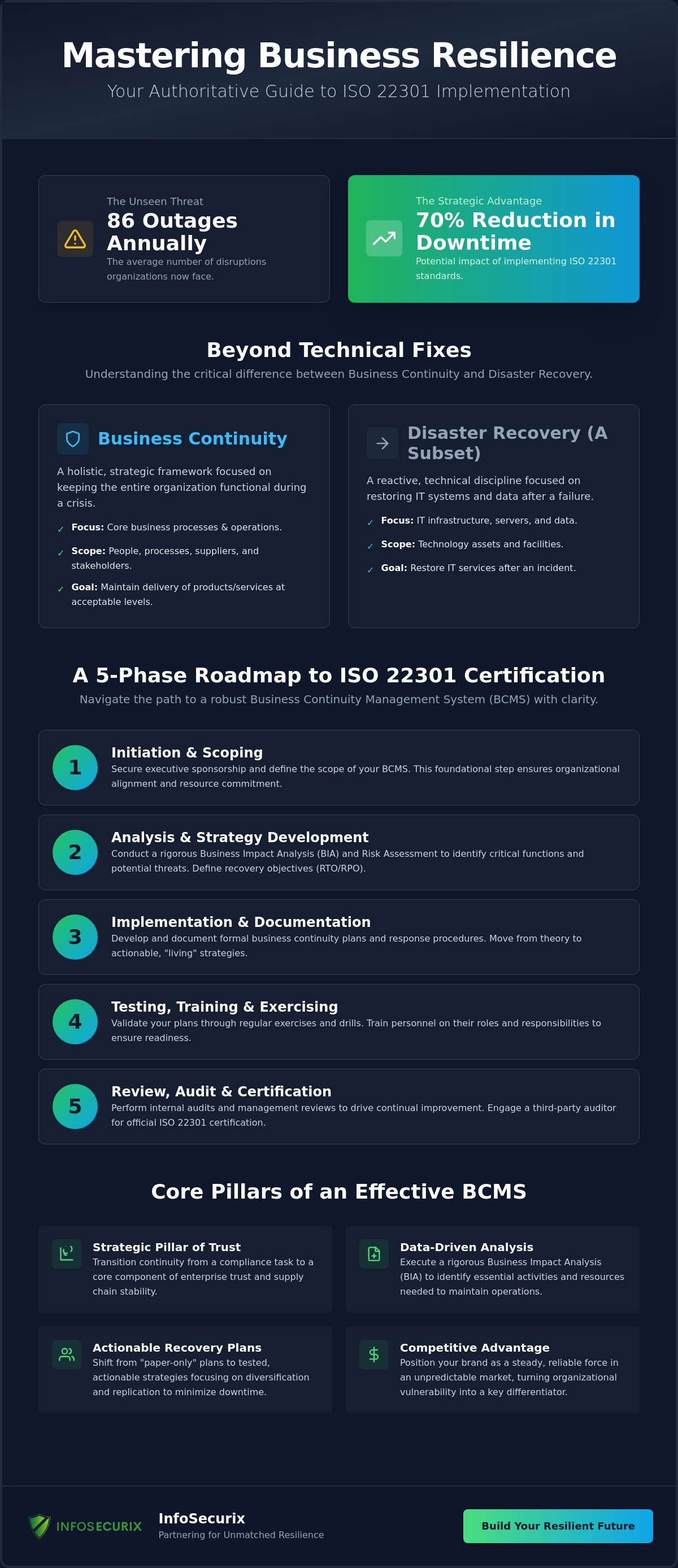
Organizations now face an average of 86 outages annually, which means the distinction between a minor setback and a systemic failure depends entirely on the depth of your preparation. You likely understand that a “check-the-box” approach to compliance offers a false sense of security that often fails under the pressure of a genuine crisis. It’s vital to move beyond static documentation toward a living system that protects your operations and secures client trust. This ISO 22301 implementation guide provides the authoritative framework you need to build a Business Continuity Management System that’s both resilient and strategically aligned with your growth.
We’ll guide you through the systematic process of mastering the Business Impact Analysis while integrating these standards seamlessly with your existing ISO 27001 or SOC 2 frameworks. By implementing these meticulous standards, organizations can realize up to a 70% reduction in downtime during disruptions. This article outlines a clear path to certification that minimizes operational friction and enhances your market reputation. You’ll gain the insights necessary to transform organizational vulnerability into a definitive competitive advantage, positioning your brand as a steady, reliable force in an unpredictable market.
Key Takeaways
- Understand how ISO 22301 transitions business continuity from a passive compliance requirement to a strategic pillar of enterprise trust and supply chain stability.
- Learn to execute a rigorous Business Impact Analysis; identifying the essential activities and resources required to maintain operations during a crisis.
- Follow our comprehensive ISO 22301 implementation guide to navigate the five-phase path toward certification with absolute clarity and executive confidence.
- Shift from “paper-only” plans to actionable recovery strategies: focusing on diversification and replication to minimize operational downtime.
- Explore how partnering with seasoned experts provides a bespoke approach to resilience; ensuring your standards remain robust in an evolving risk landscape.
Understanding the Strategic Necessity of ISO 22301
Resilience isn’t a secondary consideration for the modern enterprise; it’s the bedrock of sustainable growth. The ISO 22301 standard provides the definitive framework for organizations to manage business continuity with precision. This isn’t just about surviving a temporary outage. It’s about demonstrating to your clients, partners, and stakeholders that your operation is built on a foundation of absolute reliability. This ISO 22301 implementation guide serves as your roadmap for transitioning from a state of vulnerability to one of strategic strength.
True resilience requires a fundamental shift in mindset. Many organizations operate in a reactive mode, scrambling to respond only after a crisis occurs. ISO 22301 encourages a proactive stance where risks are identified and mitigated long before they manifest. This foresight secures your supply chain integrity and builds a level of enterprise trust that competitors simply can’t match. When you commit to this standard, you’re signaling to the market that your delivery remains consistent, regardless of external pressures.
Success begins at the top. Securing executive sponsorship is the critical first step because a Business Continuity Management System (BCMS) requires resources, cultural alignment, and long-term commitment. Without leadership’s active involvement, implementation often becomes a fragmented documentation exercise that fails when truly tested. Leaders don’t just sign off on the project; they champion a culture of preparedness that permeates every level of the organization.
The Core Objectives of a BCMS
A BCMS provides a structured approach to identifying potential threats and assessing their impact on your core operations. Its primary goal is to ensure you can continue delivering products and services at acceptable, pre-defined levels during a disruption. ISO 22301 stands as a strategic shield against operational volatility, ensuring that unforeseen disruptions don’t compromise your organizational legacy.
Distinguishing Business Continuity from Disaster Recovery
It’s a common misconception that disaster recovery and business continuity are interchangeable terms. Disaster recovery is a technical subset of the broader ISO 22301 implementation guide framework, focusing specifically on the restoration of IT infrastructure and data. Business continuity takes a holistic view. It prioritizes business processes, human capital, and communication channels over simple server uptime. By focusing on organizational survival rather than just technical recovery, you ensure that the entire enterprise remains functional when it matters most.
The Engine of Resilience: Business Impact Analysis and Risk Assessment
If strategic necessity defines the “why” of your resilience program, the Business Impact Analysis (BIA) serves as the “how.” It provides the analytical rigor required to transform high-level goals into operational reality. Within any effective ISO 22301 implementation guide, the BIA is positioned as the engine that drives every subsequent decision. It’s a meticulous process of identifying critical business activities and the specific resources required to sustain them. By quantifying the impacts of disruption over time, leadership can move away from guesswork and toward data-driven recovery priorities.
Executing a BIA involves more than just listing departments. It requires a deep dive into how various functions interact and which processes are truly indispensable to your mission. Organizations must align their findings with the broader requirements for Business Continuity Management Systems to ensure full compliance. Once the BIA is complete, a formal risk assessment identifies the specific threats, such as cyberattacks or supply chain failures, that could trigger these impacts. Conducting a comprehensive risk assessment allows you to visualize the landscape of potential disruptions before they occur.
Defining Recovery Time and Point Objectives (RTO & RPO)
Precision is the hallmark of a mature BCMS. Establishing the Maximum Tolerable Period of Disruption (MTPD) for every critical process is a non-negotiable requirement. This figure represents the absolute ceiling of downtime before your organization suffers irreparable harm. From this baseline, you define your Recovery Time Objective (RTO) and Recovery Point Objective (RPO). These metrics are the primary drivers for technical and operational investment decisions. Balancing the speed of recovery with the cost of implementation ensures your resilience strategy remains financially viable while providing a secure safety net for the enterprise.
Mapping Dependencies Across the Organization
Modern enterprises rarely operate in isolation. Resilience requires a thorough mapping of internal and external dependencies to prevent a single point of failure from triggering a cascade. This phase of the ISO 22301 implementation guide emphasizes the role of third-party vendors and supply chain partners. You must document exactly what is needed to maintain operations, including specific human capital, physical premises, and technology stacks. Understanding these interconnections protects your organization from the “domino effect” that often characterizes large-scale industrial or digital disruptions.
Developing the Business Continuity Strategy and Plans
Translating raw data from the Business Impact Analysis into a cohesive strategy marks the transition from assessment to action. This phase of the ISO 22301 implementation guide focuses on closing the gap between current capabilities and the recovery objectives established in the previous stage. Leadership must evaluate strategy options with a focus on longevity and flexibility: diversification of supply chains, replication of critical data across geographically dispersed regions, and robust alternative work arrangements. High-level decision-makers often view business continuity and resilience as a competitive differentiator that reinforces client confidence during market turbulence.
Constructing the Business Continuity Plan (BCP) requires a playbook approach that is both granular and adaptable. It’s not enough to have a static document; the plan must serve as a living guide for crisis response. For many organizations, this process involves integrating the BCMS with existing ISO 27001 certification readiness frameworks. Aligning these standards ensures that information security and operational availability work in tandem, creating a unified defense against both digital and physical disruptions. This integrated approach prevents the siloing of risk management and streamlines the path to enterprise-wide compliance.
Incident Response and Management Frameworks
Establishing a sophisticated response framework begins with clear communication protocols. Internal teams and external stakeholders must receive timely, accurate information to prevent panic and misinformation. Central to this structure is the Crisis Management Team (CMT), a group of empowered individuals with clearly defined roles and the authority to activate recovery procedures. We recommend creating tiered response plans that scale based on the severity of the incident: allowing your organization to deploy resources efficiently without overreacting to minor setbacks.
Building a Culture of Resilience Through Awareness
A plan is only as effective as the people trained to execute it. Moving beyond simple documentation requires a commitment to functional knowledge transfer where every employee understands their specific role during a BCP activation. Regular awareness programs ensure that resilience is woven into the organizational DNA rather than being treated as an annual compliance task. When your workforce is empowered with the right information, they transform from passive observers into active participants in the company’s survival and success.
A 5-Phase Roadmap to ISO 22301 Certification
Achieving certification requires a methodical approach that transforms theoretical plans into operational reality. This ISO 22301 implementation guide follows a structured 5-phase roadmap designed to ensure your Business Continuity Management System (BCMS) is both compliant and functional. Each phase builds upon the last: creating a cohesive journey from initial governance to final certification. By following this sequence, leadership can maintain oversight while technical teams execute the granular requirements of the standard.
- Phase 1: Foundation and Governance – Defining the scope of the BCMS is the first priority. This involves establishing clear boundaries for the system and securing the leadership commitment necessary to drive the project forward.
- Phase 2: Analysis and Assessment – Building on the work discussed earlier, this phase involves executing the BIA and formal risk assessment. These activities provide the data required to prioritize recovery efforts.
- Phase 3: Strategy and Planning – Translating assessment data into tactical response procedures. This phase focuses on developing the incident response and recovery plans that will guide the organization during a disruption.
- Phase 4: Implementation and Training – Deploying the BCMS across the organization. Success here depends on comprehensive workforce training to ensure every team member understands their role in the continuity strategy.
- Phase 5: Evaluation and Improvement – Validating the system through internal audits and management reviews. This final phase ensures the BCMS remains effective and aligned with evolving organizational goals.
The Critical Role of Exercising and Testing
Validation is the only way to confirm that your strategies will hold up under pressure. Conducting tabletop exercises allows your Crisis Management Team to walk through hypothetical scenarios in a low-stakes environment. These sessions are invaluable for identifying logical gaps or communication breakdowns that might otherwise go unnoticed. Simulating disruptions through more rigorous functional tests further validates the effectiveness of your recovery plans. Continuous improvement is the ultimate goal: updating your documentation based on exercise results and lessons learned to ensure your resilience remains current.
Preparing for the Certification Audit
The path to formal recognition concludes with a rigorous external assessment. Performing a comprehensive ISO 22301 gap analysis is an essential step to identify any remaining non-conformities before the auditor arrives. Addressing these issues during the internal audit phase prevents costly delays during the official certification process. You’ll need to gather clear evidence of BCMS performance, including training records, exercise reports, and management review minutes. Engaging with a partner for professional internal audit services provides the objective perspective needed to ensure your organization is fully prepared for the external registrar.
Partnering for Resilience: The InfoSecurix Advantage
Navigating the path to certification requires more than a checklist. It demands a partner who has mastered the complexities of the global risk landscape. InfoSecurix leverages over 25 years of specialized experience to guide organizations through these intricate compliance terrains with absolute precision. This ISO 22301 implementation guide has detailed the systematic requirements for a robust BCMS, but the true value lies in the execution of a bespoke strategy tailored to your unique operational footprint. We don’t believe in one-size-fits-all solutions. Instead, we provide a sophisticated framework that aligns your resilience goals with your broader business objectives.
Our methodology is built on a strategic, top-down approach. This ensures that leadership commitment isn’t just a signature on a document but a driving force behind organizational change. We focus on streamlining the entire certification journey by utilizing expert internal audit services. These audits act as a critical stress test for your BCMS; identifying potential friction points before they can impact your formal assessment. By integrating internal reviews early in the process, we help you build a culture of continuous improvement that extends far beyond the initial audit.
Comprehensive Readiness Assessments
Success in business continuity is often determined long before the external auditor arrives. Our readiness assessments are designed to identify vulnerabilities before they manifest as audit failures or, worse, operational disasters. We provide a clear, actionable roadmap for remediation that focuses on strategic improvement rather than just technical patches. This process ensures your organization is not just certified but genuinely resilient and capable of maintaining service delivery during unforeseen events. We prioritize the preservation of your reputation by ensuring your recovery plans are battle-tested and reliable.
Take the Next Step Toward Operational Security
Operational continuity is the cornerstone of enterprise trust. We invite you to engage with a seasoned guide who understands the high stakes of business survival in an unpredictable market. The InfoSecurix engagement model is inherently collaborative. We work as a protective force that enables your growth while future-proofing your operations against disruption. Our consultants have seen every possible scenario and remain unfazed by complexity. Contact us today to schedule a strategic consultation for your ISO 22301 implementation and secure your organizational legacy.
Future-Proofing Your Enterprise Through Strategic Resilience
Resilience isn’t just a defensive measure; it’s a fundamental requirement for any organization aiming for long-term growth. This ISO 22301 implementation guide has outlined how a systematic approach to business continuity transforms potential vulnerability into a definitive competitive advantage. By mastering the Business Impact Analysis and following a structured roadmap to certification, you ensure your operations remain steady during the most challenging disruptions. True resilience is built on the foundation of meticulous standards and a culture of preparedness that permeates every level of the enterprise.
Navigating this complex landscape requires a partner with deep-rooted knowledge and a legacy of success. InfoSecurix brings over 25 years of specialized security and compliance expertise to your organization. Our comprehensive readiness assessments eliminate audit surprises and provide a clear path to certification success. It’s time to move beyond reactive planning and embrace a proactive stance that protects your brand’s integrity. Secure Your Operational Resilience with InfoSecurix today and build a legacy of reliability that your clients can trust. Your journey toward absolute operational security begins with a single, decisive step toward excellence.
Frequently Asked Questions
How long does a typical ISO 22301 implementation take?
A typical implementation of the standard usually spans between six to nine months to achieve full certification readiness. While organizations with dedicated resources might achieve this in a shorter timeframe, the process requires thorough documentation and cultural alignment. This duration allows for the complete execution of the Business Impact Analysis and the necessary testing cycles that ensure the system is functional rather than just theoretical.
What is the difference between ISO 22301 and a standard Disaster Recovery plan?
ISO 22301 focuses on the continuity of the entire business operation; whereas disaster recovery is a technical subset specifically concerned with IT infrastructure restoration. A Business Continuity Management System addresses human capital, physical premises, and communication channels. It ensures that the organization survives a disruption, while disaster recovery simply ensures that the data and servers are available to support that survival.
Is ISO 22301 certification mandatory for all businesses?
Certification is generally voluntary for most organizations, though it’s increasingly becoming a contractual requirement in high-stakes sectors like finance, healthcare, and critical infrastructure. Many firms choose to follow this ISO 22301 implementation guide to secure enterprise trust and demonstrate a commitment to reliability. Even without a mandate, certification provides a definitive competitive advantage when bidding for government or multinational contracts.
Can I integrate ISO 22301 with my existing ISO 27001 framework?
You can seamlessly integrate ISO 22301 with your existing ISO 27001 framework because both standards share the high-level Annex SL structure. This alignment allows for shared governance, unified risk assessment methodologies, and streamlined internal audit processes. Integrating these systems reduces administrative burden and ensures that information security and operational resilience work as a single, cohesive defense for the enterprise.
What are the most common challenges during the Business Impact Analysis (BIA) phase?
The most common challenges during the Business Impact Analysis phase include data fragmentation and the difficulty of objectively prioritizing competing business activities. Teams often struggle with scope creep where non-essential processes are labeled as critical. Overcoming these hurdles requires clear executive guidance and a disciplined approach to identifying the Maximum Tolerable Period of Disruption for every core function.
How often should we test or exercise our Business Continuity Plans?
Organizations should test or exercise their Business Continuity Plans at least once every twelve months or whenever a significant change occurs within the business environment. Regular testing validates that recovery strategies remain effective as the organization evolves. These exercises range from simple tabletop discussions to full-scale simulations, ensuring that the Crisis Management Team remains proficient and ready to act under pressure.
What is the role of senior management in the ISO 22301 implementation process?
Senior management’s role is to provide the strategic vision, resource allocation, and governance required for the BCMS to succeed. Leadership must move beyond simple approval; they must actively champion the resilience program to foster a culture of preparedness. Without visible executive sponsorship, business continuity efforts often lack the authority needed to influence departmental priorities and secure long-term operational stability.
How does ISO 22301 help with supply chain risk management?
ISO 22301 enhances supply chain risk management by requiring organizations to evaluate the resilience of their third-party partners and critical vendors. By establishing clear continuity requirements within procurement contracts, you prevent external failures from triggering a cascade of internal disruptions. This standard ensures that your entire value chain is aligned with your recovery objectives, protecting your ability to deliver products and services consistently.