
Most leadership teams view the mandatory security review as a bureaucratic hurdle: a series of slides to be endured rather than a strategic lever to be pulled. In a 2026 environment where global information security spending has reached $240 billion, treating this session as a mere formality isn’t just inefficient; it’s a risk to your organizational resilience. You’ve likely faced the challenge of translating granular audit findings into business-level risks that actually capture executive attention. It’s frustrating to feel that your hard work on the ISMS isn’t being reflected in the budget or resources you receive.
This article provides a refined ISO 27001 management review meeting agenda that ensures you satisfy every mandatory requirement of Clause 9.3 while positioning security as a driver of corporate excellence. You’ll gain access to a professional template that transforms technical data into strategic insights. We’ll walk through the essential inputs for the 2022 standard, the necessary outputs for a successful audit, and the specific ways to leverage this meeting to secure leadership buy-in for your security roadmap.
Key Takeaways
- Bridge the gap between technical controls and executive strategy: reframe the management review as a core pillar of corporate governance.
- Implement a comprehensive ISO 27001 management review meeting agenda that satisfies Clause 9.3 requirements while fostering meaningful engagement from senior leadership.
- Navigate the complexities of the 2026 threat landscape by integrating assessments of AI-driven vulnerabilities and cloud supply chain risks into your strategic review.
- Identify the precise outputs and decision-making evidence that auditors expect to see; move beyond simple minutes to demonstrate authentic ISMS effectiveness.
- Leverage professional readiness assessments to transform your compliance obligations into opportunities for securing budget and resource commitments.
The Strategic Role of the Management Review in ISMS Governance
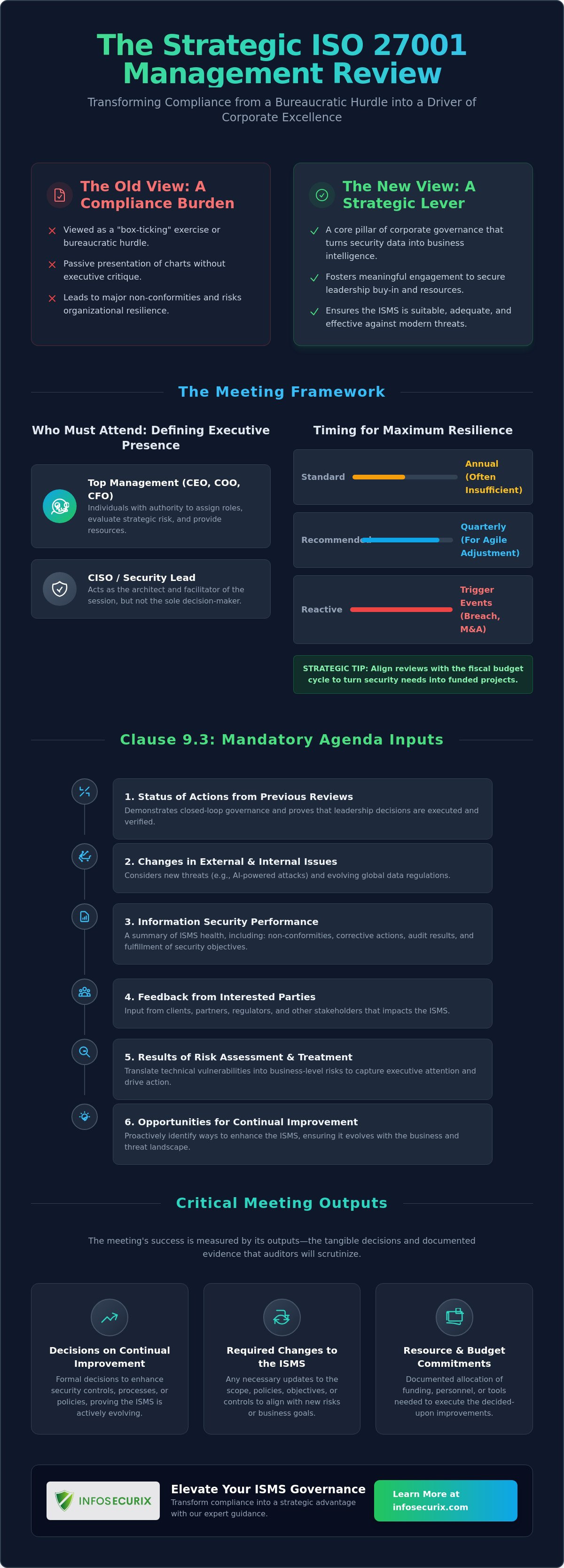
Viewing the management review as a mere compliance obligation is a fundamental misunderstanding of its power. Within the ISO/IEC 27001 standard, Clause 9.3 serves as the vital bridge connecting granular technical controls with overarching corporate strategy. It is the moment where security data transforms into business intelligence: a strategic pivot point for the entire firm. High-performing organizations use this session to ensure their Information Security Management System (ISMS) remains suitable, adequate, and effective in a landscape defined by rapid change.
Treating the ISO 27001 management review meeting agenda as a “box-ticking” exercise remains the primary reason for major non-conformities during certification audits. Auditors are trained to detect a lack of genuine leadership engagement. If the minutes show a passive presentation of charts without evidence of executive critique or resource allocation, the ISMS is deemed to lack the “Top Management” commitment required for certification. The 2026 reality requires a shift from static annual snapshots toward a model of continuous governance. This evolution ensures that your security posture adapts in real-time to emerging AI-driven threats and shifting regulatory demands, protecting your organization’s longevity.
Who Must Attend: Defining the Executive Presence
A valid management review requires the presence of “Top Management” as defined by the organization’s scope. This typically includes the CEO, COO, or CFO; individuals with the authority to assign roles and provide resources. While the CISO acts as the architect and facilitator of the session, they cannot be the sole decision-maker. Delegating this meeting to mid-level management creates a dangerous disconnect. The CEO’s role is to evaluate the strategic impact of security risks and authorize the investments necessary to mitigate them. Without this level of presence, the review loses its authority and its compliance validity.
Timing and Frequency for Maximum Resilience
The standard requires reviews at “planned intervals,” yet the traditional annual cycle often proves insufficient for modern resilience. Quarterly reviews allow for more agile adjustments to the security roadmap. Organizations should also define specific “trigger events” that mandate an ad-hoc session. These might include a significant data breach, a major acquisition, or a shift in cloud service providers. Aligning these reviews with the fiscal budget cycle is a strategic masterstroke. It ensures that the resource requirements identified during the review are integrated directly into the company’s financial planning, turning security needs into funded projects.
Mandatory Inputs: The Clause 9.3 Agenda Requirements
The ISO 27001 management review meeting agenda must be built upon a foundation of specific, mandatory data points to satisfy Clause 9.3. It’s the “input” phase where the system’s performance is laid bare for executive scrutiny. A critical starting point is the review of actions from previous sessions. This demonstrates closed-loop governance, proving to auditors that leadership decisions aren’t just recorded but are actively executed and verified. Without this historical context, the review loses its narrative of continual improvement and becomes a series of disconnected events.
Leadership teams must also analyze changes in external and internal issues that impact the ISMS. In 2026, this naturally includes the escalation of AI-powered social engineering and the complexities of fragmented global data regulations. By aligning with ISACA’s guide to ISO 27001:2022 transition, organizations can better understand how these shifting variables dictate the need for updated controls. The agenda should then move to a summary of information security performance, highlighting non-conformities, the effectiveness of corrective actions, and the overall fulfillment of security objectives. Summarizing audit results provides the final piece of evidence needed to assess the system’s health.
Risk Assessment and Treatment Status
Presenting technical vulnerabilities to a board requires a shift in perspective. Instead of listing granular technical flaws, use an ISO 27001 risk assessment methodology that translates technical gaps into business impact. Executives should focus primarily on residual risks: those threats that remain after controls are applied and require formal acceptance or additional resource allocation. Risk treatment plans must be updated during the review to reflect new priorities, changing threat levels, or the availability of advanced security technologies. This ensures that the organization’s risk appetite remains aligned with its strategic goals and financial realities.
Feedback from Interested Parties
A robust ISMS doesn’t exist in a vacuum. The review must incorporate feedback from interested parties, including evolving client security requirements and the latest regulatory mandates. Internal feedback is equally vital. Insights from department heads regarding the practicality of security controls can reveal friction points that hinder productivity. Assessing the communication plan’s effectiveness ensures that security awareness isn’t just a broadcast but a meaningful two-way dialogue. If your team finds these requirements daunting, engaging in a professional Internal Audit can provide the clarity needed to present these inputs with absolute confidence.
The 2026 ISO 27001 Management Review Agenda Template
Structuring your review as a chronological narrative ensures that leadership remains focused on the most critical outcomes. A strategic ISO 27001 management review meeting agenda doesn’t just list data; it builds a case for continued resilience. By following a logical flow from past performance to future strategy, you provide a clear path for executive decision-making. Each item in the template should be explicitly labeled with “Mandatory Clause 9.3 Item” to provide auditors with immediate transparency and confidence in your governance process.
The 2026 framework requires a deliberate focus on modern complexities that weren’t as prevalent in previous years. Your agenda must move beyond basic server uptime to address AI-driven social engineering threats and the intricacies of cloud supply chain vulnerabilities. This chronological flow ensures nothing is missed:
- Opening: Review of actions from previous management reviews (Mandatory Clause 9.3 Item).
- External & Internal Context: Shifts in the 2026 threat landscape and regulatory changes (Mandatory Clause 9.3 Item).
- Performance Data: Audit results, KPI trends, and incident summaries (Mandatory Clause 9.3 Item).
- Strategic Decisions: Resource adequacy, risk treatment updates, and budget approvals (Mandatory Clause 9.3 Item).
- Continual Improvement: Identifying opportunities for enhancement as per Clause 10.2.
- Closing: Formal record of outputs and decision-making evidence.
Section 1: Performance Metrics and KPIs
Selecting the right metrics is essential for executive clarity. Avoid overwhelming the board with granular technical logs; instead, present 3-5 high-impact KPIs that reflect the health of the ISMS. Focus on incident response times, the percentage of employees completing advanced AI-awareness training, and the maturity of your information security internal audit program. Demonstrating that your internal assessments are rigorous and objective proves to leadership that the system is self-correcting. Presenting these trends visually helps non-technical leaders grasp the effectiveness of current security controls and identify where additional focus is required.
Section 2: Resource Adequacy and Budgeting
Positioning security requirements as business enablers is the most effective way to secure executive buy-in. When discussing the ISO 27001 management review meeting agenda item on resources, frame the conversation around how security investments protect revenue streams and client trust. It’s vital to document the explicit approval or denial of proposed security budgets within the minutes. This record serves as evidence of “Top Management” exercising their authority. Additionally, use this time to evaluate the competence of your security team. Identifying specific training needs or personnel gaps ensures that your human capital is as resilient as your technical infrastructure.
Critical Meeting Outputs: What Auditors Look For
Securing a successful audit requires more than just following the ISO 27001 management review meeting agenda; it demands concrete evidence of the results. Auditors rarely focus on the aesthetic quality of your slides. Instead, they look for the “so what?” behind the data. The standard explicitly requires documented evidence that top management has made informed decisions regarding the system’s future. This includes identifying opportunities for continual improvement and recording any necessary changes to the ISMS, such as updates to the scope or core security policies. Without these recorded outputs, the meeting is merely a conversation rather than a governance event.
Documenting the allocation of resources is perhaps the most vital output for demonstrating leadership commitment. Whether it is the approval of a new threat intelligence tool or the authorization of additional security personnel, these decisions must be formalized in the meeting record. Recording a “no” is just as important as recording a “yes”; it proves that management has considered the requirement and accepted the associated residual risk. This level of transparency builds a narrative of honest, proactive management that auditors find deeply reassuring.
Documenting Strategic Corrective Actions
Aligning your meeting outputs with a structured ISO 27001 readiness checklist ensures that no mandatory requirement is overlooked. Every decision made during the session must be accompanied by an assigned owner and a clear deadline for execution. This transforms vague intentions into accountable tasks. To provide maximum weight during an audit, ensure the final “Minutes of Meeting” are formally signed by Top Management. This signature serves as an undeniable record of their involvement and their acceptance of the ISMS performance as presented. If you are preparing for your first certification, engaging our experts for an ISO 27001 Certification Readiness assessment can help you refine these outputs before the auditor arrives.
Evidence of Suitability, Adequacy, and Effectiveness
Crafting a formal summary statement is a strategic move that signals high governance maturity. This statement should explicitly use the standard’s own language to conclude that the ISMS remains “suitable, adequate, and effective” for the organization’s current needs. Using this specific phrasing acts as a “green flag” for auditors, as it demonstrates that leadership speaks the language of the standard. For organizations pursuing integrated management systems, storing this evidence in a centralized repository also supports a future ISO 20000 implementation. This unified approach to documentation reduces administrative overhead while ensuring that service excellence and information security remain strategically aligned.
Elevating Your Governance with InfoSecurix Expertise
Navigating the complexities of global security standards requires more than a checklist; it demands a partner who has seen every possible audit scenario across diverse industries. InfoSecurix brings over 25 years of experience in guiding organizations through intricate national regulatory landscapes. We act as your seasoned guide, ensuring that your ISO 27001 management review meeting agenda serves as a robust platform for leadership confidence. Our approach focuses on transforming mandatory sessions into high-value strategic discussions that resonate with board-level priorities.
A standout feature of our partnership is the professional “Mock Management Review.” Conducting this high-fidelity simulation before your actual audit allows your executive team to practice their roles in a safe, controlled environment. We identify potential friction points in your reporting and help refine the narrative of your ISMS performance. This dress rehearsal turns a potentially stressful compliance hurdle into a polished demonstration of corporate excellence, leaving you fully prepared for the scrutiny of external auditors.
Bespoke Readiness and Internal Audit Services
InfoSecurix prepares your data so the management review process remains seamless and impactful. We specialize in providing the unbiased, independent assessments that leadership teams need to make informed decisions. By delivering objective Internal Audits, we ensure the inputs to your review are accurate and reflect the true state of your controls. Our team works closely with yours to align your governance with ISO 27001 certification readiness standards, ensuring every technical finding is translated into a strategic business insight.
Securing Your Future Compliance
Future-proofing your organization requires a top-down approach to security culture that starts in the boardroom. Meticulous standards are the foundation of longevity; they protect your reputation and your revenue streams in an increasingly volatile digital world. We invite you to a professional consultation to refine your executive reporting structure and elevate your governance maturity. Engage with our experts today to ensure your ISO 27001 management review meeting agenda drives the resources and results your business deserves. Let us help you build a resilient framework that stands the test of time and audit pressure.
Mastering the Strategic Security Narrative
Transforming the management review from a technical briefing into a high-level leadership session is the definitive key to ISMS longevity. By implementing a structured ISO 27001 management review meeting agenda, you ensure that every mandatory input of Clause 9.3 is addressed while securing the executive buy-in necessary for organizational growth. This strategic alignment converts passive compliance into a proactive defense mechanism that resonates with the board. It’s about moving beyond the checklist to orchestrate a system that truly protects your firm’s most valuable assets.
Partnering with a boutique consultancy that offers national reach and 25 years of information security excellence provides the clarity required for complex certification journeys. Our expert ISO 27001 and SOC2 readiness practitioners specialize in translating technical findings into the strategic business impact that executives demand. This collaborative approach future-proofs your operations against the shifting 2026 threat landscape, ensuring your governance remains steady under pressure.
Secure Your Strategic Compliance Roadmap with InfoSecurix. Your commitment to these meticulous standards today builds the resilient foundation your organization needs for a secure and prosperous tomorrow.
Frequently Asked Questions
What is the minimum frequency for an ISO 27001 management review?
The standard requires reviews at “planned intervals” rather than a rigid timeframe. Most organizations find that an annual review is the absolute minimum, though a quarterly cadence provides superior resilience for modern businesses. This higher frequency ensures that your security strategy remains relevant in a fast-moving threat landscape and allows for more agile resource adjustments.
Can the management review be part of a larger board meeting?
You can certainly integrate this session into a larger executive or board meeting to maximize leadership efficiency. It’s vital to ensure that the ISO 27001 management review meeting agenda items are explicitly identified and demarcated in the minutes. This clear separation provides auditors with undeniable evidence that the mandatory Clause 9.3 requirements were addressed with the necessary strategic focus.
What happens if senior management cannot attend the review?
A review conducted without the presence of senior management is technically invalid and often results in a major non-conformity. The standard defines “Top Management” as those who direct and control the organization at the highest level. If these individuals don’t attend, the session lacks the authority to approve critical resource allocations or accept significant residual risks.
How much detail should be included in the management review minutes?
Minutes should focus on the “results” and strategic decisions rather than providing a word-for-word transcript of the conversation. You must document that every mandatory input was considered and record specific outputs, such as approved changes to the ISMS scope or policies. Clear evidence of leadership decision-making is what an auditor values most during their formal assessment.
Is a slide deck sufficient as evidence for an ISO 27001 auditor?
A slide deck is merely a visual aid and doesn’t constitute complete evidence of a management review. While it shows what was presented, it doesn’t prove that leadership actively engaged with the material or made required decisions. You need signed minutes and a formal record of the resulting actions to satisfy the standard’s rigorous documentation requirements.
What is the difference between a management review and an internal audit?
An internal audit is an objective fact-finding mission to check if controls are working correctly against the standard’s requirements. In contrast, the management review is a strategic session where leadership uses those audit findings to make high-level governance decisions. The audit tells you where you are; the review decides where the organization is going.
How should we address AI-related risks in our 2026 management review?
Treat AI-related risks as a critical update to your external and internal context within the ISO 27001 management review meeting agenda. Leadership should specifically evaluate how automated threats impact existing risk treatment plans and whether current controls are sufficient to manage the 2026 landscape. This ensures your ISMS remains effective against sophisticated social engineering and automated data leakage vulnerabilities.
What are the most common non-conformities related to Clause 9.3?
The most frequent failures involve missing one of the mandatory inputs, such as feedback from interested parties or changes in external issues. Organizations also often fail to record specific decisions regarding resource needs or opportunities for continual improvement. Another common issue is failing to demonstrate that actions from the previous management review were actually tracked and completed.