

Hiring an auditor to build your security framework is the fastest way to ensure your ISO 27001 certification fails before it even begins. In 2024, the number of valid certificates nearly doubled to over 96,000 organizations globally, proving that the race for digital trust is accelerating. You likely feel the weight of complex jargon and the fear that a single budgeting mistake could lead to a failed audit. Understanding the distinction between an ISO 27001 lead implementer vs lead auditor isn’t just a matter of professional titles; it’s a fundamental requirement for maintaining the independence that the ISO/IEC 27001:2022 standard demands.
We recognize that you want to protect your organization’s growth through rigorous standards without getting lost in granular mechanics. This guide clarifies the strategic boundaries between the architect who builds your Information Security Management System and the examiner who verifies its strength. You’ll gain a clear understanding of role boundaries and the ability to hire the right consultant for your current stage. We’ll explore the daily tasks, personnel certification costs, and the critical regulatory shifts that define these two indispensable roles to ensure your path to compliance is both efficient and secure.
Key Takeaways
- Understand how the Lead Implementer defines the strategic scope of your Information Security Management System to align with the latest 2022 standards and climate action amendments.
- Evaluate the strategic choice between an ISO 27001 lead implementer vs lead auditor to ensure your organization secures the correct expertise for its current compliance maturity.
- Master the essential “independence” requirement: establishing clear boundaries between the implementation of security controls and their subsequent verification.
- Identify the critical differences between internal and external audits to prepare your organization for a seamless third-party certification process.
- Discover how professional guidance translates technical Annex A controls into scalable business processes that support long-term corporate growth and resilience.
The Fundamental Distinction: ISO 27001 Lead Implementer vs. Lead Auditor
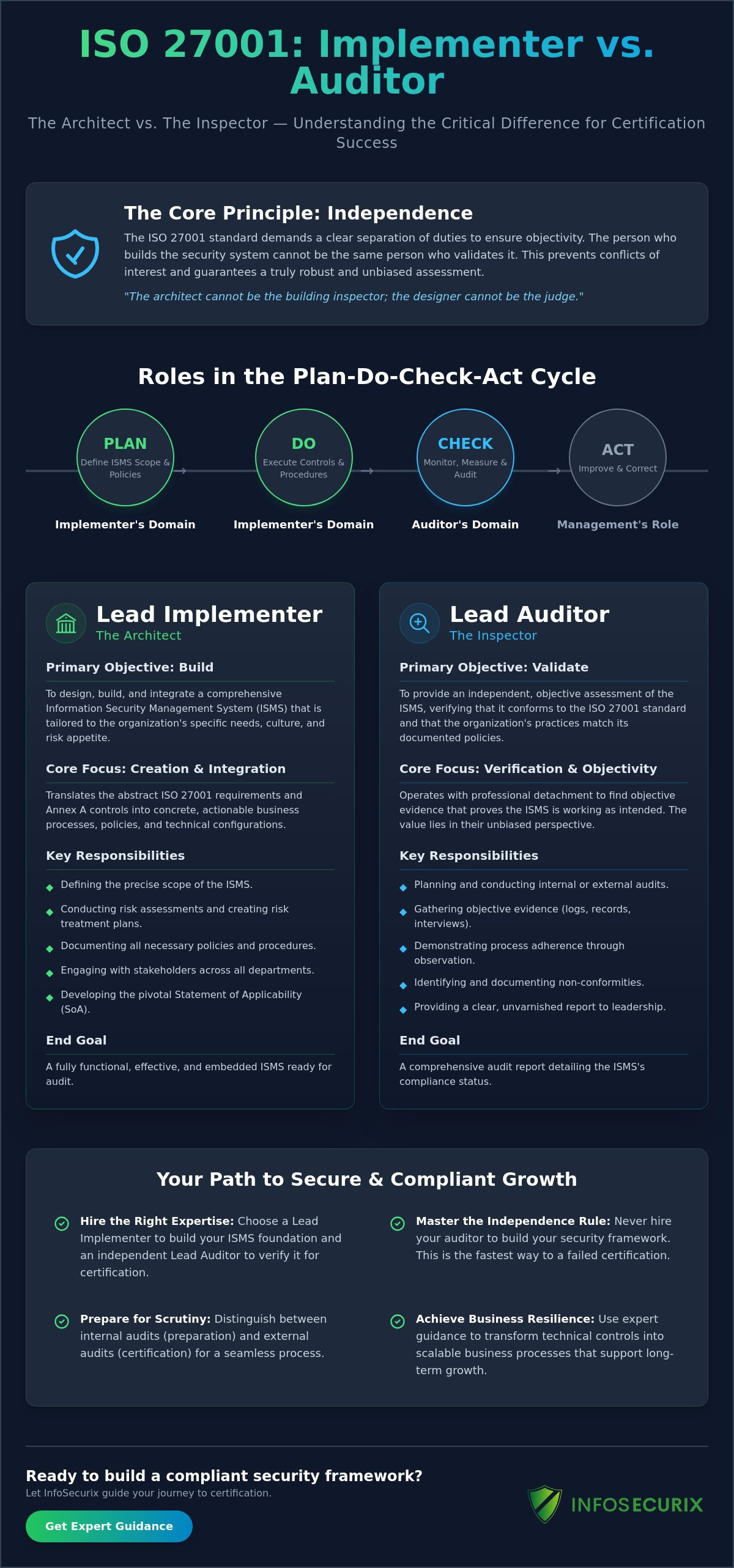
Achieving certification requires more than just technical knowledge; it demands a strategic alignment of roles. The fundamental difference between an ISO 27001 lead implementer vs lead auditor lies in their ultimate objective. One builds, while the other validates. Both professionals must possess an exhaustive understanding of the ISO/IEC 27001 standard, yet their daily application of these requirements is entirely different. The architect cannot be the building inspector; the designer cannot be the judge. This separation ensures that the system remains robust, objective, and free from the inherent biases that arise during the creation process.
The Plan-Do-Check-Act (PDCA) cycle provides the structural framework for these roles. The Implementer takes charge of the “Plan” and “Do” stages, setting the strategy and executing the security controls. The Auditor steps in during the “Check” stage, acting as a critical safeguard to ensure the “Act” stage is based on accurate, verified data. This cycle creates a continuous loop of improvement that future-proofs the organization against evolving threats.
The Lead Implementer: The Power of Creation
Focusing on the initial lifecycle of the Information Security Management System (ISMS), the Lead Implementer translates complex requirements into actionable business processes. They are responsible for the meticulous documentation of policies, the selection of technical controls, and the execution of comprehensive risk treatment plans. Their work is deeply collaborative, requiring them to engage with stakeholders across the organization to ensure that security becomes a core business enabler rather than a bureaucratic hurdle. The Lead Implementer is the primary driver of organizational security culture change.
The Lead Auditor: The Power of Verification
The Lead Auditor operates with a mandate of absolute objectivity. When examining the ISO 27001 lead implementer vs lead auditor dynamic, it’s clear that the auditor’s value is found in their professional detachment. Their role is to provide an independent assessment of the ISMS, ensuring that the “Do” phase actually aligns with the “Plan” phase. They look for objective evidence: logs, interviews, and process demonstrations that prove the organization’s claims of compliance are grounded in reality. By identifying non-conformities early, the auditor provides the executive team with a clear, unvarnished view of their security posture before the final certification audit begins.
The Lead Implementer: Architecting Your Information Security Management System
Building a resilient information security framework requires a visionary architect who understands the delicate balance between technical rigor and operational fluidity. The Lead Implementer serves as this master builder, translating the abstract requirements of the standard into a functional framework that protects your most valuable assets. While the ISO 27001 lead implementer vs lead auditor debate often focuses on the final examination, it’s the implementer’s work that determines the long-term viability of the system. They define the ISMS scope with precision, ensuring that every critical asset is protected without over-burdening the organization with unnecessary bureaucracy. This strategic approach highlights the true value of ISO 27001 certification as a driver for corporate growth and trust.
Translating Annex A controls into actionable business processes remains one of the most complex tasks in the certification journey. The Implementer doesn’t simply “install” controls; they curate them to fit the organization’s unique culture and risk appetite. By acting as a sophisticated bridge between technical teams and executive leadership, they ensure that security investments align perfectly with broader corporate objectives. This collaboration culminates in the creation of the Statement of Applicability (SoA). This pivotal document justifies why specific controls are included or excluded, providing the primary roadmap that auditors will eventually follow. Organizations often find that partnering with experts for ISO 27001 certification readiness ensures this foundation is built to withstand the most rigorous scrutiny.
Key Responsibilities in Implementation
Designing the system starts with a comprehensive gap analysis to identify where current security measures fall short of the 2022 standard. Following this, the Implementer builds a robust information security risk assessment methodology. This process isn’t static. It involves managing a sophisticated documentation toolkit and maintaining strict version control to ensure that policies reflect the current threat landscape. They transform high-level security goals into day-to-day habits for the workforce.
When Your Organization Needs a Lead Implementer
Engagement typically begins during the initial readiness phase, where the roadmap to certification is first drafted. However, their expertise is equally vital when major organizational changes occur. Mergers, acquisitions, or the adoption of new cloud-native tech stacks require an ISMS to be recalibrated. Bringing in a Lead Implementer ensures that your ISO 27001 certification readiness remains intact before the external auditors arrive to test the integrity of your defenses.
The Lead Auditor: The Independent Lens on Compliance and Controls
If the Implementer is the architect of the fortress, the Lead Auditor is the seasoned inspector testing the strength of the gates. While the Implementer focuses on creation, the Auditor operates with a mandate of absolute objectivity: collecting evidence to verify that the Information Security Management System (ISMS) performs exactly as documented. This distinction is central to the ISO 27001 lead implementer vs lead auditor comparison. The Auditor does not offer solutions; they provide a mirror. Their primary roadmap is the Statement of Applicability (SoA) developed during the implementation phase, using it to navigate the complex landscape of controls and verify their effectiveness in a real-world environment.
Understanding the context of the audit is essential for executive decision-makers. Audits typically fall into three categories: 1st party (internal audits performed by the organization or a partner), 2nd party (audits of suppliers or vendors), and 3rd party (formal certification audits conducted by accredited bodies). Regardless of the type, a Lead Auditor must master the delicate balance of interviewing rather than interrogating. High-level auditing requires the ability to put staff at ease to uncover the true operational reality: a defensive or fearful staff member is less likely to provide the transparent evidence needed for a successful certification journey.
The Internal Audit Requirement (Clause 9.2)
ISO 27001:2022 mandates an internal audit before any external certification body arrives on-site. This stage is a critical safeguard. Many organizations choose to engage a cybersecurity internal audit firm to maintain the necessary “independence” required by the standard. This external perspective ensures that the audit is unbiased and thorough. Beyond simply identifying non-conformities, the Lead Auditor provides “Opportunities for Improvement” (OFIs): strategic insights that help refine the ISMS before the final stakes are raised during the certification phase.
Professional Skepticism and Evidence
Auditing is governed by the “show me” rule. A Lead Auditor maintains a healthy level of professional skepticism, requiring objective evidence for every claim of compliance. Because it’s impossible to check every single record, they utilize sophisticated sampling methodologies to select representative data points that reflect the overall health of the system. This process culminates in a formal audit report. This document doesn’t just list failures; it provides a logical, evidence-based narrative of the organization’s security posture, which is then presented to management to drive informed, strategic action.
Strategic Implementation: Navigating Conflict of Interest and Synergy
Maintaining the integrity of your security framework requires strict adherence to the “Golden Rule” of compliance: an individual cannot audit their own implementation work. This principle of independence is not merely a bureaucratic hurdle; it’s a strategic safeguard designed to prevent blind spots and confirmation bias. When discussing the ISO 27001 lead implementer vs lead auditor roles, executive leadership must recognize that while these professionals share a common language, their objectives are fundamentally at odds. The implementer is invested in the success of the system they built, while the auditor is mandated to remain detached, seeking only the objective truth of the system’s performance.
Mismanaging these roles often results in significant financial repercussions. If an organization attempts to bypass the independence requirement, the external certification body will likely identify a major non-conformity, leading to a failed audit. The cost of remediation, combined with the necessity of a follow-up audit, can quickly exceed the initial investment of hiring separate experts. Achieving synergy between these roles requires a structured hand-off where the implementer provides a comprehensive documentation trail, allowing the auditor to perform their analytical verification with precision. For organizations seeking to avoid these pitfalls, engaging professional Internal Audits ensures that your independence remains beyond reproach.
Implementer vs. Auditor: A Side-by-Side Comparison
The skill sets required for these roles are distinct. The Lead Implementer excels in deep technical execution and project management, focusing on building sustainable policies and controls. Their interaction with your team is constant and operational. Conversely, the Lead Auditor specializes in analytical verification and risk-based sampling. Their output is a series of audit reports rather than policies, and their interaction is periodic, occurring at critical assessment milestones to provide an unvarnished view of compliance health.
Synergy with SOC 2 and Other Frameworks
Strategic alignment between ISO 27001 and other frameworks, such as SOC 2, can significantly reduce “audit fatigue” within your technical teams. A Lead Auditor can utilize a SOC 2 readiness checklist to identify overlapping controls, ensuring that evidence collected for one standard satisfies the requirements of another. By cross-mapping these controls, the Lead Implementer can design a unified compliance strategy that serves multiple masters. This integrated approach future-proofs the organization, allowing you to scale into new markets with a single, robust security foundation that meets various global expectations simultaneously.
Optimizing Your Certification Journey: How Professional Guidance Bridges the Gap
A generic training course provides an individual with a credential, but it rarely equips an organization with a functional, resilient framework. Choosing a boutique consultancy offers a level of bespoke strategy that standard classroom environments cannot replicate. While the conversation regarding an ISO 27001 lead implementer vs lead auditor often centers on personal career paths, the strategic focus for executive leadership must remain on organizational outcomes. Expert consultants don’t just teach the standard: they embed it into your unique operational DNA, ensuring that your security posture becomes a competitive advantage rather than a bureaucratic hurdle.
Transitioning from the implementation phase to the internal audit requires a meticulous roadmap. In 2026, simply “getting the badge” isn’t enough to satisfy enterprise buyers or regulatory bodies who demand proof of ongoing resilience. Future-proofing your ISMS involves moving beyond static compliance toward a model of continuous monitoring. This ensures that the controls established by the implementer remain effective as modern threats evolve and organizational structures shift. By maintaining a steady rhythm of assessment, you protect your initial investment and demonstrate a genuine commitment to information security that lasts long after the certificate is issued.
The InfoSecurix Approach to Readiness
We specialize in guiding organizations through this complex landscape by providing high-level Lead Implementer expertise to build your framework from the ground up. Our approach to ISO 27001 Certification Readiness focuses on creating scalable processes that grow with your business. To guarantee third-party audit success, we strictly separate our Internal Audits services: this maintains the absolute independence required for certification integrity. Our 25+ years of experience ensures your ISMS is both compliant and operationally efficient, providing a protective force that enables your growth.
Next Steps for Executive Leadership
Strategic planning begins with a candid assessment of your current internal expertise. Many organizations find that while they possess technical talent, they lack the specific depth required for both the ISO 27001 lead implementer vs lead auditor roles. Budgeting for both the initial implementation and the subsequent independent verification is essential for a seamless journey. We invite you to contact a professional firm to begin a readiness assessment: identifying gaps early ensures your path to certification is steady, measured, and successful.
Mastering the Path to Enterprise Resilience
Navigating the complexities of global security standards requires a clear eyed understanding of the ISO 27001 lead implementer vs lead auditor roles. By respecting the boundary between the architect who builds your framework and the examiner who verifies its strength, you ensure the absolute integrity of your Information Security Management System. Successful certification isn’t a final destination; it’s the foundation of a sustained commitment to operational excellence and digital trust. Choosing the right partner to guide this journey makes the difference between a basic compliance exercise and a strategic business enabler that fuels long term growth.
With over 25 years of information security excellence, InfoSecurix provides a seasoned perspective on national compliance readiness. Our deep expertise across ISO 27001, SOC 2, and ISO 22301 allows us to build bespoke frameworks that are both rigorous and operationally efficient. We invite you to Secure your ISO 27001 Certification Readiness with InfoSecurix and leverage our proven track record to future proof your organization. Your path to a secure and prosperous future starts with the meticulous standards we establish together today.
Frequently Asked Questions
Can a Lead Implementer also be the Lead Auditor for the same company?
No, an individual cannot serve in both roles for the same organization due to the fundamental requirement for independence. The ISO/IEC 27001:2022 standard mandates that auditors must be impartial and objective. Auditing your own implementation work creates a conflict of interest that invalidates the audit results. Maintaining this strategic separation is a necessity for any organization seeking a credible and valid certification.
Which certification is harder to obtain: Lead Implementer or Lead Auditor?
Difficulty depends entirely on your professional background and primary focus. The Lead Implementer certification requires a deep understanding of project management and the creative ability to design security controls from scratch. Conversely, the Lead Auditor path emphasizes analytical rigor and the ability to collect objective evidence. Both examinations require a high level of technical proficiency and a polished understanding of the standard’s specific requirements.
Do I need a Lead Auditor certification to perform internal audits?
While the standard does not explicitly mandate a “Lead Auditor” certificate for internal audits, it does require that auditors are competent and objective. Holding this certification provides a recognized benchmark of that competence. It ensures that the individual understands the nuances of the ISO 27001 lead implementer vs lead auditor dynamic. Utilizing a certified professional for internal audits significantly increases the likelihood of success during the formal third party certification process.
How long does it take to transition from implementation to a successful audit?
Transitioning from the design phase to a successful audit typically requires four to twelve months. Smaller organizations utilizing specialized automation tools may achieve this within a shortened window of four to six months. This timeline allows the Information Security Management System to generate sufficient records and evidence of operational effectiveness. Meticulous planning during the implementation phase ensures that the system is mature enough to withstand the scrutiny of a formal examination.
What is the role of a Lead Implementer during the actual certification audit?
The Lead Implementer acts as the primary facilitator and subject matter expert during the certification audit. They guide the external auditor through the documented processes and ensure that the necessary evidence is readily available. Their role is to explain the rationale behind specific control selections and how they align with the organization’s risk treatment plan. They bridge the gap between technical operations and the auditor’s high level compliance requirements.
Is ISO 27001 Lead Auditor training worth it for a non-auditor?
Investing in Lead Auditor training is highly beneficial for security managers who do not intend to become full time auditors. Understanding the “examiner’s lens” allows you to build more robust systems that are naturally audit ready. This training provides insights into sampling methodologies and evidence collection. It empowers you to anticipate auditor questions and design controls that are easily verifiable, ultimately streamlining the organizational path to certification.
How often should a Lead Auditor review our ISMS?
A Lead Auditor must review your ISMS at least once per year during the mandatory surveillance audit. High performing organizations often conduct more frequent internal audits to ensure continuous compliance. These periodic reviews identify potential security deficiencies before they escalate into major issues. Regular engagement with an auditor ensures that the system remains aligned with evolving threats and organizational changes, maintaining the long term integrity of your security posture.
What happens if our Lead Auditor finds a major non-conformity?
Identifying a major non-conformity means the certification body cannot recommend your organization for certification until the issue is remediated. You must conduct a root cause analysis and implement corrective actions within a specific timeframe. Once these actions are verified by the auditor, the certification process can proceed. This rigorous verification ensures that the ISO 27001 badge remains a trusted symbol of information security excellence and corporate resilience.