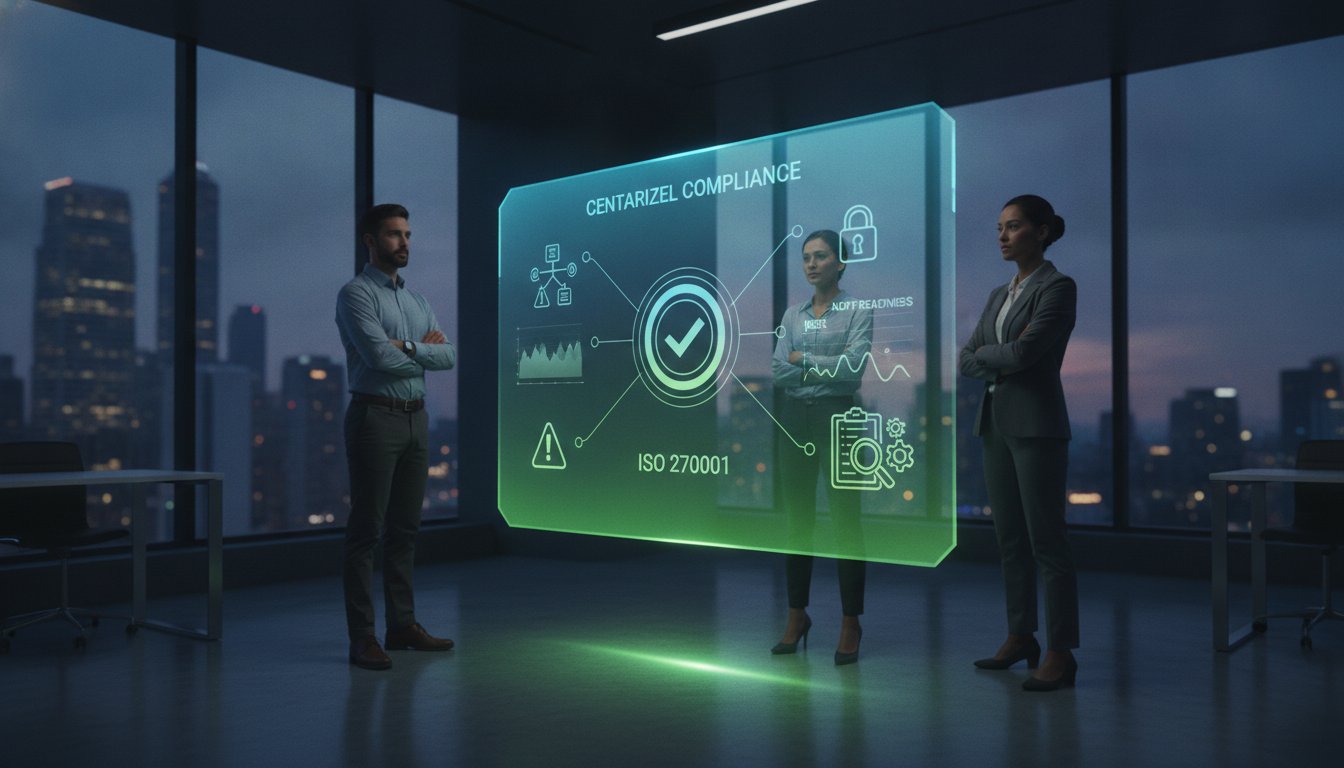
Recent data shows that 81% of organizations are now actively pursuing or maintaining ISO 27001 certification; a sharp increase that underscores the standard’s role as a cornerstone of corporate trust in 2026. For many executives, however, the day-to-day reality of the ISO/IEC 27001:2022 standard is often defined by operational fatigue and the persistent weight of manual evidence collection. You’ve likely felt the anxiety that precedes a surveillance audit when visibility into your actual risk posture is obscured by fragmented spreadsheets. Engaging with professional ISO 27001 consulting services provides the clarity needed to navigate these complexities, ensuring your security framework supports your ambitions rather than slowing them down.
This article explores how to transform your compliance journey from a one-time achievement into a sustainable, software-driven strategic asset. We’ll show you how to establish a centralized source of truth for your ISMS, effectively reducing administrative burdens through modern automation. By the end of this guide, you’ll understand how to maintain continuous audit readiness and leverage your certification as a powerful tool for long-term organizational growth.
Key Takeaways
- Learn to transcend the “post-certification slump” by establishing ISO 27001 maintenance as a systematic, ongoing preservation of your organizational security posture.
- Discover the strategic advantage of centralizing your ISMS within an automated platform to eliminate departmental friction and streamline the evidence collection process.
- Identify the essential integration and scalability requirements for selecting management software that aligns with your specific technical environment and long-term growth.
- Explore how expert ISO 27001 consulting services serve as a strategic navigator, ensuring your compliance software remains a powerful force multiplier rather than a simple digital repository.
- Master the operational workflows required to maintain constant audit readiness through risk-prioritized internal audit schedules and automated corrective action tracking.
Transitioning from Certification to Continuous ISO 27001 Maintenance
Securing an initial certification is a monumental achievement that signals your organization’s commitment to elite security standards. However, the true value of the ISO/IEC 27001 framework isn’t found in the certificate itself, but in the systematic preservation and evolution of the Information Security Management System (ISMS). Maintenance is the heartbeat of a secure enterprise. It’s the disciplined process of ensuring that your controls remain effective as your business scales and threats evolve. Without this focus, many organizations fall into the “post-certification slump,” a period of complacency where security rigor gradually erodes once the external pressure of the initial audit subsides.
This slump is perhaps the greatest threat to organizational security and enterprise trust. When documentation becomes stagnant and risk assessments aren’t updated, the gap between your stated policy and operational reality widens. Clause 10 of the standard explicitly mandates a proactive approach to improvement, requiring organizations to react to nonconformities and continually enhance the suitability of the ISMS. Utilizing professional ISO 27001 consulting services allows your leadership to move beyond reactive audit preparation. Instead, you establish a state of permanent, high-level audit readiness that reflects a mature security posture.
The Risks of Manual Compliance Management
Managing a modern security framework through manual document trackers and spreadsheet-based risk registers is inherently fragile. These traditional methods are prone to human error and often result in siloed data that doesn’t reflect your current risk environment. When information is scattered across various departments, it leads to critical non-conformities during formal surveillance audits. The hidden cost of this manual labor is significant. Staff members often spend weeks on tedious evidence collection and management reviews, pulling focus away from strategic security initiatives. Security isn’t static. Your management tools shouldn’t be either.
Strategic Resilience vs. Basic Compliance
True resilience requires shifting the organizational mindset from “passing the audit” to “mitigating the risk.” This transition transforms compliance into a competitive differentiator. In national enterprise RFPs, partners look for more than a badge; they seek evidence of a robust security culture that survives personnel turnover and rapid scaling. By operationalizing your maintenance, you create a foundation that supports sustainable growth. It’s about future-proofing your business. A well-maintained ISMS ensures that your protective measures remain as dynamic as the digital landscape they inhabit, providing a sense of absolute confidence to your stakeholders and clients alike.
The Role of Compliance Management Software in Sustaining ISO 27001
Maintaining the international standard for information security requires a shift from manual oversight to technical orchestration. Utilizing sophisticated ISO 27001 consulting services alongside modern management tools allows for a more integrated approach to security. Compliance management software serves as the central nervous system of your ISMS; it consolidates disparate data points into a single, automated source of truth. By digitizing your security framework, you eliminate the fragmented visibility that often plagues large enterprises. This centralized approach allows for the automation of evidence collection, a process that traditionally creates significant administrative friction across IT, HR, and legal departments. Instead of chasing stakeholders for screenshots or logs, the software pulls data directly from your tech stack, ensuring your records are always current.
Executive-level dashboards provide real-time monitoring of control effectiveness, linking technical performance directly to governance requirements. This visibility is crucial for decision-makers who need to understand the organization’s risk posture at a glance. As your business landscape evolves, software streamlines updates to the Statement of Applicability (SoA), ensuring your scope remains accurate without manual re-mapping. This digital foundation also facilitates seamless collaboration with your chosen ISO 27001 consulting services partner, allowing them to provide high-level strategic guidance based on live data rather than historical reports. If you’re looking to refine your current strategy, exploring a tailored risk assessment can help identify the best automation path for your specific needs.
Automating the Risk Assessment Lifecycle
Moving away from static, annual assessments is vital for maintaining resilience. Dynamic, software-driven monitoring links specific emerging threats directly to your information security risk assessment methodologies. This ensures that when a vulnerability is detected, the system triggers automated workflows for treatment. Consistency becomes the default, as the software assigns tasks and tracks remediation progress without manual intervention, ensuring that no identified risk is left unaddressed.
Document Control and Versioning Excellence
Centralized repositories eliminate the inherent risks of “wrong version” documents during formal external audits. Automated review workflows ensure that policy updates receive timely management approvals, maintaining the integrity of your documentation across the entire organization. Every change is recorded in a comprehensive audit trail, providing a transparent history of access and revisions that satisfies even the most rigorous auditor inquiries. Precision in documentation is not just a requirement; it’s a reflection of operational excellence.
Selecting the Optimal ISO 27001 Compliance Management Software
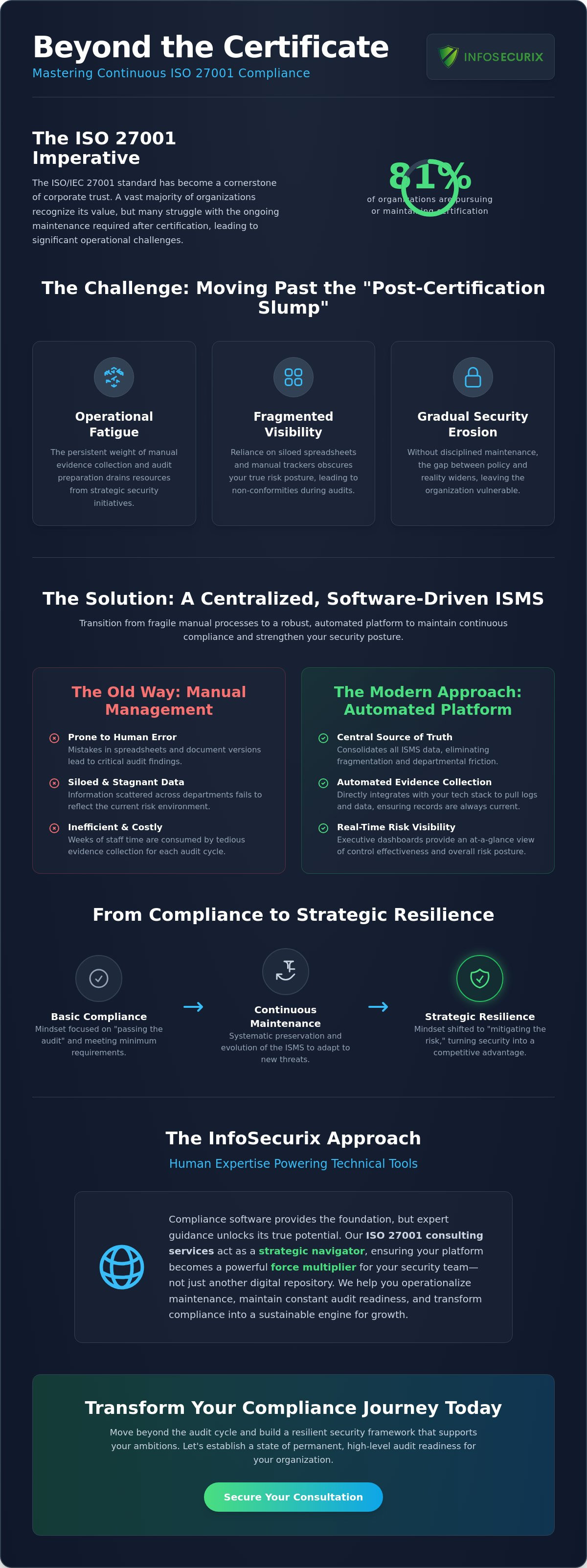
Choosing the right platform requires a strategic evaluation of how a tool facilitates the long-term health of your ISO/IEC 27001 framework. A common pitfall is selecting software based solely on its ability to help you pass an initial audit. Instead, you should evaluate scalability. Does the platform accommodate an expanding security scope as you add new products or geographic regions? Superior software provides deep integration capabilities, connecting natively with your primary tech stack including AWS, Azure, and HRIS systems. This connectivity ensures that evidence collection remains an automated background process rather than a manual chore. When paired with expert ISO 27001 consulting services, the right software becomes a powerful asset that aligns technical controls with business objectives.
User experience is equally critical. If the platform is too complex for non-security staff, adoption rates will plummet, leading to gaps in your compliance data. You need a solution that offers intuitive interfaces for HR and Legal teams while providing the reporting depth required by the executive board. High-quality reporting should offer a clear view of ISMS health and compliance maturity, turning technical metrics into strategic insights that drive investment decisions. This transparency fosters a culture of accountability that extends far beyond the IT department.
Key Features for Long-Term Maintenance
Look for tools that offer automated task reminders for recurring activities. These notifications ensure that access reviews and log monitoring don’t slip through the cracks. Essential modules should include built-in information security internal audit capabilities to facilitate rigorous, risk-based reviews. Additionally, vendor risk management portals are vital for maintaining Annex A supply chain security, allowing you to oversee third-party risks with the same precision as your internal controls. Without these features, maintenance remains a fragmented and reactive process.
The Build vs. Buy vs. Consult Dilemma
Organizations often struggle between choosing broad GRC platforms or specialized boutique solutions. The danger of “shelfware” is real. Software alone cannot solve governance challenges without a strategic implementation plan that accounts for your unique organizational culture. You must evaluate the total cost of ownership, which includes licensing, training, and the necessary expert oversight. To better manage your software assets, you can check out LicenseIQ to discover and recover wasted spend on Microsoft 365 licenses. While automation is a force multiplier, ISO 27001 consulting services provide the human intelligence required to navigate complex maintenance scenarios that software alone might overlook. This balanced approach ensures your investment delivers lasting value rather than becoming an expensive, underutilized digital repository.
Operationalizing Maintenance: Internal Audits and Management Reviews
Transitioning from software implementation to operational excellence requires a methodical approach to governance. It’s the stage where your ISMS becomes a living entity, moving beyond static documentation into a rhythmic cycle of evaluation and improvement. Orchestrating this lifecycle effectively demands a clear roadmap. Engaging professional ISO 27001 consulting services ensures that your internal audit program is not merely a box-ticking exercise, but a strategic tool for identifying operational gaps before they escalate into non-conformities.
The operationalization process follows a structured five-step path to ensure nothing is overlooked. First, you must establish a software-driven internal audit schedule based on risk priority and scope; this ensures that high-risk areas receive the most frequent scrutiny. Second, utilize automated workflows to assign and track corrective and preventive actions (CAPAs), closing the loop on identified issues. Third, aggregate performance data for the annual strategic Management Review meeting to provide a clear picture of ISMS health. Fourth, document all management decisions and resource allocations directly within the ISMS to maintain a transparent record of governance. Finally, update the Statement of Applicability to reflect the “Improved” state of the system, ensuring your compliance posture is always current.
Conducting High-Impact Internal Audits
Software templates ensure consistency across different audit scopes and business units, providing a unified language for security. By using centralized evidence repositories, you can prove control operation over the entire year rather than relying on point-in-time snapshots. This approach significantly reduces “audit fatigue” for your subject matter experts by streamlining evidence requests through automated notifications. It’s about working smarter, not harder, to maintain a robust security foundation.
The Strategic Management Review
Transforming raw compliance data into strategic insights is essential for gaining C-suite and Board-level buy-in. Modern dashboards visualize trends in security incidents and non-conformities, allowing executives to make informed decisions about resource allocation. This high-level oversight ensures the ISMS remains aligned with evolving business objectives and your long-term iso 27001 certification readiness roadmap. Precision in reporting builds the trust necessary to sustain ongoing security investments. To ensure your governance remains flawless, schedule a professional internal audit with our seasoned guides today.
The InfoSecurix Approach: Human Expertise Powering Technical Tools
While automation provides the essential infrastructure for a modern ISMS, software remains a force multiplier rather than a complete replacement for professional judgment. Technology excels at data aggregation and alerting; however, it lacks the contextual nuance required to interpret complex risk scenarios or specific organizational cultures. InfoSecurix serves as your “Seasoned Guide” in this digital landscape, providing the strategic oversight needed to transform automated alerts into decisive, high-impact actions. By integrating our ISO 27001 consulting services with your technical tools, we ensure that your compliance posture isn’t just a digital record, but a resilient framework capable of withstanding evolving international threats.
Bridging the gap between a software notification and a strategic corrective action requires a deep understanding of the standard’s intent. Our advisors bring years of experience to the table, helping you manage the nuances of maintenance and scaling that off-the-shelf algorithms often overlook. We don’t just point to a dashboard. We provide the roadmap for addressing the root causes of vulnerabilities. This future-proofing ensures your organization remains ahead of regulatory shifts, maintaining a steady course even as the global security environment changes.
Bespoke Compliance Readiness and Maintenance
Our methodology begins with a highly curated approach to software selection, ensuring the tools you deploy match your unique organizational scope and technical complexity. We provide independent internal audits that penetrate deeper than automated checks, uncovering subtle process failures that software might miss. When external surveillance audits identify complex non-conformities, our consultants offer the bespoke guidance necessary to remediate those issues with precision. This level of rigor ensures your certification remains a mark of true operational excellence rather than a mere administrative exercise.
Partnering for Long-Term Operational Resilience
We believe in moving beyond the traditional vendor relationship to establish a collaborative, protective partnership that enables your long-term growth. An effective ISMS should act as a catalyst for business velocity, not a bureaucratic hurdle that stifles innovation. By aligning your security standards with your commercial objectives, we help you build a culture of resilience that stakeholders can trust implicitly. We invite you to take the next step in your security journey. Reach out to schedule a professional consultation today to evaluate your current maintenance maturity and future-proof your enterprise through our comprehensive ISO 27001 consulting services.
Advancing Your Strategy for Long-Term Resilience
Transforming ISO 27001 from a one-time milestone into a sustainable strategic asset requires a deliberate shift from reactive auditing to a continuous, software-driven lifecycle. By centralizing your ISMS and automating evidence collection, you eliminate the administrative friction that often hinders organizational growth. This digital foundation ensures your security posture remains robust even as your business complexity increases. Technical tools achieve their full potential only when directed by seasoned intelligence. Engaging professional ISO 27001 consulting services provides the vital oversight needed to navigate intricate risk landscapes and complex non-conformities with absolute precision.
InfoSecurix brings over 25 years of information security expertise to every partnership, offering a boutique consultancy approach that delivers bespoke strategies across ISO 27001, SOC 2, and ISO 22301. We’re dedicated to ensuring your compliance framework is both rigorous and agile, reflecting a legacy of success and deep-rooted knowledge. We invite you to Secure Your Legacy with InfoSecurix Professional Compliance Maintenance. Elevate your standards and build a foundation of trust that supports your vision for years to come.
Frequently Asked Questions
How often should I perform an internal audit to maintain ISO 27001 compliance?
You should perform internal audits at planned intervals, typically at least once per year, to ensure the ISMS remains effective and compliant. While some organizations review the entire system annually, a more mature approach involves a rolling schedule where specific controls are audited quarterly based on their risk profile. This continuous oversight prevents the accumulation of non-conformities and ensures that your security posture evolves alongside your operational environment.
Can compliance management software replace the need for ISO 27001 consulting services?
Software serves as a powerful force multiplier for data collection, but it cannot replace the strategic judgment provided by ISO 27001 consulting services. While a platform can alert you to a missing log, a consultant interprets the underlying risk and provides the bespoke guidance necessary to align security with your business objectives. True resilience requires the synergy of technical automation and seasoned human expertise to navigate complex governance challenges effectively.
What happens if we fail a surveillance audit during the maintenance cycle?
Failing a surveillance audit usually results in the issuance of major or minor non-conformities that must be addressed within a specific timeframe to preserve your certification. A major non-conformity indicates a significant breakdown of the ISMS, requiring immediate corrective action and a follow-up review by the auditor. Minor non-conformities are less severe; however, they still require a documented remediation plan to demonstrate your commitment to the continuous improvement mandated by the standard.
Is compliance management software necessary for small businesses with ISO 27001?
While not strictly mandatory, compliance management software is highly recommended for small businesses to reduce the heavy administrative burden of manual record-keeping. Smaller teams often lack dedicated compliance personnel, making automated evidence collection and task reminders essential for maintaining standards without sacrificing business velocity. Investing in a streamlined platform ensures that your security framework remains organized and scalable as your organization grows and its risk profile changes.
How does ISO 27001 maintenance differ from the initial implementation phase?
Maintenance focuses on the systematic preservation and improvement of an established system, whereas implementation is concerned with building the initial framework and documentation. During the maintenance phase, the emphasis shifts to monitoring control effectiveness and reacting to internal or external changes. It’s a transition from a project-based mindset to an operational rhythm that ensures the ISMS remains a living, protective force for the organization rather than a static binder on a shelf.
What are the most common non-conformities found during maintenance audits?
The most frequent non-conformities involve a failure to perform regular management reviews, incomplete risk treatment plans, or a lack of evidence for recurring activities like access reviews. Organizations often struggle with maintaining the documentation required to prove that controls operated consistently throughout the entire audit cycle. Utilizing ISO 27001 consulting services helps identify these operational gaps early, ensuring that your evidence repository remains comprehensive and audit-ready at all times.
How do I integrate ISO 27001 maintenance with other standards like SOC 2 or ISO 22301?
You can integrate these standards by mapping common controls into a unified compliance framework, often referred to as an Integrated Management System. Many requirements for ISO 27001 overlap with SOC 2 security criteria or the business continuity mandates of ISO 22301. Centralizing these requirements within a single management platform allows you to perform one internal audit that satisfies multiple standards, significantly reducing departmental friction and the duplication of internal resources.
What is the role of senior management in maintaining ISO 27001 compliance?
Senior management must demonstrate leadership and commitment by ensuring that the ISMS is integrated into the organization’s core business processes and strategic objectives. This role includes providing the necessary resources, participating in annual management reviews, and fostering a culture where security is prioritized at every level. Management’s active involvement is a critical requirement of Clause 5, signaling to auditors and stakeholders that security is a strategic priority rather than a peripheral IT concern.