
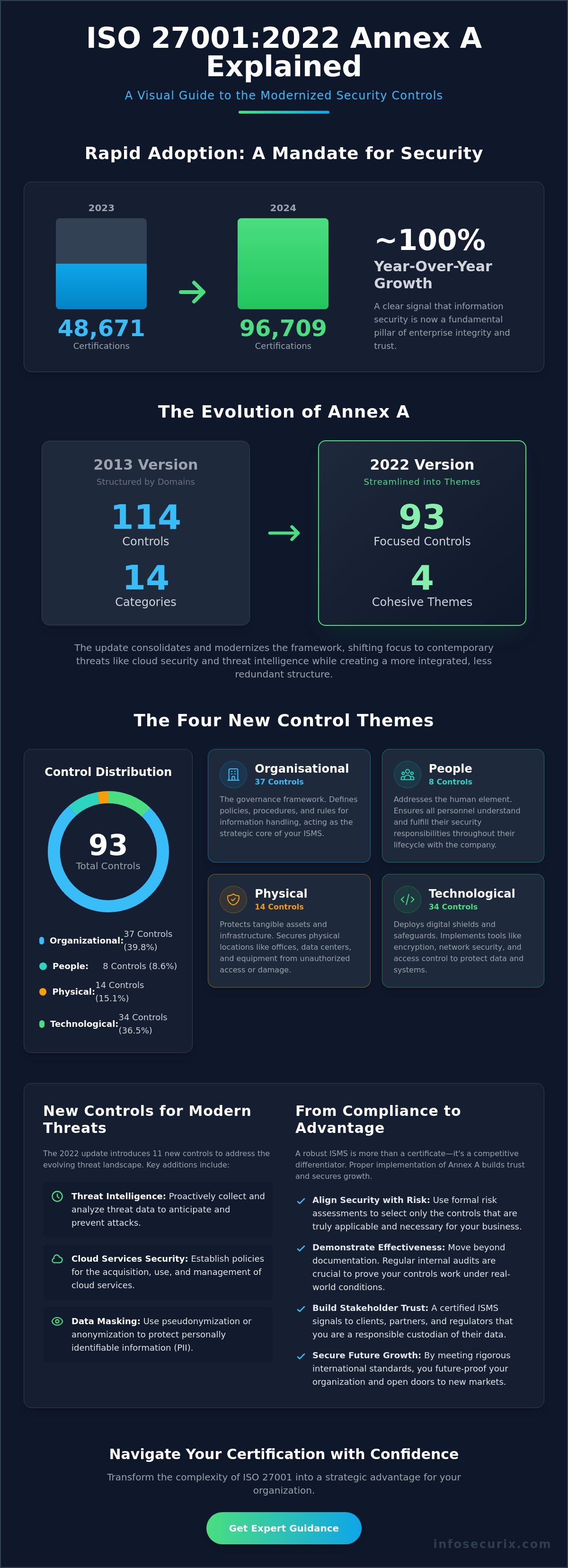
With ISO 27001 certifications nearly doubling from 48,671 in 2023 to 96,709 in 2024, the global business community is sending a clear message: information security is no longer just a safeguard, it’s a fundamental pillar of enterprise integrity. You likely recognize the immense value of this standard, yet the transition to the 2022 update often brings more questions than clarity. Having this ISO 27001 Annex A controls explained clearly is the first step toward transforming a complex regulatory requirement into a lean, strategic advantage for your organization.
It’s natural to feel a sense of hesitation when faced with 93 distinct security measures. We understand that mapping these requirements to your unique business processes feels like a monumental task, especially with the shift from 14 categories to four streamlined themes. This article promises to demystify that complexity by providing a clear, actionable roadmap for selecting and implementing the controls that matter most. We’ll explore the nuances of the 2022 revisions, examine the four organizational themes, and provide the technical confidence you need to meet rigorous auditor standards with poise.
Key Takeaways
- Discover how the 2022 update modernizes security by consolidating 114 controls into 93 focused safeguards. This transition prioritizes contemporary challenges like cloud security and data masking.
- Master the four new thematic pillars: organizational, people, physical, and technological. Having these ISO 27001 Annex A controls explained provides the clarity needed to build a cohesive security framework.
- Align your control selection with your unique risk profile. A methodical risk assessment is the foundation for determining which safeguards are truly applicable to your business operations.
- Focus on demonstrating operating effectiveness rather than just design intent. Regular internal audits verify that your security measures perform reliably under real-world conditions.
- Transform your compliance journey into a strategic advantage. A robust implementation of Annex A builds stakeholder trust and secures your organization’s future growth.
The Strategic Architecture of ISO 27001 Annex A (2022 Version)
Annex A serves as the prescriptive heart of any robust Information Security Management System (ISMS). It’s the definitive catalogue of security safeguards designed specifically to mitigate risks identified during a formal risk assessment. While the main body of ISO/IEC 27001 defines the high-level management framework, this annex provides the practical, technical, and organizational tools needed to build a resilient defense. Having these ISO 27001 Annex A controls explained is essential for any organization that views security as a business enabler rather than a technical hurdle.
The 2022 update reflects a significant modernization of the standard. By consolidating 114 controls into 93, the International Organization for Standardization has created a more integrated and less redundant framework. This revision isn’t just about reducing numbers; it’s about shifting focus toward modern threats. New controls now specifically address cloud services security, threat intelligence, and data masking. This ensures that your security posture remains relevant in an era of distributed workforces and complex digital supply chains.
The Evolution from 2013 to 2022
The most striking change is the shift from 14 rigid domains to four fluid themes: Organizational, People, Physical, and Technological. This transition allows for better alignment across different business departments. Having these ISO 27001 Annex A controls explained through the lens of these four themes simplifies the mapping of security measures to actual business processes. Don’t be misled by the lower control count; the implementation depth has actually increased. The 2022 version introduces “Attributes,” which are metadata tags that help you categorize and filter controls based on specific business needs or regulatory requirements. This makes the framework far more adaptable to your unique operational environment.
Why Annex A Matters to Executive Leadership
Effective security implementation moves far beyond the IT department. Annex A is a vital tool for protecting brand reputation and ensuring operational continuity. By meticulously selecting and applying these controls, you satisfy the needs and expectations of interested parties as required by Clause 4.2. This isn’t just a compliance exercise. It’s a strategic move that positions your organization as a trusted partner. In a competitive national marketplace, demonstrating this level of rigor becomes a powerful differentiator that secures long-term growth and stakeholder confidence. It’s about future-proofing your business through meticulous, current-day standards.
Deciphering the Four Control Themes: A Comprehensive Breakdown
Transitioning from the high-level architecture to specific safeguards requires a nuanced understanding of how different business functions intersect. The 93 controls are now categorized into four logical themes to streamline implementation and assign clear ownership. This structure replaces the fragmented domains of the past with a more cohesive approach to risk management. Having these ISO 27001 Annex A controls explained through these four distinct pillars allows your organization to build a defense that is both comprehensive and manageable.
Organisational Controls (37) act as the governance framework: they define the policies, procedures, and rules that guide how information is handled across the enterprise. People Controls (8) address the human lifecycle within the company, ensuring that everyone from new hires to departing contractors understands their security responsibilities. To reinforce this, Core Integrity helps organisations build cultures of trust and accountability that align with these standards. Physical Controls (14) protect tangible assets, such as server rooms and office perimeters, while Technological Controls (34) deploy digital shields like encryption and network monitoring. This holistic view ensures no gap is left unaddressed.
Organisational and People Controls
Building a resilient culture starts with robust policies that aren’t merely static documents. One of the most significant additions in the 2022 update is Control 5.7: Threat Intelligence. This requires organizations to collect and analyze information about current threats to build proactive defenses. It shifts the posture from reactive to predictive. Similarly, people-centric controls move beyond simple background checks. They emphasize continuous awareness and specialized training. If you’re concerned about how these requirements fit your current structure, an ISO 27001 readiness assessment can clarify the path forward and identify potential gaps in your human-centric defenses.
Physical and Technological Safeguards
Securing the physical perimeter remains a non-negotiable requirement for achieving ISO 27001 Certification. This involves managing sensitive areas and protecting equipment from environmental threats or unauthorized access. However, the modern focus leans heavily toward technological integration. Controls such as 8.28 (Secure Coding) are now essential for organizations developing internal software. This ensures that security is baked into the development lifecycle rather than being an afterthought. Having these ISO 27001 Annex A controls explained in the context of cloud monitoring and data leakage prevention highlights the standard’s commitment to modern technical reality. These digital defenses must be precisely tuned to prevent unauthorized data exfiltration while maintaining operational speed and business agility.
Selecting Your Controls: The Intersection of Risk and Applicability
Selecting the right safeguards is a deliberate exercise in alignment rather than a race to completion. While the 93 controls provide a comprehensive menu, their true value is realized only when they’re mapped precisely to your organizational vulnerabilities. Having these ISO 27001 Annex A controls explained within the context of a robust ISO 27001 risk assessment methodology ensures that your security budget is spent where it matters most. Every control must be weighed against the specific threats your business faces. If a control doesn’t mitigate a documented risk, its inclusion may lead to unnecessary operational friction.
The Statement of Applicability (SoA) stands as the definitive record of these decisions. It’s the first document an external auditor will request because it outlines which controls you’ve chosen to implement and, crucially, which ones you’ve omitted. Justifying an exclusion requires more than a simple “not applicable.” You must provide a sophisticated rationale that demonstrates a deep understanding of your risk landscape. This level of detail transforms the SoA from a compliance hurdle into a strategic roadmap for your ISO/IEC 27001 journey.
The Statement of Applicability (SoA) Framework
Think of the SoA as the master blueprint for your ISO 27001 certification readiness. It bridges the gap between high-level risk identification and the granular technical reality of your environment. For each selected control, you must clearly state its implementation status: whether it’s fully implemented, partially active, or currently in the planning phase. This transparency builds immediate trust with auditors. It shows you’re not just guessing at security but managing it with professional precision. A well-constructed SoA serves as a living document that guides your internal teams and reassures external stakeholders of your commitment to excellence.
Synergy with SOC 2 and Other Standards
For organizations operating on a national or global scale, the strategic value of Annex A extends beyond a single certification. Many of these controls map directly to the SOC 2 Trust Services Criteria. By having these ISO 27001 Annex A controls explained and implemented correctly, you’re simultaneously laying the groundwork for SOC 2 readiness assessments. This unified compliance approach eliminates redundant audits and saves hundreds of hours in documentation. It’s a visionary way to future-proof your business while satisfying the diverse security requirements of your most demanding enterprise clients. Instead of managing disparate checklists, you’re building a singular, powerful security engine that drives market trust.
From Documentation to Demonstration: Implementing Controls That Pass Audits
Moving from the theoretical selection phase to the practical application of safeguards requires a fundamental shift in mindset. It’s no longer enough to maintain a well-defined Statement of Applicability. Modern auditors prioritize operating effectiveness over mere design effectiveness. They seek tangible proof that your security measures perform reliably under pressure. Having these ISO 27001 Annex A controls explained in terms of their daily execution is the only way to secure a successful certification. Proving that a control exists is the baseline; proving that it consistently achieves its intended outcome is the standard for excellence.
Establishing a methodical cadence for information security internal audits allows you to identify implementation gaps before they become formal non-conformities. These internal checks serve as a stress test for your digital and physical defenses. During these reviews, remember that evidence must be persistent, retrievable, and verifiable. Continuous monitoring plays a vital role here. It ensures control integrity remains high between audit cycles, preventing the “compliance drift” that often occurs when teams focus solely on the annual assessment rather than daily security hygiene.
Evidence Collection Best Practices
Professional organizations move away from manual spreadsheets in favor of automated evidence collection. Utilizing GRC platforms or integrated log management tools allows you to capture security events in real time. For People and Organisational controls, “sufficient” evidence often takes the form of timestamped training records, signed policy acknowledgments, or meeting minutes from security steering committees. The goal is to create a chronological audit trail that tells a story of consistent security practice. This narrative of diligence reassures auditors that your security posture is a permanent business asset rather than a temporary facade.
Common Implementation Pitfalls
One of the most frequent hurdles is the “Policy Gap.” This occurs when an organization maintains an elegant policy document but lacks the corresponding technical record to prove it’s being followed. Conversely, over-implementing can be just as damaging. Selecting overly restrictive controls often creates operational friction that tempts staff to bypass security protocols entirely. Don’t neglect Control 5.37: the management of information security incidents. Auditors look for documented proof that you’ve tested your response plans, as a failure to demonstrate incident management maturity is a common cause for audit failure. To ensure your controls are truly audit-ready, consider engaging an expert for ISO 27001 Certification Readiness to validate your implementation before the external assessor arrives.
Navigating Certification Readiness with InfoSecurix
Achieving compliance shouldn’t be a journey taken in isolation. InfoSecurix brings over 25 years of experience in navigating complex regulatory landscapes, providing the steady hand needed to transform rigorous standards into catalysts for business growth. Having these ISO 27001 Annex A controls explained by a seasoned veteran ensures that your implementation isn’t just a checklist: it’s a sophisticated framework for enterprise trust. Our readiness assessments are designed to identify critical gaps in your Annex A implementation long before an external auditor arrives, allowing you to address vulnerabilities with professional poise and precision.
Bridging the gap between granular technical requirements and overarching strategic goals is where our expertise provides the most value. We understand that executive leadership requires a clear view of how security investments protect brand reputation and operational continuity. By developing meticulous corrective action plans, we position your organization for long-term resilience. This proactive approach ensures that when the formal audit begins, your team isn’t just hoping for success; they’re demonstrating a legacy of excellence that has been carefully curated and verified.
The Readiness Assessment Advantage
Conducting a formal gap analysis is the most cost-effective step an organization can take on its certification journey. Our “Seasoned Guides” do more than just audit. They interpret Annex A within your specific industry context, ensuring that every control adds measurable value to your unique operations. This bespoke approach ensures your Information Security Management System (ISMS) remains scalable and future-proof against emerging threats. Focusing on the strategic impact of technical processes allows us to help you build a resilient foundation that supports sustainable, long-term growth.
Engaging Your Strategic Partner
Our comprehensive service portfolio ranges from meticulous internal audits to high-level strategic consulting. We don’t just help you cross the finish line. We empower your team with the knowledge and tools required to maintain these controls long after the certificate is issued. This collaborative partnership ensures that your security posture remains a living part of your corporate culture rather than a static document. We invite you to Schedule your ISO 27001 Readiness Assessment with InfoSecurix today to begin your transition from simple compliance to a state of strategic security leadership.
Future-Proofing Your Security Legacy
Mastering the transition to the 2022 standard ensures your organization remains at the forefront of global security excellence. By having these ISO 27001 Annex A controls explained through a strategic lens, you move beyond mere technical compliance to build a resilient framework that secures long-term stakeholder confidence. The evolution from rigid domains to fluid themes allows for a more integrated approach: security is now woven into the very fabric of your business processes. Precision is paramount. Success in high-stakes regulatory environments requires more than just documentation; it demands the consistent demonstration of operating effectiveness.
InfoSecurix offers national coverage for complex enterprise audits, backed by 25+ years of information security expertise. Our specialized corrective action strategies ensure that every vulnerability is addressed with professional rigor, transforming your compliance posture into a powerful competitive advantage. Secure your enterprise trust with an InfoSecurix ISO 27001 Readiness Assessment and begin your journey toward a more secure and prosperous future. Your commitment to these rigorous standards today is the foundation for your organization’s growth tomorrow.
Frequently Asked Questions
What is the primary purpose of Annex A in ISO 27001?
The primary purpose of Annex A is to provide a comprehensive menu of security safeguards designed to mitigate the risks identified during your formal risk assessment. It serves as the technical and organizational backbone of your Information Security Management System (ISMS). By having these ISO 27001 Annex A controls explained through a risk-based lens, organizations can ensure they aren’t just following a checklist but are actively protecting their most critical assets from modern threats.
Do we have to implement all 93 controls in Annex A?
You don’t have to implement every single control. The selection process is entirely dependent on your unique risk profile and specific business requirements. If a specific control isn’t applicable to your environment, you can exclude it; however, you must provide a clear and professional justification for this decision within your Statement of Applicability. This ensures your security posture remains lean and focused on actual vulnerabilities rather than unnecessary administrative overhead.
How does the 2022 version of Annex A differ from the 2013 version?
The 2022 version modernizes the standard by consolidating 114 controls into 93 and restructuring them into four logical themes. It replaces the previous 14 domains with Organizational, People, Physical, and Technological categories to better align with modern business structures. This update also introduces 11 new controls, including threat intelligence and cloud services security, which reflect the complexities of today’s digital landscape and the shift toward distributed work environments.
What is a Statement of Applicability (SoA) and why is it mandatory?
The Statement of Applicability (SoA) is a mandatory document that identifies which Annex A controls you’ve selected and explains why they’re relevant to your organization. It’s the primary roadmap that auditors use to verify your compliance status. Without a well-constructed SoA, there’s no formal record of your security decisions, making it impossible for an external body to certify that your ISMS meets the required standards for protecting sensitive information.
Can we use alternative controls not listed in Annex A?
You can implement alternative or additional controls if the baseline set doesn’t fully address your specific risks. ISO 27001 is designed to be flexible: it encourages organizations to look beyond the standard catalogue if their industry or technology stack requires bespoke safeguards. When having these ISO 27001 Annex A controls explained to stakeholders, it’s helpful to position them as a minimum standard that can be enhanced with custom measures to achieve superior resilience.
How often should we review our Annex A control implementation?
You should review your control implementation at least once a year or whenever your business undergoes a major change, such as a merger or a significant technology migration. Regular reviews ensure that your safeguards haven’t become obsolete as new threats emerge. Maintaining a steady cadence of internal audits and management reviews helps prevent “compliance drift” and ensures that your security measures remain as effective on day 300 as they were on day one.
What happens if an auditor finds a control is not effectively implemented?
If an auditor determines a control isn’t effectively implemented, they’ll issue a non-conformity report. This requires your organization to develop and execute a formal corrective action plan to resolve the underlying issue. While a minor non-conformity won’t necessarily prevent certification, it demands a professional response that demonstrates you’ve identified the root cause and implemented a permanent fix to prevent the lapse from recurring in the future.
How do Annex A controls relate to the ISO 27002 standard?
ISO 27001 Annex A provides the high-level list of controls you must consider, while ISO 27002 serves as the detailed implementation guide. Think of Annex A as the “what” and ISO 27002 as the “how.” While you’re audited against the requirements in Annex A, referencing the best practices in ISO 27002 provides the technical depth and explanatory detail needed to implement each safeguard to a professional, industry-recognized standard.