
In the pursuit of operational excellence, many leaders treat the choice between ITIL and ISO 20000 as a binary competition: a misconception that overlooks the most potent path to organizational maturity. You probably recognize the internal friction of selecting a framework that justifies its investment without drowning your team in abstract theory. It’s a valid concern, especially when the market demands both the agility of modern practices and the rigorous proof of an international standard. Understanding the nuance of ISO 20000 vs ITIL is no longer just a technical requirement; it’s a strategic necessity for any firm aiming to lead in 2026.
This comparison clarifies the critical distinctions and powerful synergies between the ISO 20000 standard and the ITIL framework to elevate your service management strategy. We’ll provide a clear decision-making framework, illustrating how to leverage existing ITIL practices to accelerate ISO certification. From the integration of generative AI to the 2026 arrival of ITIL 5 and the latest climate action amendments, you’ll discover a systematic roadmap to enterprise-level service maturity that turns complex jargon into a competitive advantage.
Key Takeaways
- Differentiate between the prescriptive requirements of an international standard and the descriptive guidance of a best-practice framework: a vital distinction for strategic planning.
- Identify whether your organization requires the flexible process adoption of ITIL or the comprehensive, auditable compliance of ISO 20000 to meet stakeholder expectations.
- Navigate the strategic landscape of ISO 20000 vs ITIL to determine which path provides the highest market value and competitive advantage for your specific business objectives.
- Master the framework-first approach, using established ITIL practices as the foundational engine for achieving organizational ISO 20000 certification.
- Future-proof your service management by integrating 2026 trends, including generative AI and climate action amendments, into your existing operational systems.
ISO 20000 vs ITIL: Understanding the Core Relationship
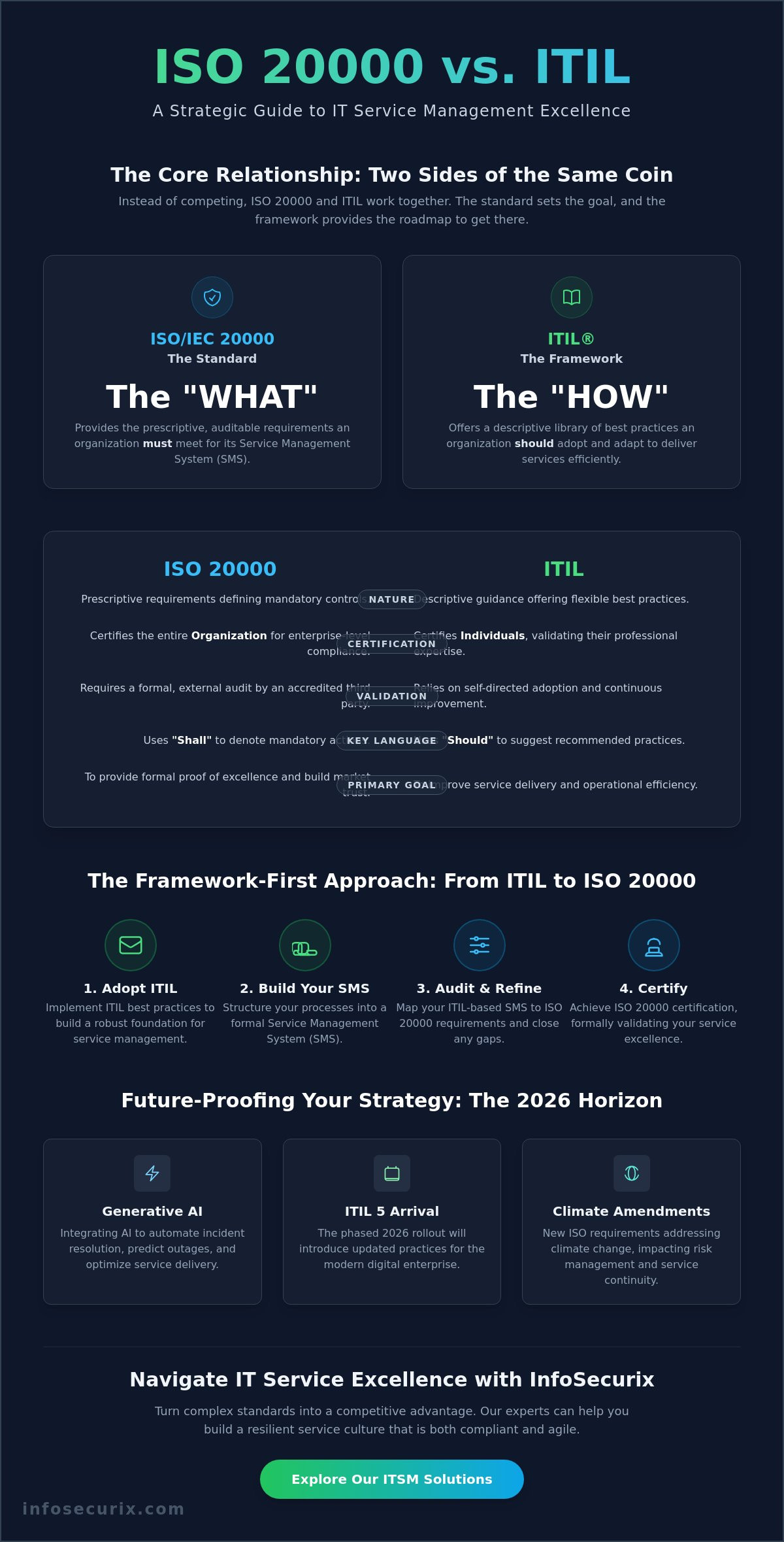
Establishing a robust IT Service Management (ITSM) ecosystem requires more than just technical proficiency; it demands a clear understanding of the governance structures that underpin success. At the heart of this strategic discussion lies the relationship between ISO/IEC 20000 and the Information Technology Infrastructure Library (ITIL). While they’re frequently discussed as competitors, they’re actually two sides of the same coin. ISO 20000 provides the rigid, auditable requirements for a Service Management System (SMS). ITIL, conversely, offers the detailed processes and practices that help an organization meet those requirements. Deciding between ISO 20000 vs ITIL isn’t about choosing one over the other. It’s about recognizing how they complement each other to create a resilient service culture that withstands the complexities of 2026.
The Prescriptive Nature of ISO 20000
ISO 20000-1:2018 follows the Annex SL high-level structure, the same sophisticated blueprint used for ISO 27001. This alignment ensures that your service management integrates seamlessly with broader corporate governance and security protocols. Because it’s an international standard, it’s prescriptive by design. It uses “shall” statements to define mandatory requirements that an organization must meet to achieve certification. Auditors focus on the “what” of your service management. They verify that specific controls and processes exist, providing a verified baseline of trust for your clients and stakeholders.
The Descriptive Guidance of ITIL
ITIL functions as a comprehensive library of best practices. It’s descriptive rather than prescriptive, suggesting what your team “should” do based on decades of global industry experience. With the phased rollout of ITIL 5 throughout 2026, the framework remains the gold standard for the “how” of service delivery. It encourages organizations to “adopt and adapt.” This flexibility is its greatest strength. You can select specific practices that align with your unique business goals without the immediate pressure of total compliance required by a formal standard.
The distinction between these two is fundamental to your long-term strategy. ISO 20000 acts as the destination, providing the formal proof of excellence that wins contracts and builds institutional reputation. ITIL serves as the implementation engine, providing the tactical maneuvers and process depth required to reach that destination efficiently. This synergy allows you to build a system that’s both compliant and agile. It’s the difference between merely surviving a periodic audit and actually delivering superior, measurable value to your end users. By leveraging ITIL to satisfy ISO requirements, you create a roadmap to maturity that is both visionary and grounded in reality.
Key Differences Between ISO 20000 and ITIL
Distinguishing between these paths requires more than a glossary; it demands a strategic grasp of how validation occurs within a modern enterprise. The most visible divergence in the ISO 20000 vs ITIL debate lies in the scope of certification and the resulting market perception. While ITIL empowers individuals with a common language and professional credentials, ISO 20000 serves as the institutional seal of quality. This difference in auditability transforms the way teams approach their daily operations: ISO 20000 mandates external validation by an accredited third party, whereas ITIL remains a self-directed journey of continuous improvement. Choosing the right path involves balancing the flexible “adopt and adapt” philosophy of a framework with the uncompromising rigor of an international standard.
Organizational vs. Individual Certification
Staff members often pursue ITIL certifications to bolster their professional standing, yet a company itself cannot be “ITIL certified.” Instead, an organization achieves the ISO 20000 corporate seal to signal enterprise-level maturity to global markets and prospective clients. This distinction is critical for leaders navigating RFPs or high-stakes contracts where documented compliance is a non-negotiable prerequisite. Certified professionals bring the expertise necessary to build and maintain the very systems that a certified organization uses to prove its reliability.
Service Lifecycle vs. Service Value Chain
Modern service management has evolved beyond the linear “Service Lifecycle” structures of previous decades. Today, the ITIL 4 Service Value Chain (SVC) provides a multidimensional model that aligns with the ISO 20000 standard regarding performance evaluation and continual improvement. In 2026, the trend has shifted toward integrated service and security management, reflecting the 2024 climate action amendments and the rise of generative AI governance. This evolution requires a more holistic approach to performance: moving from siloed metrics to integrated operational intelligence that satisfies both internal efficiency and external audit requirements.
While ITIL permits selective adoption of its 34 management practices, ISO 20000 requires total compliance with every applicable requirement within its scope. This rigor ensures that no critical aspect of service delivery is neglected, providing a protective layer for the organization’s reputation. Many leaders find that partnering with a seasoned guide for ISO 20000 implementation helps translate these rigid requirements into actionable, ITIL-aligned processes. By harmonizing the descriptive guidance of ITIL with the prescriptive strength of ISO, you create a system that is both resilient and remarkably efficient, ensuring your service management strategy is future-proofed for the challenges of the coming years.
Synergy in Action: Using ITIL to Achieve ISO 20000
Success in modern ITSM isn’t found in choosing a side; it’s found in the sophisticated integration of both. When organizations weigh ISO 20000 vs ITIL, they often overlook the fact that ITIL provides the very blueprints needed to build the house that ISO 20000 inspects. Think of ITIL as your implementation engine. It provides the tactical depth and vocabulary required to satisfy the high-level requirements of the international standard. By adopting a framework-first approach, your team builds service maturity through proven practices before submitting to the rigorous scrutiny of an external audit. This sequence reduces friction. It ensures that compliance is a byproduct of operational excellence rather than a forced administrative exercise. In the 2026 landscape, where AI-driven services demand rapid governance, this synergy allows for a more agile response to shifting market requirements.
Mapping ITIL Practices to ISO Clauses
Many core ISO 20000 requirements find their answers within the ITIL practice library. For instance, the ISO clauses regarding service operation and control map directly to ITIL’s Incident, Change, and Problem Management practices. When you ask What is ITIL?, the answer lies in its ability to provide the “how-to” for these essential controls. Consider these primary points of alignment:
- Incident Management maps directly to Clause 8.1 regarding operational planning and control.
- Change Enablement aligns with Clause 8.5.1 for service design and transition.
- Continual Improvement satisfies Clause 10.1 for nonconformity and corrective action.
Organizations that follow a structured ISO 20000 implementation path often find that a significant portion of the necessary documentation already exists within their ITIL-aligned processes. This mapping streamlines the journey, allowing you to focus on refining existing workflows rather than inventing new ones from scratch.
Bridging the Gaps: What ITIL Misses
While ITIL is exceptionally strong on process, ISO 20000 places a heavier emphasis on the Service Management System (SMS) as a whole. This includes specific mandates for leadership commitment, resource management, and the establishment of a formal governance framework. You can’t simply “best practice” your way through a certification audit. You need documented evidence of management’s active role. This is where a regular information security internal audit becomes indispensable. It acts as a strategic dry run, verifying that your ITIL-based controls are actually meeting the prescriptive rigors of the ISO standard. This level of documentation rigor is a defining factor in the ISO 20000 vs ITIL comparison, shifting the focus from individual skill to institutional capability.
Strategic Selection: Which Path Fits Your Organization?
Choosing between these two paths requires a candid assessment of your current operational maturity and your long-term commercial objectives. When debating ISO 20000 vs ITIL, the primary question shifts from which framework is technically superior to which delivers the specific validation your clients demand. For organizations focused on internal optimization and cultural cohesion, ITIL provides a flexible, low-friction entry point. However, the business case for ISO 20000 becomes undeniable when entering the national enterprise market. Large-scale RFPs and government contracts frequently mandate certifiable standards as a non-negotiable baseline for trust. By aligning with a recognized standard, you demonstrate a level of institutional discipline that frameworks alone cannot prove.
Decision Factors for High-Growth Startups
For emerging firms, the path to maturity often begins with security compliance for startups. Integrating these strategies early prevents the accumulation of “compliance debt,” where disorganized processes become too costly to retrofit later. While many small businesses start with ITIL to build basic service habits, those targeting enterprise clients find that the impact of soc 2 for small business often creates a natural bridge toward ISO 20000. This proactive stance provides a distinct competitive edge, signaling to major stakeholders that your organization is ready for high-stakes partnerships from day one.
Preparing for the Journey: Gap Analysis and Readiness
Moving from an ITIL-aligned environment to a certified Service Management System requires a shift toward a how to prepare for a security audit mindset. This transition typically spans six to twelve months, depending on your current process maturity. Success in this journey hinges on executive buy-in; without leadership’s commitment to resource allocation and cultural change, even the most robust technical processes will struggle to pass an external audit. A comprehensive gap analysis identifies where your existing ITIL practices meet ISO requirements and where new controls are necessary to bridge the ISO 20000 vs ITIL divide.
Establishing this level of operational excellence is a significant undertaking that demands precision and seasoned guidance. If your organization is ready to move beyond informal best practices and achieve a certifiable standard of excellence, InfoSecurix provides the expert support necessary to navigate the process. Contact us today to begin your ISO 20000 Implementation and secure your place in the enterprise market.
Navigating IT Service Excellence with InfoSecurix
Navigating the transition from informal best practices to a certifiable international standard requires a level of precision that generic tools simply cannot provide. InfoSecurix acts as your seasoned guide through the complexities of ISO 20000 vs ITIL, offering the clarity needed to transform technical workflows into executive-level assurance. We understand that your goal isn’t just to pass an audit: it’s to build a resilient service culture that attracts high-value enterprise contracts. By bridging the gap between the “how” of ITIL and the “what” of ISO, we ensure your organization remains unfazed by shifting regulatory landscapes or technological disruptions. Our partnership provides the steady hand required to future-proof your business through meticulous current-day standards.
Our Bespoke Readiness Framework
Our approach to iso 20000 implementation centers on a bespoke readiness framework that leverages 25 years of expertise to turn complexity into clarity. We don’t rely on generic checklists that overlook your unique operational nuances. Instead, we provide a curated roadmap that respects your existing ITIL investments while addressing the specific documentation and leadership mandates of the ISO standard. This “Trusted Advisor” relationship ensures that your path to certification is logical, structured, and entirely predictable. We focus on creating a Service Management System (SMS) that is both visionary and grounded, enabling your team to scale without sacrificing service quality or compliance integrity.
Taking the Next Step Toward Certification
Securing your organization’s future begins with a comprehensive gap analysis. This diagnostic deep-dive evaluates your current maturity against the ISO 20000 vs ITIL landscape, identifying exactly where your processes need refinement to meet audit requirements. Many forward-thinking leaders choose to integrate this journey with iso 27001 certification readiness, creating a unified framework of service excellence and information security. This holistic strategy maximizes efficiency: it allows you to build a single, robust management system that satisfies multiple global standards simultaneously. We invite you to engage in a strategic consultation to define your roadmap to enterprise-level maturity and long-term resilience.
Securing Your Lead in the Next Era of Service Management
Mastering the strategic landscape of ISO 20000 vs ITIL is about more than just checking boxes; it’s about building a foundation for sustainable enterprise growth. By harmonizing the flexible practices of ITIL with the rigorous standards of ISO, you create a service environment that is both agile and demonstrably reliable. This alignment ensures your organization is prepared for the high-stakes demands of 2026 and beyond. Your journey toward excellence is defined by the quality of the systems you build today.
InfoSecurix leverages over 25 years of compliance excellence to guide national enterprise clients through this vital transformation. Our bespoke readiness frameworks provide a clear path forward: integrating deep expertise across ISO 27001, ISO 20000, and SOC2 to ensure your systems are robust and audit-ready. We’re committed to turning your complex compliance requirements into a definitive competitive advantage that resonates with global stakeholders.
Take the definitive step toward operational maturity today. Secure your enterprise future with a Strategic ISO 20000 Readiness Assessment and lead your industry with absolute confidence.
Frequently Asked Questions
Is ISO 20000 based on ITIL?
ISO 20000 originated from BS 15000, which was heavily influenced by the early ITIL framework. While they’ve evolved into distinct entities, they remain deeply compatible. ISO 20000 defines the mandatory requirements for a Service Management System, while ITIL provides the best-practice guidance to implement the processes that satisfy those requirements.
Can an individual be ISO 20000 certified?
Individuals can achieve personal certifications such as the ISO 20000 Foundation or Lead Auditor designations. However, in a corporate context, the term usually refers to the organizational certification against the ISO/IEC 20000-1 standard. This is a primary distinction in the ISO 20000 vs ITIL comparison: ITIL focuses on professional credentials, while ISO 20000 validates institutional capability.
Which is better: ITIL or ISO 20000?
Neither is inherently better because they serve different strategic objectives. ITIL is a flexible framework for internal improvement, allowing you to adopt practices at your own pace. ISO 20000 is an auditable standard that provides external proof of excellence. Most high-growth organizations use ITIL to build the maturity required to achieve the formal ISO 20000 seal.
How much does ISO 20000 certification cost for a startup?
Total investment depends on your current service maturity, the size of your team, and the complexity of your service portfolio. Costs typically include implementation consulting, staff training, and the formal audit fees from an accredited body. While exact figures vary, startups should view this as a strategic investment in enterprise readiness that facilitates entry into high-value markets.
Do I need ITIL to get ISO 20000 certified?
ITIL is not a formal prerequisite for ISO 20000 certification, but it’s the most effective way to reach the standard. Without a framework like ITIL, satisfying the prescriptive “shall” requirements of the ISO standard becomes significantly more difficult. ITIL provides the proven vocabulary and process depth that makes passing a formal audit much more predictable.
What are the main benefits of ISO 20000 over ITIL?
The standout benefit is the ability to achieve a certifiable organizational standard that is globally recognized. While ITIL is a self-directed journey, ISO 20000 requires independent verification. This provides an objective trust signal that is often a mandatory requirement for large-scale RFPs, government contracts, and enterprise-level partnerships in 2026.
How often is ISO 20000 updated compared to ITIL?
ISO standards undergo a formal review every five years to ensure they remain relevant. The current version is ISO/IEC 20000-1:2018, which received a climate action amendment in February 2024. ITIL updates are managed by Axelos and occur less predictably; ITIL 4 was released in 2019, and the phased rollout of ITIL 5 is currently taking place throughout 2026.
Can ISO 20000 and ITIL be implemented together?
Implementing them together is the most sophisticated approach to IT service excellence. This synergy allows you to use ITIL’s descriptive guidance to build the very processes that ISO 20000’s prescriptive clauses require. It results in a robust Service Management System that is both operationally efficient and fully prepared for the rigors of an external audit.