
While 81% of organizations are now actively pursuing certification, many still struggle to transform their compliance requirements into a genuine competitive advantage. You likely recognize that a sophisticated iso 27001 risk assessment methodology is the heartbeat of a successful Information Security Management System, yet the technical nuances of Clause 6.1.2 often create more confusion than clarity. With the transition deadline for the 2022 standard now firmly in the past, auditors in 2026 aren’t just looking for documentation; they’re demanding proof that your risk process actually protects enterprise value.
This article provides the clarity you need to build a robust, audit-ready framework that satisfies rigorous international standards while empowering your leadership to make informed decisions. We’ll guide you through a repeatable process that aligns security controls with your specific business goals, ensuring every stakeholder sees the value in your security posture. You can expect a comprehensive look at modernizing your approach, including how to integrate the 2024 Climate Action Amendment and manage the four updated Annex A control themes with absolute confidence.
Key Takeaways
- Establish a definitive iso 27001 risk assessment methodology as the formal blueprint for identifying and evaluating information security risks within your enterprise.
- Design bespoke assessment criteria tailored to your unique corporate context: ensuring that likelihood and consequence scales provide meaningful data for executive decision-making.
- Compare traditional asset-based models with modern scenario-based approaches to select the path that best utilizes the flexibility offered by the 2022 standard update.
- Execute a systematic five-step risk lifecycle that culminates in a precise Risk Treatment Plan, bridging the gap between technical vulnerabilities and strategic mitigation.
- Future-proof your organization by aligning rigorous security standards with long-term growth, transforming compliance from a hurdle into a pillar of enterprise value.
Defining the ISO 27001 Risk Assessment Methodology
A formal iso 27001 risk assessment methodology serves as the definitive blueprint for identifying, analyzing, and evaluating information security risks within an enterprise. It’s far more than a simple compliance checklist; it represents a fundamental shift from reactive security measures to a proactive, risk-based posture that anticipates threats before they manifest. By establishing this framework, organizations move beyond “firefighting” and begin to protect their enterprise value with meticulous precision. This strategic approach ensures that every security investment is justified by a documented risk, providing a clear narrative of protection for both internal stakeholders and external auditors.
Securing a successful certification depends entirely on the integrity of this process. Without a documented methodology, an Information Security Management System (ISMS) lacks the structural foundation required by the standard. For those seeking an ISO/IEC 27001 overview, it’s clear that the standard prioritizes a systematic approach to risk over fragmented technical controls. This methodology ensures that risks aren’t just identified in isolation but are evaluated against a consistent set of criteria that reflects the organization’s unique risk appetite.
The Role of Clause 6.1.2
Clause 6.1.2 mandates that organizations establish and maintain information security risk assessment processes that produce consistent, valid, and comparable results. It’s not enough to perform an assessment once: the standard requires a repeatable mechanism that remains effective as the threat landscape evolves. Clause 6.1.2 functions as the regulatory heartbeat of the risk management process. By adhering to these specific mandates, businesses ensure their methodology remains objective and free from the biases that often plague ad-hoc security reviews.
Core Pillars: Confidentiality, Integrity, and Availability
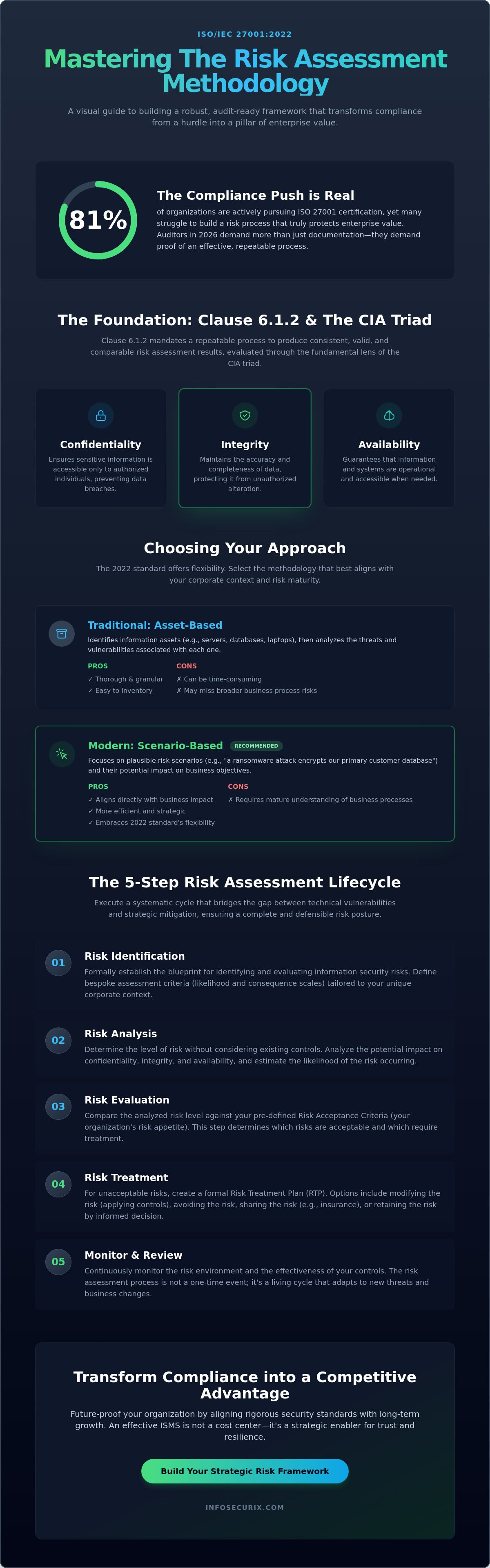
The CIA triad serves as the fundamental lens through which every risk is evaluated within the iso 27001 risk assessment methodology. Confidentiality ensures that sensitive information is accessible only to those authorized to have it. Integrity maintains the accuracy and completeness of data; availability guarantees that information and systems are ready for use when needed. Threats to these pillars translate directly into business impact, ranging from reputational damage to operational paralysis. In a modern digital landscape, these three elements are deeply interconnected: a breach in integrity often leads to a loss of availability, while a failure in confidentiality can undermine the entire trust structure of a business. Evaluating risks through this triad allows leadership to understand the strategic consequences of technical vulnerabilities, ensuring that security controls are always aligned with broader corporate objectives.
Structural Requirements: Designing Your Assessment Criteria
Designing a bespoke iso 27001 risk assessment methodology necessitates a deep understanding of your organization’s unique operational DNA. A generic, one-size-fits-all approach often fails to capture the specific nuances of your risk profile, leading to either over-investment in minor threats or dangerous exposure to critical ones. Establishing clear, documented criteria ensures that your assessment remains objective and yields results that are comparable over time. This consistency is vital for tracking the effectiveness of your security posture and demonstrating progress to stakeholders, especially as the 2022 standard version now demands a more integrated approach to risk governance.
Defining your Risk Acceptance Criteria, or risk appetite, is perhaps the most critical step in this architectural phase. It acts as the threshold that determines which risks require immediate mitigation and which can be monitored. This decision isn’t merely technical; it’s a strategic executive choice that balances security requirements with business growth objectives. Organizations often look to established standards like the NIST Risk Management Framework to inform their own internal scoring systems. By aligning your methodology with globally recognized structures, you provide a layer of professional rigor that auditors expect and appreciate.
Defining Impact and Likelihood Scales
Precision in your scales transforms subjective opinions into actionable data. Most enterprises utilize a 3×3 or 5×5 matrix to calculate risk scores, where impact is measured across several dimensions: financial loss, legal non-compliance, and reputational damage. While quantitative data provides a hard numerical value for risk, qualitative descriptions are equally important for capturing the nuance of a threat. Combining these two perspectives creates a comprehensive view that technical teams and executive boards can both understand. If you find the complexity of these matrices daunting, engaging in professional Risk Assessments can provide the necessary guidance to calibrate your scales accurately.
Identifying and Assigning Risk Owners
A common pitfall in many iso 27001 risk assessment methodology designs is the failure to distinguish between a technical custodian and a business risk owner. A system administrator might manage the server, but the head of finance owns the risk of data loss on that server. Executive accountability is the linchpin of a successful audit because it ensures that those with the power to allocate resources are also those responsible for the risk. Formalizing this ownership within your ISMS ensures that risk treatment plans aren’t just technical tasks but are integrated into the business’s overall governance structure.
Asset-Based vs. Scenario-Based Methodologies: Selecting the Optimal Path
Choosing the correct iso 27001 risk assessment methodology is a strategic pivot point for any enterprise. While earlier iterations of the standard leaned heavily toward asset-based approaches, the ISO 27001:2022 update introduces a welcome degree of flexibility. This shift recognizes that modern businesses don’t always operate in a world of tangible hardware and server rooms. Instead, the current standard allows you to select a path that mirrors your unique organizational structure, ensuring that the resulting risk profile is both accurate and actionable for your executive board.
Selecting the optimal path often involves a sophisticated hybrid approach. Seasoned consultants frequently recommend using scenario-based methods for executive reporting while maintaining asset-based rigor for critical technical systems. This balanced view ensures that you don’t lose sight of the big-picture risks while still protecting the specific components that keep your business running. For those navigating this transition, professional Risk Assessments can help determine which combination of methodologies will best satisfy auditors while providing real-world protection.
The Asset-Based Tradition
The asset-based tradition remains a cornerstone for organizations with significant physical infrastructure, such as legacy manufacturing or healthcare facilities. This method involves a meticulous inventory of all information assets, followed by an analysis of specific threats and vulnerabilities associated with each item. It offers a granular level of detail that is exceptionally thorough. However, large enterprises often encounter spreadsheet fatigue when attempting to manage thousands of individual assets, leading to a process that feels more like a clerical burden than a strategic exercise. It is best suited for environments where hardware is the primary vessel for sensitive data.
The Scenario-Based Evolution
The scenario-based evolution offers a more intuitive alternative for business leaders and cloud-centric organizations. Rather than starting with a list of laptops and databases, this approach focuses on high-level events, such as a ransomware attack on a customer database or a service outage from a critical third-party provider. It simplifies risk identification in complex cloud ecosystems where traditional asset boundaries are often blurred. By presenting risks as narrative events, security professionals can engage stakeholders in more meaningful discussions about business impact and recovery priorities. This method often streamlines the iso 27001 risk assessment methodology by grouping related technical vulnerabilities under a single, high-impact business event. Organizations looking to further strengthen their broader security posture may also benefit from reviewing a comprehensive it risk assessment methodology aligned with ISO 27001:2022 and NIST CSF standards to ensure enterprise-wide coverage.
The 5-Step Lifecycle of an Effective Risk Assessment
Executing a sophisticated iso 27001 risk assessment methodology requires a disciplined, rhythmic approach. It isn’t a static document to be filed away after a single use; it’s a continuous cycle that breathes life into your security posture. A seasoned guide knows that the most common pitfall is treating this lifecycle as a linear “one and done” project. In reality, as your business evolves and new threats emerge, the lifecycle must reset to ensure your defenses remain as agile as your growth. This systematic execution transforms abstract fears into a structured roadmap for protection.
Risk Identification and Analysis
Identification is the first critical gate. It involves a meticulous deep dive into your operations through stakeholder interviews, internal audits, and automated technical scans. You aren’t just looking for broken locks; you’re uncovering the subtle vulnerabilities that could compromise your information security. Once identified, each risk undergoes rigorous analysis to determine its potential consequence and the probability of it actually occurring. Risk analysis is the bridge between raw data and strategic insight. By quantifying these elements, you move away from guesswork and toward a data-driven understanding of your threat landscape. Organizations facing mounting regulatory pressure in 2026 may find that investing in structured cybersecurity risk assessment services designed for enterprise resilience provides the analytical depth needed to translate technical findings into boardroom-ready intelligence.
Risk Evaluation and Treatment Planning
Evaluation is where the technical meets the strategic. Here, you compare your analyzed risk scores against your pre-defined risk appetite: the threshold of what your organization is willing to endure. This comparison dictates your next move. Every risk must be addressed through one of four specific treatment paths:
- Treat: Implement controls to reduce the risk to an acceptable level.
- Tolerate: Accept the risk because the cost of mitigation outweighs the potential impact.
- Transfer: Shift the risk to a third party, often through insurance or outsourcing.
- Terminate: Eliminate the activity or system that creates the risk entirely.
This process culminates in two essential documents: the Statement of Applicability (SoA) and the Risk Treatment Plan (RTP). The SoA justifies why specific controls from Annex A were selected or excluded, while the RTP serves as your tactical project plan for implementation. To ensure your lifecycle is built on a foundation of professional excellence, consider partnering with experts for your Risk Assessments to guarantee every step meets the highest audit standards. By formalizing these plans, you provide auditors with the evidence of a meticulous, risk-based approach that is the hallmark of a mature ISMS.
Strategic Risk Management with InfoSecurix: Beyond Simple Compliance
Mastering the iso 27001 risk assessment methodology requires more than just technical proficiency; it demands a strategic partner who understands that security is a catalyst for enterprise growth. InfoSecurix positions itself as that collaborative ally, transforming what many perceive as a complex regulatory burden into a streamlined, value-driven operation. By viewing compliance through the lens of business enablement, we help organizations build a foundation of trust that resonates with clients and stakeholders alike. Our approach ensures that your security posture isn’t just a defensive shield but a proactive asset that supports your long-term vision.
Leveraging 25+ years of experience navigating diverse regulatory landscapes, InfoSecurix brings a level of seasoned insight that software-only solutions simply cannot replicate. We’ve seen the evolution of standards firsthand and understand the nuances that lead to a successful, stress-free audit. Our readiness assessments are designed to identify gaps early, frequently saving our clients thousands in potential remediation costs by ensuring the framework is right the first time. This meticulous attention to detail protects your budget and your reputation simultaneously.
The Value of a Seasoned Consultant
An external perspective is often the most effective tool for identifying “blind spot” risks that internal teams might overlook due to operational familiarity. InfoSecurix acts as a bridge between technical teams and executive leadership, translating granular vulnerabilities into the strategic language of risk and impact. This ensures that the board doesn’t just see a list of patches but understands the protection of enterprise value. Every InfoSecurix Risk Assessment is bespoke, curated to fit the specific needs of your industry and organizational structure. We don’t believe in generic templates; we believe in precision.
Preparing for Certification and Beyond
The journey doesn’t end with a completed risk register. Moving from your initial iso 27001 risk assessment methodology into rigorous internal audits and final certification requires a steady hand. InfoSecurix guides you through this transition, ensuring that every control is documented and every process is repeatable. This level of preparation future-proofs your organization against the evolving threat landscape of 2026 and beyond. By instilling these meticulous standards today, you’re not just passing an audit; you’re building a resilient enterprise that is ready for any challenge the modern digital economy presents.
Take the first step toward a more secure and strategically aligned future. Partner with InfoSecurix for your ISO 27001 Risk Assessment and discover the confidence that comes from working with a seasoned guide dedicated to your success.
Future-Proofing Your Enterprise Governance
Navigating the complexities of information security in 2026 requires a shift from viewing compliance as a hurdle to embracing it as a strategic pillar. By establishing a bespoke iso 27001 risk assessment methodology, you ensure that your organization’s unique threat landscape is met with precision and executive clarity. We’ve explored the necessity of defining clear impact scales and the vital role of the five-step lifecycle in maintaining a resilient posture. These elements don’t just satisfy an auditor; they provide a roadmap for sustainable growth and operational trust.
InfoSecurix brings over 25 years of information security expertise to every engagement, delivering national reach with a specialized focus on executive-level strategic impact. Our team provides bespoke compliance roadmaps designed for enterprise resilience, ensuring your security investments align perfectly with your business goals. Secure Your Strategic Advantage with an InfoSecurix Risk Assessment and transform your regulatory requirements into a genuine competitive edge. Building a secure future starts with a meticulous framework today, and we’re here to guide you through every stage of that journey.
Frequently Asked Questions
Is a specific risk assessment methodology mandatory for ISO 27001?
ISO 27001 does not mandate a specific methodology; instead, it requires that your chosen process produces consistent, valid, and comparable results. This flexibility allows organizations to tailor their approach to their unique operational context. Whether you choose an asset-based or scenario-based path, the focus remains on meeting the requirements of Clause 6.1.2 through a documented and repeatable framework that aligns with your business goals.
What is the difference between an asset-based and a scenario-based risk assessment?
Asset-based assessments focus on identifying individual physical and digital components to uncover specific threats and vulnerabilities tied to those items. In contrast, scenario-based assessments evaluate high-level events, such as a ransomware attack or a critical service outage, to determine potential business impacts. Scenario-based models are often more intuitive for executive leadership because they frame risks as narrative events rather than technical inventories.
How often should an ISO 27001 risk assessment be performed?
You should perform a risk assessment at least once per year or whenever significant changes occur within your business environment. These triggers include major infrastructure migrations, new product launches, or shifts in the regulatory landscape. Continuous monitoring ensures your iso 27001 risk assessment methodology remains effective against an ever-evolving threat profile, maintaining the integrity of your information security management system over time.
Can we use ISO 31000 for our ISO 27001 risk assessment methodology?
Yes, ISO 31000 provides an excellent high-level framework that aligns seamlessly with the requirements of ISO 27001. While ISO 31000 offers general risk management principles, you’ll still need to ensure your specific methodology addresses the information security nuances required for certification. Integrating these standards creates a comprehensive governance structure that supports both enterprise risk management and meticulous data security standards.
What are the most common mistakes in ISO 27001 risk assessments?
The most frequent errors include overcomplicating the scoring matrix and failing to assign clear business owners to identified risks. Many organizations also treat the assessment as a static checkbox exercise rather than a dynamic management tool. This often leads to a lack of meaningful engagement from executive leadership, resulting in a risk treatment plan that does not accurately reflect the organization’s strategic priorities. Enterprises that struggle to translate technical findings into board-level narratives may find value in adopting a structured it risk assessment methodology designed to bridge the gap between technical vulnerabilities and business impact.
Who should be involved in the risk assessment process?
A successful assessment requires a cross-functional team including IT specialists, department heads, and executive leadership. While technical teams identify specific vulnerabilities, business owners must evaluate the potential impact on operations and revenue. This collaborative approach ensures that the iso 27001 risk assessment methodology reflects the true priorities of the entire enterprise, bridging the gap between technical security and corporate governance.
How do we define our risk appetite for ISO 27001 compliance?
Your risk appetite is defined by executive leadership and represents the level of risk the organization is willing to accept in pursuit of its goals. This threshold is often established through workshops that evaluate the trade-offs between security costs and potential business disruptions. Once set, this appetite becomes the benchmark for determining which risks require immediate treatment and which can be tolerated under current conditions.
What documentation is required to prove our risk assessment methodology to an auditor?
Auditors expect to see a formal methodology document, a comprehensive risk register, and a Statement of Applicability. You must also provide a Risk Treatment Plan that outlines how you intend to mitigate, transfer, avoid, or accept each identified risk. These documents serve as the primary evidence that your risk management process is systematic, repeatable, and fully compliant with the 2022 version of the standard.