
What if your IT infrastructure was no longer viewed as a cost center, but as the primary architect of your organization’s competitive advantage? Many executives feel the frustration of inconsistent service delivery and a lack of alignment between technical output and business goals. It’s a disconnect that often makes proving service quality to external stakeholders feel like an uphill battle. When defining what is iso 20000 standard, it’s essential to view it as a sophisticated framework: it transforms IT services from a technical necessity into a strategic engine for enterprise growth.
We recognize that justifying the investment in rigorous standards to executive leadership requires a focus on tangible value and long-term security. This article provides a clear understanding of the ISO/IEC 20000-1:2018 structure and its synergy with modern practices like ITIL Version 5. You’ll gain a comprehensive roadmap for achieving compliance, allowing you to future-proof your business through meticulous, world-class service management standards. By moving beyond granular mechanics, we’ll explore how this standard establishes a legacy of success and reliability for the modern enterprise.
Key Takeaways
- Understand what is iso 20000 standard by exploring its role as the premier international benchmark for IT Service Management excellence.
- Explore how the architecture of a Service Management System integrates people, processes, and technology: creating a foundation for continual organizational growth.
- Learn to distinguish between ITIL’s tactical guidance and the certifiable requirements of ISO 20000 to better justify your strategic investment.
- Recognize how standardized service delivery eliminates operational silos and provides a significant advantage during complex bidding processes.
- Identify the precise roadmap for achieving compliance: starting with a comprehensive gap analysis to ensure your organization’s certification readiness.
Understanding ISO 20000: The Global Benchmark for IT Excellence
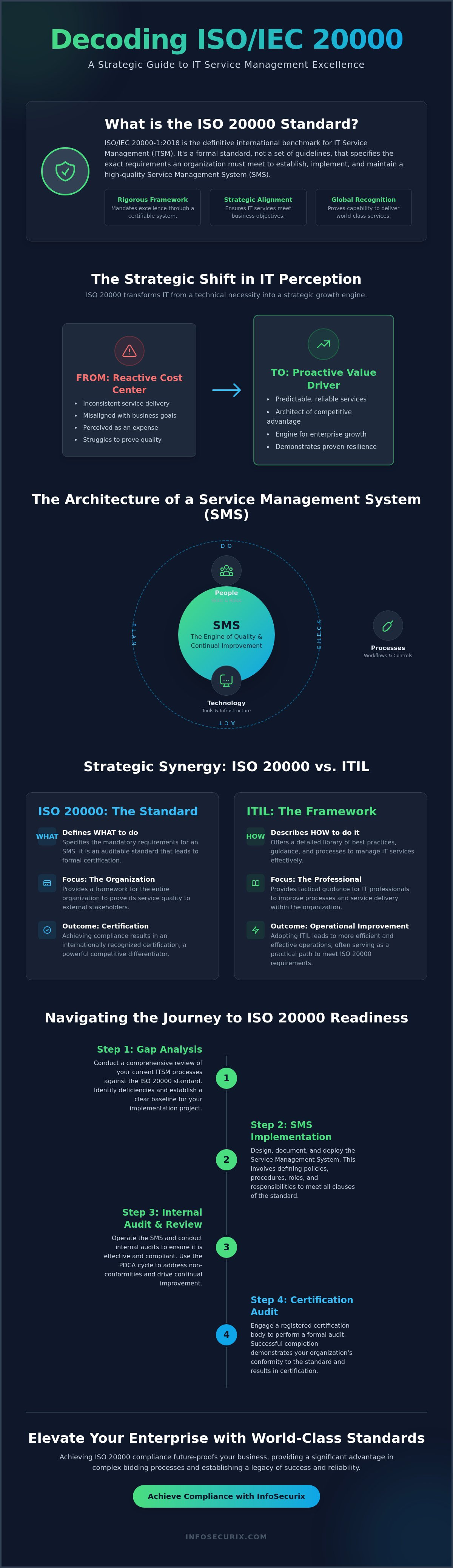
ISO/IEC 20000-1:2018 stands as the definitive international benchmark for IT Service Management (ITSM). For leaders seeking to understand what is iso 20000 standard, it’s best described as a rigorous framework that mandates excellence through a formal Service Management System (SMS). This standard doesn’t merely suggest best practices; it specifies the exact requirements an organization must meet to establish, implement, and maintain an effective service environment. By adhering to these criteria, an enterprise ensures its IT services are meticulously aligned with both business objectives and international expectations. This alignment transforms technical processes into a strategic engine that powers organizational growth.
Achieving this certification serves as a powerful professional validation: it demonstrates a proven capability to deliver high-quality managed services that remain resilient under pressure. It shifts the perception of IT from a reactive support function to a proactive, strategic partner. This transition is vital for modern enterprises where downtime or service inconsistency can lead to significant financial and reputational loss. The standard provides the steady hand needed to navigate these complexities with absolute confidence and precision.
A Brief History of the Standard
The standard’s journey began with the British Standard BS 15000, which was originally developed to address a growing global demand for IT consistency. As technological complexity increased, the framework evolved into the international ISO/IEC 20000 series. Significant revisions occurred in 2011 and 2018 to reflect the rise of cloud-based infrastructure and agile methodologies. As of 2026, the 2018 version (ISO 20000-1:2018) remains the active, auditable standard for organizations worldwide. These updates ensure the standard stays relevant in an era of rapid digital transformation, providing a stable foundation even as the underlying technology shifts.
The Scope of ISO 20000
The versatility of the standard is one of its greatest strengths. It’s equally applicable to internal IT departments supporting a single corporation and external Managed Service Providers (MSPs) serving a diverse client base. When stakeholders ask what is iso 20000 standard during a procurement process, they’re looking for assurance that your processes focus on the entire service lifecycle: this includes planning, design, transition, and delivery. Whether a business is a small boutique firm or a global enterprise, the standard provides a scalable roadmap for operational maturity. It ensures that every service, regardless of its technical complexity, is managed with precision. This comprehensive scope means that no aspect of service delivery is left to chance, creating a culture of reliability that permeates the entire organization.
The Architecture of a Service Management System (SMS)
At the heart of a truly mature IT organization lies the Service Management System (SMS). This isn’t just a collection of technical manuals; it’s a sophisticated architecture that harmonizes people, processes, and technology into a single, cohesive unit. When evaluating what is iso 20000 standard, one must view the SMS as the central engine of quality. It provides the essential structure to ensure every service delivered is predictable, reliable, and secure. This system is the cornerstone of the international standard for IT service management, serving as a protective force that enables a client’s long-term success.
The standard utilizes the Plan-Do-Check-Act (PDCA) cycle to foster a culture of perpetual refinement. This methodical approach ensures service delivery never stagnates. It evolves alongside the enterprise. By embedding risk-based thinking and resource management into the daily workflow, leadership moves from reactive troubleshooting to steering strategic growth. Understanding what is iso 20000 standard in this context means recognizing it as a commitment to executive leadership and long-term operational resilience. Documentation plays a critical role here; it acts as the bedrock of knowledge retention. This ensures that operational continuity remains intact even during significant personnel transitions, preserving the organization’s intellectual capital.
Service Planning and Design
Excellence begins long before a service goes live. It starts with establishing crystal-clear requirements based on the nuanced needs of your stakeholders. Designing with scalability and security as foundational elements prevents the technical debt that often plagues rapid growth. For those seeking a deeper clause-by-clause analysis, our guide on ISO 20000 requirements offers a strategic reference for aligning your design phase with the standard’s rigorous expectations. This phase ensures that every new service is bespoke to the business’s unique trajectory.
Service Transition and Delivery
Moving a service from the design board to the production environment is a critical phase where many organizations stumble. The SMS mandates a robust transition process to manage new or changed services without disrupting existing business operations. This involves implementing measurable Service Level Agreements (SLAs) that define exactly what success looks like for both the provider and the end-user. By focusing on capacity, availability, and information security across the entire portfolio, you create a protective force for your business. These metrics aren’t just technical benchmarks; they are indicators of enterprise health. If you’re ready to move beyond theory, beginning an ISO 20000 Implementation can help solidify these architectural foundations within your own infrastructure, ensuring your services are always performance-optimized.
Strategic Synergy: Distinguishing ISO 20000 from the ITIL Framework
Understanding the distinction between frameworks and standards is vital for any organization aiming for operational maturity. While many professionals are familiar with the Information Technology Infrastructure Library (ITIL), there is often a lack of clarity regarding how it interacts with formal certification. When leadership asks what is iso 20000 standard, they’re often seeking a way to formalize the best practices they’ve already begun to adopt through ITIL. The relationship is symbiotic: ITIL provides the “how-to” guidance for service management, while ISO 20000 establishes the “must-have” requirements that ensure those processes are effective and auditable.
Integrating both creates a sophisticated environment of structured best practices and verified compliance. ISO 20000 serves as a formal, rigorous audit of the processes often built using ITIL methodologies. It moves beyond the theoretical and into the realm of measurable, high-level performance. This international standard for IT service management (ITSM) acts as a protective force for your enterprise, ensuring that your service delivery isn’t just based on good intentions, but on a foundation of absolute precision and reliability. By aligning these two powerhouses, an organization can transform its technical output into a strategic engine for growth.
Certification vs. Best Practice
The primary difference lies in the nature of the recognition. Organizations cannot be “ITIL Certified,” as ITIL is a framework designed for individual practitioner certifications and internal process design. In contrast, ISO 20000 is an organization-level certification that is verified by external, third-party auditors. It’s a statement of corporate excellence rather than individual skill. ISO 20000 serves as the objective proof of ITIL implementation success. This distinction is crucial for stakeholders who require independent verification of your service quality before entering into high-stakes partnerships.
Complementary Implementation
Successful enterprises use ITIL to build the maturity levels required to pass an ISO 20000 audit. This approach bridges the gap between theoretical excellence and documented compliance. Leveraging both frameworks is becoming a standard requirement to satisfy complex vendor procurement requirements in 2026. It’s no longer enough to claim you follow best practices; you must prove it through a meticulous, auditable system. By using ITIL as the roadmap and ISO 20000 as the destination, you future-proof your business through a bespoke approach to service management that remains unfazed by increasing market complexity. This dual strategy ensures your organization remains a seasoned veteran in a rapidly shifting digital landscape.
Elevating Enterprise Value through Standardized Service Delivery
Standardizing service delivery is more than a technical exercise; it’s a fundamental shift in how an organization communicates value. When businesses ask what is iso 20000 standard, they’re often looking for a way to dissolve the operational silos that hinder cross-departmental collaboration. By implementing a unified framework, communication flows more naturally between IT teams and the broader business units they support. This alignment ensures that every technical decision supports a specific corporate goal, transforming the IT department from a distant service provider into an integrated, strategic partner. It creates a seamless narrative of achievement where technical output and business growth are perfectly synchronized.
This transformation provides a significant competitive advantage in both public and private sector bidding. In a market where trust is the primary currency, ISO 20000 certification serves as a badge of reliability. It tells potential clients that your service delivery is governed by rigorous, international benchmarks: a clear indicator of operational maturity. Enhanced service reliability directly correlates to higher customer satisfaction and retention. When clients perceive that their service provider is unfazed by complexity, their confidence in the partnership deepens. This reliability is not accidental; it is the result of a systematic approach to excellence that prioritizes the client’s long-term success over short-term technical fixes.
Operational Efficiency and Cost Reduction
Operational maturity is frequently measured by the absence of redundant efforts. Streamlining service management allows organizations to eliminate overlapping processes that drain financial resources and human capital. By moving toward proactive management, the frequency and impact of IT incidents are drastically reduced, preventing the costly downtime that often plagues unstandardized environments. Data-driven capacity planning ensures that resource allocation is optimized for actual service needs rather than guesswork. This methodical approach protects the bottom line while ensuring the service portfolio remains performance-optimized, allowing for a leaner and more agile enterprise.
Building Enterprise Trust and Resilience
Building trust requires demonstrating to stakeholders that IT is a controlled, professional, and reliable asset. When you define what is iso 20000 standard for your executive board, you’re describing a framework that aligns technical operations with corporate governance and risk management strategies. It provides a meticulous structure for managing third-party suppliers, ensuring that supply chain risks are identified and mitigated before they impact delivery. This level of oversight is essential for future-proofing the organization against rapid technological shifts and market volatility. It positions your organization as a steady veteran that remains calm under pressure. If you’re looking to identify hidden vulnerabilities in your current strategy, performing a comprehensive Risk Assessment is a vital step toward establishing this long-term resilience.
Navigating the Journey Toward ISO 20000 Certification Readiness
Achieving a state of certification readiness requires a methodical transition from tactical IT management to a culture of audited excellence. The journey begins with a comprehensive gap analysis: a rigorous assessment of your current ITSM maturity against the standard’s requirements. This process often involves a nuanced alignment of existing ITIL processes with the specific mandates of the Service Management System (SMS). Understanding what is iso 20000 standard in a practical sense means recognizing that every process must be documented, repeatable, and performance-optimized. Engaging with a specialized information security consulting firm can significantly accelerate this timeline. Expert guides help you navigate the complexities of documentation while ensuring your technical staff remains focused on core operations.
Success in this endeavor isn’t just about passing an audit; it’s about establishing a steady, reliable foundation for your organization’s future. When you define what is iso 20000 standard for your stakeholders, you’re describing a commitment to international best practices that remain resilient under pressure. This roadmap ensures that your IT services are not just functional but are strategically designed to enable growth. By following a structured path to readiness, you minimize the risk of operational disruption and maximize the return on your investment in quality.
The Role of Internal Audits
Internal audits represent the final line of defense before the formal external assessment. These sessions verify process adherence and ensure documentation accuracy across every department. By utilizing our framework for mastering information security internal audits, organizations can identify vulnerabilities with precision. Identifying non-conformities early is essential to prevent audit failure. It also avoids the significant remediation costs associated with post-audit corrections. This proactive stance ensures that when the external auditor arrives, your team remains calm and confident, projecting the image of a seasoned veteran who is fully prepared for scrutiny.
Achieving Long-Term Excellence
It’s vital to remember that certification is a milestone: it is not the final destination. Maintaining the standard requires an ongoing commitment to the PDCA cycle discussed earlier. Systematic success is best achieved by utilizing a comprehensive ISO 20000 audit preparation checklist to ensure no detail is overlooked. This methodical approach transforms rigorous requirements into a permanent engine for organizational growth. InfoSecurix provides the seasoned expertise and collaborative partnership necessary to navigate this complex landscape with absolute confidence. We remain invested in your long-term success, helping you future-proof your business through meticulous, current-day standards.
Securing Your Strategic Future through Service Excellence
Transforming your IT infrastructure into a strategic engine for growth requires more than just technical proficiency; it demands a commitment to international benchmarks. Fully grasping what is iso 20000 standard allows your organization to move beyond simple technical support and into the realm of enterprise-level resilience. By harmonizing the architecture of a Service Management System with the best practices of ITIL, you create a culture of reliability that stakeholders and clients can trust implicitly. This isn’t just a badge of compliance. It’s a fundamental shift toward operational maturity and long-term security.
Navigating this complex landscape is far simpler with a seasoned guide at your side. InfoSecurix brings over 25 years of specialized compliance expertise to every partnership. Our proven methodology for ISO 20000, ISO 27001, and SOC2 readiness ensures that your journey is methodical and performance-optimized. We provide customized strategic roadmaps designed to future-proof your business through meticulous standards. Partner with InfoSecurix for Expert ISO 20000 Implementation and take the first step toward a more resilient, value-driven future. Your path to excellence is ready to begin.
Frequently Asked Questions
Is ISO 20000 mandatory for IT service providers in 2026?
ISO 20000 isn’t a legal requirement for IT service providers in 2026, though it’s increasingly becoming a prerequisite for high-value contracts. Many public and private sector organizations mandate this standard during the procurement phase to ensure their partners maintain rigorous, auditable service levels. Implementing the framework remains a strategic choice for those seeking to demonstrate absolute operational maturity and secure a competitive advantage in a crowded market.
How long does it typically take to achieve ISO 20000 certification?
The journey toward certification typically spans six to twelve months, depending on the organization’s current maturity level. Those who utilize structured approaches and dedicated budgeting often achieve certification 40% faster than those who don’t. This timeline allows for a thorough gap analysis, the steady implementation of the Service Management System, and the collection of necessary evidence for the final audit.
Can a small business implement ISO 20000 without a large IT team?
Yes, small businesses can effectively implement the standard by focusing on their specific service scope. The framework is designed to be scalable, allowing leaner teams to define what is iso 20000 standard within their unique operational context. Success for smaller firms often comes from a bespoke approach that prioritizes high-impact processes, ensuring that the burden of documentation doesn’t outweigh the benefits of standardized delivery.
What is the difference between ISO 20000-1 and ISO 20000-2?
ISO/IEC 20000-1:2018 specifies the mandatory requirements that an organization must meet to achieve certification. In contrast, ISO/IEC 20000-2:2019 provides guidance on the application of service management systems, offering practical advice on how to fulfill those requirements. Part 1 is the auditable standard that defines the “must-have” elements, while Part 2 serves as a seasoned guide for the implementation process.
How often does an organization need to be re-certified for ISO 20000?
Certification follows a three-year cycle that requires a full recertification audit at the end of the term. To maintain the certificate, organizations must undergo annual surveillance audits to verify continued adherence to the standard and the efficacy of their internal improvements. This methodical cycle ensures that your Service Management System remains performance-optimized and aligned with evolving business goals.
Does ISO 20000 help with compliance for other standards like ISO 27001?
Yes, ISO 20000 is built on the High-Level Structure (HLS), which makes it highly compatible with other management standards like ISO 27001. This shared architecture allows for a seamless integration of service management and information security controls. Organizations often find that establishing a robust Service Management System provides a protective force that simplifies the path to broader corporate governance and risk management compliance.
What are the most common reasons organizations fail an ISO 20000 audit?
Organizations often encounter difficulties due to a lack of documented evidence or inconsistent process adherence across different departments. Failing to demonstrate a commitment to the Plan-Do-Check-Act cycle is another frequent cause of non-conformities during an audit. Meticulous preparation, including regular internal audits, is essential to identify vulnerabilities early and navigate the external assessment with absolute confidence.
How much does ISO 20000 implementation typically cost?
Understanding what is iso 20000 standard implementation cost requires evaluating the specific scope of services, the current maturity of your processes, and the size of your organization. The total investment includes expenses for gap analysis, process documentation, staff training, and the final certification audit. While costs vary by scope, organizations that follow a structured roadmap typically find the long-term gains in operational efficiency and market trust far outweigh the initial investment.