

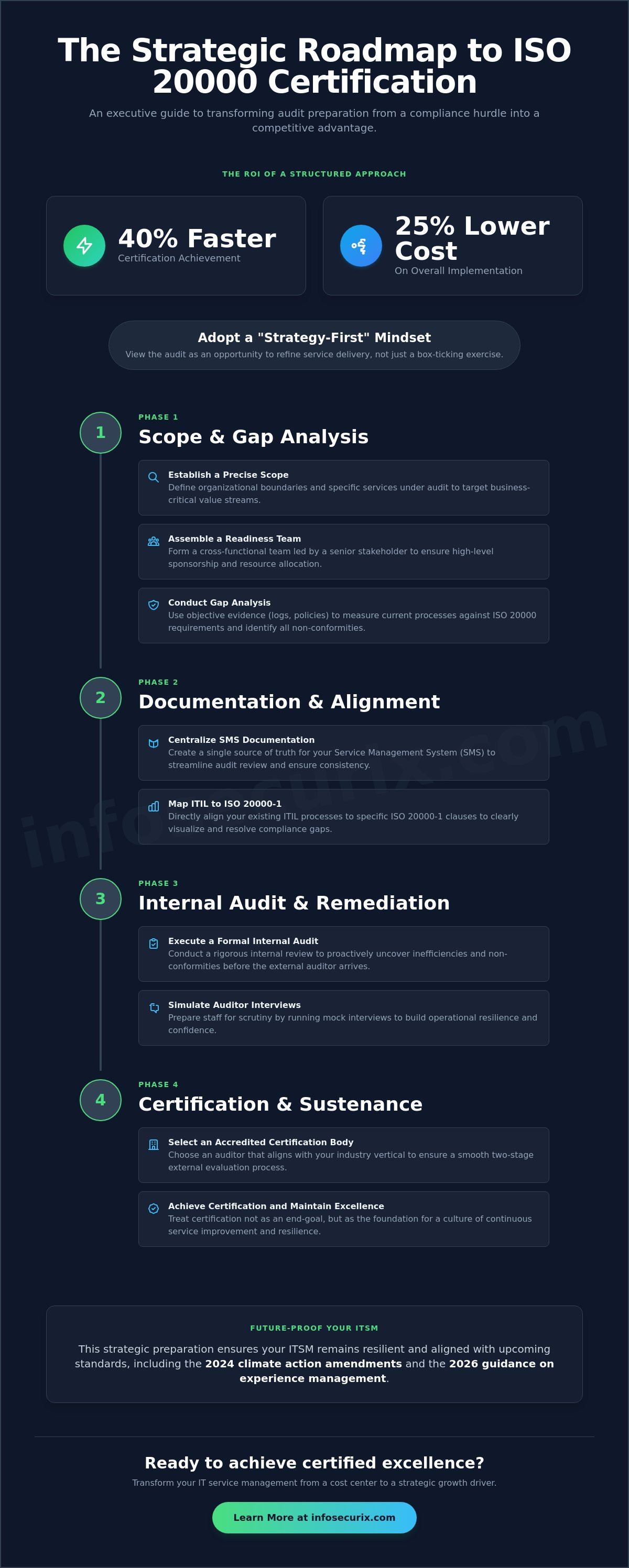
Organizations that adopt a structured approach to certification are certified 40% faster and at a 25% lower cost; a statistic that underscores the value of strategic foresight. Aligning complex ITIL processes with ISO standards often introduces significant resource strain, particularly during the documentation phase of iso 20000 audit preparation. It’s a delicate balance where the fear of audit failure can overshadow the pursuit of service excellence. We recognize that your goal isn’t just to pass an inspection: it’s to demonstrate a definitive commitment to quality that resonates with your stakeholders.
This article provides a comprehensive, executive-level roadmap designed to instill absolute confidence in your leadership team. Utilizing a clear, actionable checklist allows you to bridge the gap between technical mechanics and strategic impact. We’ll examine the essential steps for navigating the 2024 climate action amendments and the upcoming 2026 guidance on experience management, ensuring your IT service management remains a resilient, future-proof pillar of your organization’s growth.
Key Takeaways
- Establish a precise organizational scope to ensure your audit targets the specific services that drive business value.
- Centralize your Service Management System documentation to create a single source of truth; it’s a critical step that streamlines your iso 20000 audit preparation.
- Map your existing ITIL processes directly to ISO 20000-1 clauses to identify and resolve any underlying compliance gaps.
- Execute a formal internal audit and simulate auditor interviews to build operational resilience and ensure your staff is ready for scrutiny.
- Select an accredited Certification Body that aligns with your industry vertical to facilitate a smooth, two-stage external evaluation process.
The Strategic Importance of ISO 20000 Audit Preparation
ISO/IEC 20000-1:2018 remains the definitive benchmark for modern IT Service Management (ITSM). In 2026, digital transformation has rendered service reliability a non-negotiable requirement for enterprise survival; achieving this certification is no longer a luxury. It’s a clear signal to the market that your service delivery is governed by world-class standards. Effective iso 20000 audit preparation acts as the essential bridge between operational chaos and certified excellence. It transforms a reactive IT department into a proactive, strategic partner capable of sustaining growth in a volatile market.
Adopting a “strategy-first” mindset yields far greater dividends than a simple “compliance-first” box-ticking exercise. While a compliance-first approach focuses on surviving the auditor’s visit, a strategic approach views the audit as an opportunity to refine the very engine of service delivery. It’s about building a system that doesn’t just pass an inspection but thrives long after the auditor has departed. This forward-thinking preparation ensures that your processes are robust enough to withstand the scrutiny of modern digital supply chain requirements.
Defining the Service Management System (SMS)
The audit doesn’t merely scrutinize individual IT processes. It evaluates the entire Service Management System (SMS). This distinction is vital for long-term success. A mature SMS represents the intricate interconnectedness of people, processes, and technology. For a detailed look at the standard’s components, you can consult this ISO/IEC 20000 Overview. Focusing on the system as a whole ensures that service delivery is both scalable and resilient. A well-constructed SMS provides the structural integrity needed to support enterprise-level expansion, ensuring that quality remains consistent as demand increases.
The ROI of Meticulous Preparation
Meticulous preparation uncovers hidden operational inefficiencies long before an external auditor identifies them. This proactive discovery allows for internal remediation on your own terms. It avoids the high costs and reputational risks associated with audit non-conformities. Investing in iso 20000 audit preparation is significantly more cost-effective than the frantic, expensive remediation required after a failed Stage 1 review. Beyond the financial metrics, the preparation process serves as a powerful catalyst for cultural change. Aligning the entire IT organization under a unified vision of quality fosters a sense of ownership and professional pride that persists throughout the certification cycle.
Phase 1: Establishing the Scope and Conducting Gap Analysis
Success in iso 20000 audit preparation begins with a clear definition of what you intend to certify. It’s impossible to secure every service at once. You must define the organizational boundaries and specific service inclusions that will fall under the auditor’s lens. This isn’t just a technical task; it requires assembling a cross-functional readiness team. This team should be led by a senior stakeholder who can command resources and ensure that the project remains a priority. Without high-level sponsorship, the documentation and process changes required will likely face internal resistance.
Strategic Scoping for Enterprise Resilience
Defining the “Context of the Organization” is a fundamental requirement of the Official ISO 20000-1 Standard. It involves analyzing the external and internal influences that impact your service delivery. Leaders play a critical role here by validating the scope to ensure it aligns perfectly with broader business objectives. For complex, multi-national organizations, it’s often wise to exclude non-essential services in the initial phase. You might choose to certify your core cloud infrastructure while leaving legacy on-premise systems for a later surveillance audit. This strategic exclusion streamlines the initial certification process and allows your team to focus on the services that drive the most value for your clients.
The Gap Analysis: Your Preparation North Star
Think of the gap analysis as a high-precision diagnostic tool. It measures your current operational state against the rigorous ISO 20000 requirements. During this phase, you must be honest about your findings. Relying on objective evidence, such as logs, policy documents, and incident records, is essential. You can’t fix what you haven’t accurately identified. The findings from this analysis don’t just point out flaws; they build a realistic remediation roadmap. It’s about understanding exactly where your ITIL-based processes fall short of the standard’s specific clauses. If you find the complexity of this initial phase daunting, seeking professional guidance for ISO 20000 Implementation can provide the clarity needed to move forward with certainty.
Once the gaps are visible, you must prioritize ‘High-Risk’ non-conformities. These are the issues that could trigger an immediate audit failure, such as missing risk assessments or incomplete service level agreements. Focusing your energy here ensures the most significant risks are mitigated first. This methodical approach transforms a daunting task into a series of manageable, strategic steps. It ensures that when the auditor arrives, you aren’t just hoping for success; you’re demonstrating it through meticulous preparation and factual evidence.
Phase 2: Documentation and Process Alignment
Centralizing the Service Management System (SMS) documentation serves a dual purpose: it simplifies auditor access while reinforcing internal governance. During iso 20000 audit preparation, the sheer volume of records can become overwhelming if not managed through a structured hierarchy. Auditors don’t just look for the existence of documents; they evaluate the maturity of the approval workflows and version control mechanisms that keep them current. For those seeking a practitioner’s view on these evaluations, this ITSM Auditing Guide provides invaluable perspective on how assurance professionals approach the SMS.
Aligning ITIL-based processes such as Incident, Change, and Problem management with specific ISO 20000-1 clauses requires a shift from operational habit to documented evidence. It’s not enough to resolve a ticket; the system must prove that the resolution followed a controlled, repeatable path. Service Level Management must move beyond aspirational targets to documented, measurable, and realistic SLAs that reflect actual business requirements. Furthermore, Service Reporting must transition from simple uptime stats to data-driven insights that demonstrate the health and continuous improvement of the service ecosystem.
The Documentation Hierarchy
Creating the Service Management Plan is the foundational step in establishing your SMS. This document acts as the master blueprint, detailing how the standard’s requirements are met within your specific context. Auditors look for a clear distinction between ‘Policy’ and ‘Procedure.’ The policy defines the organization’s intent and commitment, while the procedure outlines the specific steps taken to achieve it. Effective iso 20000 audit preparation ensures these layers are interconnected and reflect the actual day-to-day operations of the IT team, demonstrating a culture of disciplined governance.
Process Integration: Moving Beyond ITIL
Modern audits in 2026 place a heavy emphasis on ‘Relationship Management.’ You must document your interactions with both customers and suppliers to prove that service quality remains consistent across the entire value chain. Supply Chain Governance is particularly critical; it ensures that third-party providers are held to the same rigorous standards as your internal teams. Additionally, Capacity and Availability Management must demonstrate foresight. Auditors expect to see documented evidence that your organization is planning for the increased service demands of 2026, ensuring that resources are optimized and resilient before performance issues arise. A comprehensive iso 20000 implementation strategy can provide the structured methodology needed to navigate these complex documentation and process alignment requirements with confidence. Partnering with a qualified information security consulting firm can provide the specialized expertise needed to navigate these complex documentation and process alignment requirements with confidence.
Phase 3: The Internal Audit and Corrective Actions
Transitioning from documentation to verification marks a decisive shift in your iso 20000 audit preparation strategy. It’s the phase where theoretical frameworks meet operational reality. Initiating a formal information security internal audit allows you to evaluate your Service Management System through the eyes of an impartial assessor. This internal review must be uncompromising; it should focus specifically on ISO 20000 criteria to ensure every process is scrutinized. Simulating auditor interviews with process owners is equally vital: it builds the necessary confidence and ensures consistency in how your team articulates their daily responsibilities under pressure.
The Internal Audit as a ‘Dress Rehearsal’
An effective internal audit functions as a high-stakes dress rehearsal for the official event. To maintain the necessary objectivity, the internal auditor must remain independent of the processes they are reviewing. Their primary objective is to uncover ‘Evidence of Operation.’ It isn’t enough to present a polished policy document. Your team must prove that these processes are actively followed in day-to-day scenarios through logs, meeting minutes, and system records. Identifying ‘Minor Non-Conformities’ at this stage is a significant win. It provides the opportunity to address gaps before they escalate into ‘Major Non-Conformities’ that could trigger an immediate audit failure.
Executing the Corrective Action Plan
Every finding from your internal review must be meticulously documented in a ‘Corrective Action Plan.’ Each entry requires a clearly assigned owner and a firm deadline for resolution. We advocate for a rigorous root cause analysis to ensure remediations address the core issue rather than merely masking the symptoms. Documenting the successful closure of these gaps provides the objective evidence that external auditors look for during their formal assessment. These results also inform the Management Review meeting. This is where senior leadership reviews the audit findings and confirms that the SMS remains suitable, adequate, and effective for the organization’s long-term goals.
Reviewing the effectiveness of these remediations before the external auditor arrives on-site is the final step in your iso 20000 audit preparation. It confirms that the changes have been embedded into the organizational culture rather than being temporary fixes. If your team requires an objective, expert perspective to identify hidden risks before your official assessment, our specialists provide professional Internal Audits designed to guarantee your certification success.
Phase 4: Finalizing Certification and Sustaining Excellence
Selecting an accredited Certification Body (CB) that understands your industry vertical is the first critical step of this final phase. You should partner with an assessor who recognizes the unique nuances of your service environment rather than one who applies a generic template. This partnership ensures the audit adds genuine value to your operations. The external evaluation begins with the ‘Stage 1’ Audit: a high-level documentation review where the auditor confirms your system is ready for deeper scrutiny. This stage is the ultimate validation of your previous iso 20000 audit preparation efforts, proving that your theoretical framework is sound.
Navigating the External Audit Stages
The Stage 1 ‘Document Review’ provides a vital window into the auditor’s priorities. You should treat their feedback as a strategic gift; it allows you to refine your evidence before the final assessment. When you transition to the ‘Stage 2’ Audit, the focus shifts entirely to operational effectiveness and objective evidence. Managing the ‘Audit Room’ requires a blend of transparency and precision. You should provide concise answers and direct evidence without over-explaining. Professional conduct and a collaborative attitude often facilitate a smoother engagement, as auditors appreciate a team that is confident in its own processes.
Beyond the Certificate: The Path to Maturity
Achieving the certificate is a significant milestone, but it’s not the finish line. Establishing a ‘Continual Service Improvement’ (CSI) cycle is essential to maintain certification long-term. This cycle ensures your Service Management System remains a living, evolving entity that adapts to the shifting service demands of 2026. InfoSecurix supports the transition from being ‘audit-ready’ to achieving true operational excellence through our bespoke iso 20000 audit preparation and implementation services. We help you leverage this foundation to streamline other rigorous requirements like ISO 27001 or SOC 2. Annual surveillance audits then serve as a protective force, ensuring your SMS remains relevant and robust as your organization grows.
Achieving Long-Term Operational Resilience
Establishing a mature Service Management System represents a visionary commitment to your organization’s longevity and competitive edge. Throughout this roadmap, we’ve outlined how strategic scoping, meticulous documentation, and rigorous internal testing transform a complex requirement into a manageable, value-driven process. Successful iso 20000 audit preparation doesn’t just secure a certificate; it future-proofs your service delivery against the evolving demands of the 2026 digital landscape. It’s about shifting from reactive management to a state of disciplined, proactive excellence.
InfoSecurix offers a legacy of over 25 years of information security excellence to guide you through every milestone. Our seasoned compliance veterans provide bespoke expertise, ensuring your preparation is precise and aligned with your unique business objectives. Our milestone-based engagements focus on your specific scope to deliver absolute confidence before the external auditor arrives. Partner with InfoSecurix for a comprehensive ISO 20000 readiness assessment and secure your path to certified excellence. You have the strategy and the vision; now it’s time to lead your team toward a successful certification.
Frequently Asked Questions
How long does it typically take to prepare for an ISO 20000 audit?
Preparation typically spans six to twelve months, though this timeline varies based on your organization’s existing process maturity during iso 20000 audit preparation. A seasoned guide can help accelerate this journey by identifying shortcuts to compliance. It’s a deliberate process that requires consistent leadership support and resource allocation. Organizations that rush the documentation phase often face challenges during the final assessment, so a methodical pace is always recommended for long-term success.
What is the difference between ITIL and ISO 20000 in the context of an audit?
ITIL serves as a comprehensive library of best practices that suggest how to manage services, whereas ISO 20000-1 is a formal standard that mandates specific requirements. During an audit, you aren’t evaluated on your adherence to ITIL guidance but on your compliance with the standard’s clauses. Many successful organizations use ITIL as the foundation to build the processes that eventually satisfy the rigorous demands of the certification body.
Can a small IT department realistically achieve ISO 20000 certification?
Small IT departments can realistically achieve certification by focusing on a tightly defined scope. It’s about quality over quantity; certifying your most critical services first allows for a more manageable implementation. This approach ensures that your limited resources are applied where they generate the most strategic value. Meticulous planning and a bespoke implementation strategy allow smaller teams to demonstrate the same level of service excellence as global enterprises.
What are the most common reasons organizations fail their ISO 20000 audit?
Organizations often fail because they lack objective evidence of their processes in action. It’s a common pitfall to have polished policies that aren’t reflected in daily operations. Auditors frequently identify “broken links” between incident, problem, and change management workflows. Without a cohesive narrative that shows how these processes interact, the Service Management System appears fragmented, leading to major non-conformities that stall the certification process during the final assessment.
Is an internal audit mandatory before the certification body arrives?
An internal audit isn’t just a recommendation; it’s a mandatory requirement under Clause 9.2 of the standard. This step acts as a critical quality gate that identifies gaps before the external certification body arrives. It provides an opportunity for your team to practice their responses and refine their evidence in a controlled environment. Skipping this rigorous “dress rehearsal” significantly increases the risk of unexpected findings during the formal Stage 2 assessment.
How much does ISO 20000 audit preparation typically cost for a mid-sized firm?
Budgeting for iso 20000 audit preparation involves several variables, including the complexity of your service catalog and the current state of your documentation. Rather than focusing on a single figure, mid-sized firms should evaluate the cost of implementation, staff training, and the ongoing surveillance required to maintain the standard. Viewing these expenses as a proactive investment in service quality helps justify the resources needed to achieve a resilient, future-proof IT organization.
What happens if the auditor identifies a major non-conformity during the Stage 2 audit?
If a major non-conformity is identified, the auditor cannot recommend your organization for certification until the issue is resolved. You’ll need to perform a thorough root cause analysis and implement corrective actions within a specific timeframe. A follow-up visit or a review of evidence is typically required to verify that the gap is closed. While this can feel like a setback, it’s an essential part of ensuring your system is truly robust and effective.
How often must an organization undergo a re-certification audit for ISO 20000?
ISO 20000 certification follows a three-year cycle. After the initial certification, your organization must undergo annual surveillance audits to ensure continued compliance and improvement. At the end of the third year, a more comprehensive re-certification audit is performed to renew the certificate for another cycle. This steady rhythm ensures that your Service Management System remains relevant and adapts to the changing technological landscape and business requirements of your industry.